Validation Is an Emotional Game. Period.And If You’re a Founder in Validation, This Is the Only Lens That Keeps You Sane.
If you are a founder validating a new idea right now — whether in AI, deeptech, biotech, hardware, retail, marketplaces, B2C, B2B, or B2G — this essay is designed for you and you alone. Not for investors. This is a field guide for the ones in the fog — building something that might exist, sensing markets that might care, and wrestling with a million unknowns every single week. Let’s strip it down to the truth most founders intellectually understand but emotionally resist:
And because of that, validation is an emotional game — not a systems game, not an operational play, not a strategic scaling exercise. Here’s the part no one tells you:
Let’s walk through this with the clarity you deserve. Validation Is Not Company-Building.It’s Conviction-Building.** When you’re validating, you’re not on a quest to build a polished structure. Everything else is secondary. I don’t care if you’re sequencing RNA for a synthetic biology application, designing a new AI agent framework, building a hardware sensor for municipal wastewater detection, creating a D2C wellness product, or launching a local services marketplace. The same reality applies: Until you know the truth about the customer, the pain, the urgency, and the willingness to pay… Not your logo. Founders in validation fall into two categories: (1) Those who think they’re building a company and fail. If you’re in category 2, this article is for you. The Actual Job Description of a Validating FounderIf we remove the startup jargon, your job right now is:
You are not supposed to know what you’re doing yet. You are supposed to become aware of what’s true — and what’s false. This is the work. And emotional intelligence is not “soft stuff” here — it is the primary tool of discovery. Why Validation Feels Chaotic — And Why That’s CorrectValidation feels like:
This is not dysfunction. The chaos is not a bug — it’s the data. If you aren’t confused, you’re not exploring wide enough. In validation, “feeling lost” means you’re doing the work. Improvisation Is the Operating System of ValidationTwo major research works confirm this: 1. “Improvising Entrepreneurship” (TIM Review, 2014)The paper shows that early-stage entrepreneurs rely primarily on real-time improvisation because the unknowns are too large for structured planning. 2. “Toward a System Model of Improvisation” (2022)This study describes founders in uncertain environments as operating in “Real-Time Doing” mode — acting, reacting, adjusting in the moment. In other words:
You cannot run Six Sigma on fog. Validation demands improvisation because only improvisation can “feel around” reality fast enough. Story #1 — Airbnb: Validation Through Emotional SensitivityPeople mythologize Airbnb as a clever growth story. Brian Chesky and Joe Gebbia were:
The famous moment — when they personally took better photos of early listings — wasn’t strategy. It was emotional sensitivity:
Had they asked, “Is this scalable?” the company would’ve died. Instead, they asked, “What emotion changed when we did this?” That’s validation. Systems came years later. Validation Across All Domains:The Emotions Are the Same. The Objects Are Different.** A deeptech founder validating computational chemistry tooling faces the same emotional dynamics as a D2C skincare founder validating a serum:
A hardware founder pitching to municipalities experiences the same emotional oscillation as a marketplace founder pitching salon owners. A biotech founder talking to clinicians experiences the same uncertainty as an AI founder talking to enterprise CIOs. Why? Because the foundation of validation is human behavior — not category mechanics. The content changes. Story #2 — Superhuman: Validation Before SystemsBefore Superhuman became the “fastest email experience,” Rahul Vohra spent months inside what he calls “qualitative hell.” He did:
When they sensed repeatable desire, THEN they built the PMF Engine — a quantifiable system. This is the sequence validating founders must internalize:
Most Validating Founders Fail Because They Adopt Post-PMF Behavior Too EarlyIf you try to copy:
…while still validating your idea, you will inject complexity before clarity. Premature operationalization is the #1 silent killer of early-stage startups. Before we go deeper, here’s a simple but powerful reminder from the trenches.
This is the essence of validation: The moment you start optimizing before you understand the problem, you lock yourself into the wrong direction. Why? Because systems amplify whatever you feed them. If you feed a system:
…it doesn’t take you further. Validation is the act of preventing that tragedy. Story #3 — Ironclad: Emotional Pattern Recognition in an Industry That’s “Unemotional”Ironclad — a legal workflow automation company — sounds like a rational, enterprise SaaS story. But Jason Boehmig validated in a purely emotional way:
Lawyers. But Boehmig still found signal in micro-expressions, pauses, frustration, relief. This is the secret: The Danger Signals: When a Validating Founder Is Playing the Wrong GameIf you’re validating but you find yourself:
…you are playing the wrong game. Many founders desperately want validation to feel like growth. They want:
But if these things appear too early, it usually means something dangerous: You’re no longer discovering. Validating founders don’t need confidence. Confidence comes later — when reality replaces guesswork. What Actually Matters in Validation (The Only Four Things)Strip everything else away. 1. Know the exact customerNot a persona. 2. Know the exact painNot a problem statement. 3. Know the urgencyNot “this is interesting.” 4. Know the willingness to payNot compliments. Everything else — everything — is noise. If you don’t know these four with confidence, you are still validating, no matter how much revenue or hype you have. When to Stop Playing the Emotional Game and Start Thinking SystemicallyYou should only begin behaving like a “company” when:
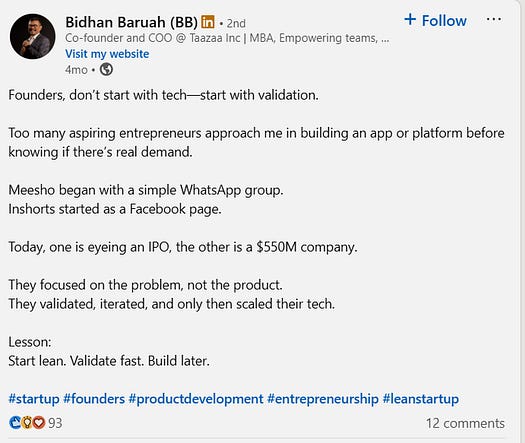
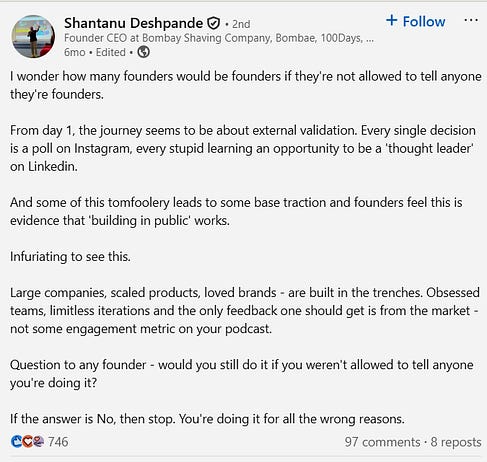
This does not mean you are ready to scale. But only after validation has done its job. You Are Not Supposed to Feel Like a CEO YetYou’re not a CEO. And to make this even sharper, here’s a post that captures a quiet truth founders rarely admit — especially during validation, when self-identity becomes tangled with external perception:
This hits hard because it’s true: When you remove the performance layer, what remains is the real job: You don’t need:
You need:
You are building a map of a territory that does not exist yet. Final Thought:Validation Is Not the Beginning of Company-Building. You are not failing. You are discovering whether this idea deserves the next decade of your life. That’s not a process. The founders who win aren’t the ones with the smartest idea or the cleanest playbook. They’re the ones who understand the game they’re in —
|
Wednesday, November 26, 2025
Validation Is an Emotional Game. Period.





Sunday, November 23, 2025
When Every Sale Feels Uphill: The Physics of Manufactured Demand
When Every Sale Feels Uphill: The Physics of Manufactured DemandHow to recognize the hidden force that keeps startups stuck—no matter how good the product is.
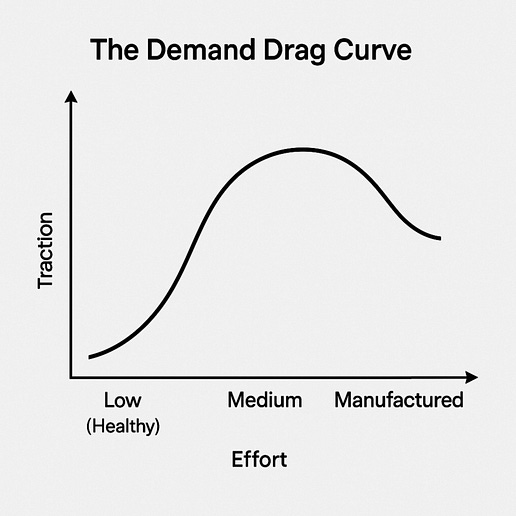
There’s a moment in every founder’s journey where the work stops feeling like progress and starts feeling like resistance. You can’t quite explain it. Nothing is “wrong,” but nothing is flowing either. You’re waking up earlier, pushing harder, refining the pitch deck, tightening your product, adjusting your ICP, rewriting messaging, and doing everything experts say founders should do. And yet every sale still feels like climbing a hill with sandbags tied to your ankles. Some conversations take heroics. And deep down, beneath the optimism and the hustle, you feel something you can’t ignore: This shouldn’t require this much force. It’s not burnout. It’s a physics problem. Because in early-stage markets, demand behaves like gravity. When the market wants what you’re building, you feel a subtle acceleration in everything: in energy, in clarity, in referrals, in conversations, in inbound momentum. Buyers lean forward. Doors open with less strain. People finish your sentences. They repeat your narrative back to you.
But when the market doesn’t want what you’re building—even if you’ve built something genuinely valuable—you feel drag. Heavy, exhausting, soul-draining drag. The dangerous part? That’s why we’re going to explore demand drag—not as five checklist items, but as a single, continuous force expressed through five distinct founder experiences. Each one corresponds to a stage in the revenue-validation ladder of Pricing Before Product (your uploaded document), but instead of writing them as steps, we’ll track them as sensations, patterns, and physics you can feel in real time. Because the market always speaks first through sentiment, not spreadsheets. The earliest drag: when enthusiasm masks the absence of energyDrag begins quietly. It’s the phase where everyone loves your idea, admires your insight, compliments your clarity… but no one commits. You’re having conversations that feel positive but don’t move. You walk out of meetings energized by interest but empty-handed on action. Everyone is cheering. This is the earliest sign of manufactured demand: You’re the one outlining the problem. And if you stop talking, the interest stops existing. False positives at this stage set the slope of the entire mountain. Drag begins as politeness. And because nothing structurally contradicts your narrative yet, you climb higher, building more, investing more, believing more. You don’t know it yet, but the hill has already formed. The drag of intent: when people want the outcome but won’t take the first stepAs you move from idea to something testable—maybe a manual service, a hand-built prototype, a concierge MVP—you start to encounter a deeper form of resistance. People love the concept. But when you ask them to try the manual version next week, suddenly:
This is the drag of intent without initiative. It’s not that people don’t care. You’re still supplying 100% of the activation energy required to start anything. If you stopped initiating trials, demos, or follow-ups for even two weeks, progress would grind to a halt. This phase is deceptive because it feels like you’re close. When the market wants something, they take initiative. The difference reveals the slope you’re on. The drag of misalignment: when the product exists but gravity doesn’tNow you have an MVP. Something that works. Something you can show. This is the stage founders dream of—the moment where “the product speaks for itself.” Except often, it doesn’t. Instead, you begin to experience friction around meaning, positioning, and interpretation. You demo the product and prospects say:
But they struggle to see where it fits into their workflow. They don’t instantly connect the dots between your product’s capabilities and their own priorities. You find yourself:
That’s misalignment drag—the drag of pulling comprehension uphill. Your product may solve a problem, but if customers don’t naturally feel the pain at the intensity you assumed, you end up pushing people toward an insight they don’t yet have. This is the moment every founder must face the brutal distinction between solving something real and solving something important. MVP drag is the drag of trying to convince the market to care. The drag of conversion: when users are active, but customers are absentUsage is one of the most dangerous early signals because it feels like momentum. People are logging in. But when you move from:
everything changes. Suddenly, they become budget-constrained, timeline-constrained, priority-constrained. Rejections shift from:
This is the drag of behavior without belief. Users are willing to exert effort, but not allocate resources. They want the benefit until it costs them something. They perceive value but not urgency. When usage doesn’t evolve into revenue, the slope sharpens. Founders rationalize it as:
But beneath these justifications is a harder truth: Conversion drag is the drag of transforming habit into necessity. The drag of momentum: when your early successes don’t replicateThis is the deepest and most disorienting drag of all. You have paying customers. Maybe a few dozen. Maybe a few hundred. Enough to believe you’re onto something. Enough to show early traction. Enough to raise money or build a team. But now comes the core test of demand pull: Does your success replicate? Do new customers convert at the same rate as early ones? If the answer is no, you have reached the stage of non-propagating demand. Your early buyers were outliers—people whose pain was unusually strong, whose motivations were unusually aligned, or whose context made them unusually willing to take a bet on something new. You mistake outliers for a market. From here, every sale becomes disproportionately heavy because every sale is a new origin story. There is no compounding. No acceleration. No shared language. No “network effect” of narrative. This is the moment where drag becomes existential. Momentum drag is the final expression of manufactured demand. Drag is not a signal of failure — it is a signal of misalignmentManufactured demand does not mean you’re wrong. Drag is not a verdict. A message that says:
The market has to participate. The presence of drag means you’re relying on effort where you need gravity. How to know when gravity existsHere’s the simplest test: If you stopped selling for 30 days, would anything—anything—still move? Would:
If nothing moves without you, you’re not feeling gravity—you’re creating it manually. But if even a few things move on their own—small pulls, subtle nudges, quiet signals—you’ve hit something real. Because demand pull doesn’t look like rocketship growth at the beginning. Pull is not loud. When the market wants something, you don’t have to keep explaining why they should. The founder’s real job: to search for gravity, not manufacture itThe mistake founders make is believing their job is to create demand. It isn’t. Your job is to find where that gravity already lives. Because when you’re in the right market, solving the right problem, with the right pain narrative, you feel the slope reverse. Your work is still hard. The physics shift. The slope changes. You move from carrying everything uphill That is the difference between manufactured demand and validated demand. And it is the single inflection point that determines whether a startup endures, or exhausts itself dragging a market that never asked to be moved.
|


Pilots Are the Atomic Unit of a Real Business
Pilots are the smallest sellable version of a startup’s core value. Discover how founders use pilots to validate ideas, find repeatability, ...
-
Crypto Breaking News posted: "Mikhail Fedorov, Ukraine's Deputy Prime Minister and the head of the country's Minist...
-
kyungho0128 posted: "China's crackdown on Bitcoin (BTC) mining due to energy consumption concerns is widely regarded as...
-
Techie.Buzz posted: " [ANN] Serverless Kubernetes Solution For Cloud-Native Apps by CTO.ai CTO.ai is a provider of deve...


