It’s common advice for early-stage founders: get more leads, widen your funnel, cold email everyone you can. But what if that’s the wrong move — or at best, a slow one? What if the real leverage is not more volume, but precision: targeting those already feeling the pain your product solves — people who are in motion — versus those you hope might be in pain someday. In this article, we’ll explore:
Then, if you want a ready-to-share, structured version, you can download the full micro eBook at the end. Why So Many Startups Fail to Find TractionLet’s begin by acknowledging a brutal truth: most startups fail. The key failure modes often relate to not having paying users, or not solving a problem people feel deeply.
These numbers reinforce a pattern: building features is not enough. You must build value-communication to people who already feel the need. If your outreach is scattershot — sending messages to leads who don’t feel urgency yet — your conversion rates will suffer, and your runway will bleed. The Psychology: Urgency, Scarcity & Decision-MakingTo target people already in motion, you need to understand the mental triggers that push someone from curiosity → action. Two of the most powerful are urgency and scarcity. The Scarcity Effect & Urgency
In short, urgency and scarcity are powerful levers — but only when used ethically and aligned with genuine pain. Overuse or false scarcity will backfire. Temporal Motivation and Action BiasBeyond scarcity, theories like Temporal Motivation Theory say that perceived value of an action is inversely proportional to delay — the longer you delay, the less likely someone will act. In startup outreach, if your messaging doesn’t accelerate the perceived benefit (and raise the perceived cost of delay), your leads will procrastinate or forget. Also, humans have a bias toward inaction when choices are ambiguous. Clear, urgent, and contextualized prompts overcome that inertia. That’s what your outreach should aim to do. The Concept of “Users in Motion”What does it mean to “be in motion”? These are people actively feeling frustration, losing something — and primed to talk to someone who understands. Key Indicators of Users in Motion
When you reach someone who is already in motion, two things happen:
Here’s one example:
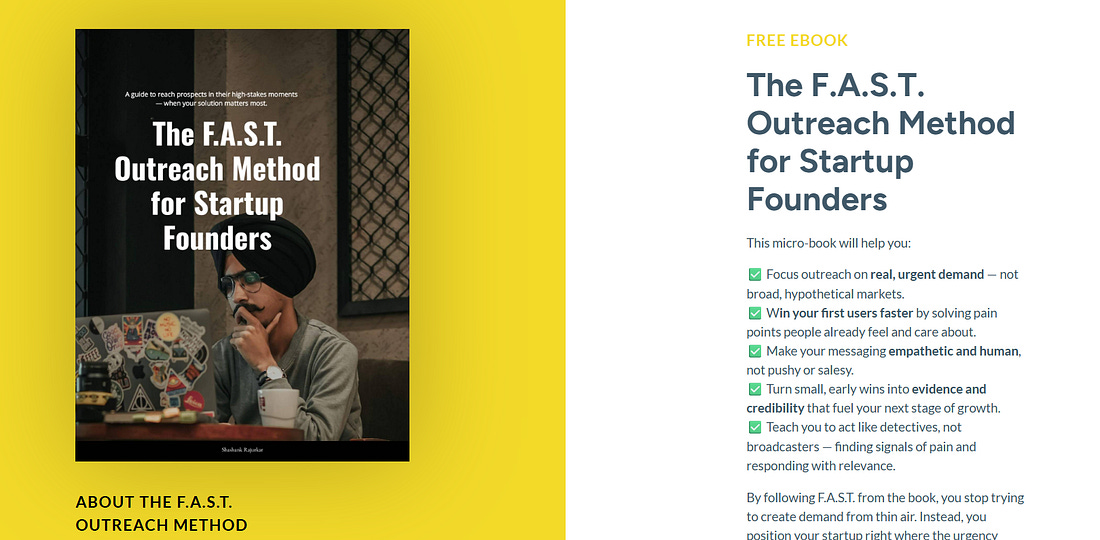
That kind of story is not anecdotal — it’s the core of influencing motion. Introducing F.A.S.T. (A Sneak Peek)I won’t reveal the full eBook here — but here’s a taste of how the framework works in context, and what you’d get if you download it.
To help you see it in action, imagine this applied: You build a micro-pilot to reduce demo follow-up delay. You find two startups publicly complaining about lost deals. You message them:
One replies. You run the pilot, show a 20% uplift, get a testimonial. Then you use that as proof to reach the next one. That’s F → A → S → T in motion — but the full version has scripts, worksheets, escalation paths, and email/DM templates. Caveats & Pitfalls
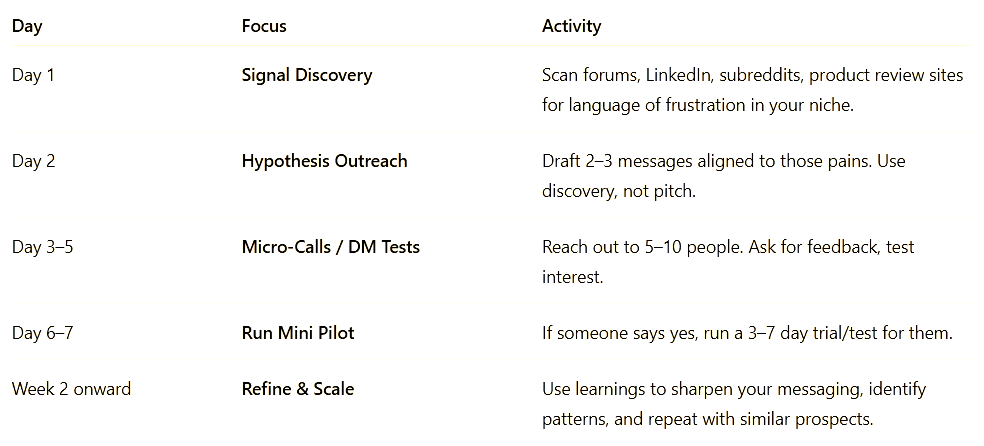
How You Can Try This This Week (Mini-Playbook)Below is a short roadmap you can apply right now — even if you don’t have paying users yet.
Download the Full F.A.S.T. eBookIf you want the full, structured version — with templates, workflows, best practices, and scaling paths — you can download the micro eBook here: 👉 [Download the F.A.S.T. Outreach Method PDF]
Use it as:
No fluff. Just actionable steps you can follow. Final ThoughtsYou don’t need traction. You need traction from the right people. Volume is meaningless if conversion is near zero. When you target those already in motion — with empathy, clarity, and proof — you turn your outreach into a scalable engine. That’s how you get from zero users → first paying users → momentum. Invite your friends and earn rewardsIf you enjoy Startup-Side , share it with your friends and earn rewards when they subscribe.
|
Sunday, October 12, 2025
When Most Founders Chase Ghosts: Why You Should Reach Users Already in Motion




Monday, July 7, 2025
Jumping the curve
Jumping the curveWhy the boldest founders don’t just ride the S-curve—they leap to the next one before everyone else sees the drop coming.
 The changes happening around would be the most challenging thing for all existing businesses. The only constant thing is “change”. The changes are all-pervasive, and no business is immune to them. In today’s fast-paced world, success often depends on how quickly your business can adapt to changing conditions. How well-versed are you, ready to pivot when the market changes?
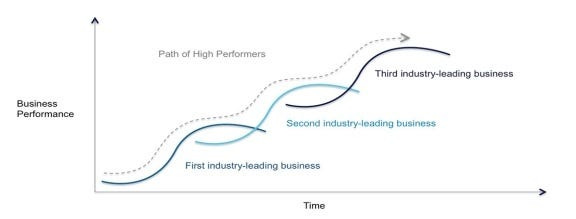
In the world of innovation, an S-curve explains the common evolution of a successful new technology or product. At first, early adopters provide the momentum behind uptake. A steep ascent follows, as the masses swiftly catch up. Finally, the curve levels off sharply, as the adoption approaches saturation. High performance is defined by companies that execute repeated climbs and jumps of the S-curve. Origins “Jumping the curve” is a saying that has been around for a few decades. It is attributed to the Irish philosopher and management futurist Charles Handy, who said that companies need to become aware of the sigmoid curve.
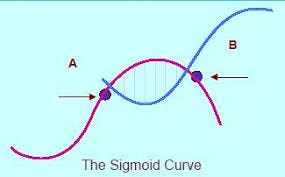
The sigmoid curve (or S Curve) is the naturally occurring sloping line that Handy used to show that “companies will come to a natural end if they don’t re-create themselves during good times What does it take to jump the curve? You jump to the next curve by breaking old patterns of thinking and behaving. If you keep doing what you have been doing, you’ll keep getting what you have been getting.” To achieve different outcomes, you need to approach things differently. Guy Kawasaki, while discussing “The Art of Innovation” at TEDxBerkeley, advises startup founders about the matter of perspective when it comes to new opportunities. He says, “The perspective is to jump curves and not to stay on the same stupid curve that you’re on while trying to do things 10% better.” A classic example he elaborates on is that of the ice business. In this example, he points out how the ice-making business transformed over the past century from being ice harvesters to ice factories and then to refrigerators. The very interesting story about all of these curves is that none of the organizations that were ice harvesters became ice factories, and ice factories did not become refrigerator companies, because most companies define themselves in terms of what they do, not the benefits they provide. If you define yourself as we cut blocks of ice out of lakes, you remain an ice harvester. If you define yourself as freezing water centrally, you remain an ice factory. If you define yourself as making a mechanical gadget called a refrigerator, then you stay on the refrigerator curve. The way to jump the curve is to define yourself from the point of view of the benefits that your users get, as opposed to what you currently do. No one can predict the future, but Jack Uldrich can help you prepare for it. Jack Uldrich is a futurist who helps organizations gain the critical foresight they need to create a successful future. His work is based on the transformation principles of unlearning — or freeing yourself from obsolete knowledge and assumptions — as a strategy to survive and thrive in an era of unparalleled change.  In this video, he talks about the importance for entrepreneurs to understand the concept of Jumping the Curve. He says, if anything is growing exponentially, and if nine technologies are growing exponentially, you can’t just go by the early trends, you have to follow it up with conclusions. The future does not increase linearly, but it grows exponentially.
Jumping the curve is inevitable Every business eventually faces the moment when growth plateaus and the old playbook stops working. This is the heart of the “S-curve” model: initial slow progress, a burst of rapid growth, and then a flattening as mastery—and market saturation—set in. As Whitney Johnson, cofounder of the Disruptive Innovation Fund, puts it in the Author Talks with Whitney Johnson: “Every time you start something new, you are at the base of the S-curve. Then you hit mastery... but because you’re no longer enjoying the feel-good effects of learning, you can get bored. This is the place where growth is actually slow.” The real challenge is recognizing when it’s time to leap—when to “jump the curve” and start climbing a new S-curve before stagnation sets in. This dilemma is at the core of Clayton Christensen’s classic, The Innovator’s Dilemma (Wikipedia, Book PDF). Christensen warns, “Good management principles... were precisely the reason large firms lost to up-and-coming businesses with disruptive technologies.” Incumbents, focused on perfecting what already works, often miss the moment to jump to new curves, leaving the door open for bold newcomers to redefine the game. As Paul Nunes explains in Jumping the S-Curve, “What matters is not just climbing your current S-curve... but making the moves you must make on the way to your next business—that is, making the jump to your future S-curve.” When do you jump the curve? If we view the first curve as a technology beginning to die out, and the second curve as a newer and more promising alternative, their first point of intersection shows continued improvements to the old system alongside the short-term upstart costs of investing in new methodologies.
The best time to change is therefore when there is no immediate benefit to doing so, whereas sticking with successful practices eventually ensures their failure. Lessons for startups In today’s environment, there are rapid changes happening everywhere — markets, and technologies, and that continues to build a big challenge for a startup founder. As a founder, the most critical skill that you probably need today, irrespective of the startup stage, is to be able to jump your curve, generate a huge number of ideas, run efficient experiments to test assumptions underlying those ideas and launch new businesses as quickly as possible. This can happen by seeing and pursuing the “big enough” market insights that can take a startup business to the top of an industry and by creating a strategy “from the edge” to find and capture the next winning business idea.
Jumping the curve is not just relevant for the startups already in business, but also for wannabe founders who are looking for the next business idea! This skill is one of the core skills of entrepreneurship today. Invite your friends and earn rewardsIf you enjoy Startup-Side , share it with your friends and earn rewards when they subscribe.
|

Why Features Stop Selling for hardware startups as Deal Size Grows
Learn why hardware startups must evolve from feature-led selling to enterprise trust and how buying decisions change as deal size and cus...

-
Techie.Buzz posted: " [ANN] Serverless Kubernetes Solution For Cloud-Native Apps by CTO.ai CTO.ai is a provider of deve...
-
Crypto Breaking News posted: "Mikhail Fedorov, Ukraine's Deputy Prime Minister and the head of the country's Minist...
-
Crypto Breaking News posted: "Circle's merger with Concord Acquisition Corp, a special purpose acquisition company, or ...


