Everyone remembers Steve Jobs as a master of persuasion. In hundreds of early-stage conversations, one pattern never changes: founders mistake curiosity for intent. Users nod, smile, even ask for a demo — then vanish. Behavioral science has a name for this: action bias. People act not when they understand, but when inaction becomes unbearable. That’s why urgency, not persuasion, determines traction. It’s the hidden force behind whether your outreach lands, your pitch converts, or your product gets used twice. Why Persuasion Often FailsMost outreach frameworks assume people decide rationally. But founders quickly learn that logic rarely moves people — pain does. Psychologists Daniel Kahneman and Amos Tversky showed decades ago that humans fear losses roughly twice as much as they value equivalent gains. That insight — known as loss aversion — is why your prospect might admire your product yet still delay the decision. We move only when doing nothing feels riskier than doing something. In a startup context, that means your job isn’t to make users want your product. It’s to noticing when they already can’t afford to wait. That’s what the F.A.S.T. Outreach Method is built on: F — Find the Flooded Basement Moment A — Align with Urgency S — Specify the Solution Outcome T — Turn Proof into Trust
Each step is rooted in behavioral psychology — and together, they turn outreach from noise into timing. F — Find the Flooded Basement MomentEvery product solves something, but not everything it solves hurts right now. The flooded basement is that exact moment when pain crosses the threshold of tolerance. Early in Slack’s story, teams didn’t switch because they “liked chat better than email.” They switched because email chaos was breaking their workflows. They had hit the flooded-basement moment. Behaviorally, this is loss aversion in action — people respond to pain of loss faster than to promise of gain. For early founders, the question isn’t “Who can use this?” It’s “Who is already suffering enough to move?” That distinction decides whether you’re chasing interest or solving urgency. A — Align with UrgencyTiming is empathy. Great outreach happens not when you talk, but when you show up at the right emotional timestamp. Behavioral studies on temporal motivation show that urgency rises as deadlines close — motivation spikes because delay becomes costly. That’s why people fix billing systems at quarter-end, not mid-cycle. Founders often mistake outreach for persistence, but it’s really alignment. A B2B founder I know pitched enterprise teams all year with no luck. Then she noticed procurement spikes in March and September — budget rollover periods. When she timed her outreach to those windows, reply rates tripled. Same message. Different moment. That’s Aligning with Urgency. S — Specify the Solution Outcome“Our brain hates uncertainty more than pain,” a 2016 study from University College London found. When outcomes are vague, anxiety rises. That’s why saying “We help you grow” creates confusion, not curiosity. The mind can’t visualize what that means. Specificity, by contrast, provides relief. It tells the user, “You’ve measured this before; you can guide me.” Calendly didn’t win because scheduling was new. It won because it promised — “Eliminate the back-and-forth of finding meeting times.” No fluff. No abstractions. Just relief. Clarity isn’t decoration — it’s a cognitive shortcut to trust. So, specify the outcome. Numbers help, but what matters most is precision: “Cut onboarding time by 40%.” “Recover lost revenue in 30 days.” “Reduce missed appointments by 80%.” That’s what the brain can act on. T — Turn Proof into TrustWhen uncertainty is high, people don’t look for more data — they look for evidence that someone else survived the decision. That’s social proof, one of the most replicated behavioral effects ever studied. Robert Cialdini called it “the shortcut to certainty.” Notion didn’t scale through advertising — it grew through screenshots, community threads, and user stories. Calendly’s earliest traction came not from press but from shared links that said, “this works.” Proof turns from marketing to momentum when it’s authentic. For an early founder, that might mean: a beta user quote, a small data point, a visible testimonial that others can verify. People don’t buy features. They buy evidence that others made the same leap safely. How F.A.S.T. Behaves Across Startup StagesThe beauty of behavioral principles is that they don’t change as your company grows — only their expression does. What urgency means to a founder at the idea stage is different from what it means to a growth-stage company with thousands of users. But underneath, the same human triggers drive every decision: pain, timing, clarity, and trust. F.A.S.T. isn’t a checklist. It’s a lens for understanding how people decide when to act — and how that decision evolves as your startup matures. Stage 1 — Idea / Discovery: Empathy Over EvidenceAt this stage, urgency lives in conversation, not in data. Your job isn’t to convince anyone — it’s to notice. Listen for the emotional fingerprints of pain: the hesitation in a founder’s voice, the repeated “this is killing us.” Psychologists call this affective forecasting error — people underestimate how painful recurring frustrations become. Your strength is empathy that translates those fragments into insight. Think of how Figma began — not by asking designers what they wanted, but by listening to their frustration with endless file versions and feedback chaos. Or how Duolingo noticed that people didn’t want to “learn languages,” they wanted the micro-satisfaction of not breaking a streak. Both started by hearing emotion before data. Alignment here means presence. When you show genuine curiosity without pushing an agenda, people reveal the truth. Specificity means emotional precision: “What if this stopped costing you your weekends?” And trust begins not with a pitch, but with the humility to listen longer than you talk. Principle: At the idea stage, F.A.S.T. is about empathy as data collection. You’re not selling a solution; you’re earning the right to see the real problem. Stage 2 — MVP / Early Revenue: Evidence Over AssumptionNow urgency becomes observable. Patterns of frustration turn into metrics — drop-offs, churn, missed renewals. This is where loss aversion becomes visible: people act when the pain of losing progress outweighs the comfort of staying still. When Notion analyzed how users built and shared pages, they noticed that teams creating shared wikis stuck around — those using it for personal notes churned. That insight reframed everything. They weren’t just helping people write — they were helping teams not lose structure. That’s loss aversion in data form. Finding the flooded basement now means identifying where inaction has a measurable cost. Alignment is about timing conversations to the moments when people feel that loss most acutely — not when you’re free to reach out. Behavioral science calls this the action bias: under pressure, people act to regain control. Your outreach should become that safe, immediate act of control. Specificity evolves into operational clarity. You’re no longer just describing relief; you’re quantifying it. And trust is earned through patterned reliability — each new proof reinforcing the same promise. Principle: At the MVP stage, F.A.S.T. is about building credibility through repeated relief. You move from hearing pain to mapping it. Stage 3 — Growth / Scale: Design Over DiscoveryAs you scale, urgency stops being personal and starts becoming systemic. Now it’s less about one user’s pain and more about collective discomfort — competitors moving faster, regulations tightening, industries shifting. Here, F.A.S.T. becomes an architecture for momentum. You’re no longer just responding to urgency; you’re shaping how your market perceives it. Consider Shopify’s pandemic-era pivot — they didn’t invent urgency, they acknowledged it. When small merchants were panicking about going online overnight, Shopify didn’t push features. They reframed their messaging around survival and support. That’s F.A.S.T. at scale — reading collective discomfort and designing trust at category level. Finding the flooded basement means identifying inflection points that make entire categories uneasy. Alignment becomes orchestration — syncing marketing, product, and narrative so the message lands across hundreds of stakeholders at once. Specificity now lives in simplicity — translating complexity into a sentence people can rally behind. And trust becomes institutional — your brand itself becomes a symbol of safety in a noisy market. Principle: At scale, F.A.S.T. is about designing momentum. You use the same human instincts, just at higher resolution. The Behavioral ContinuumAcross all stages, the underlying rhythm never changes: People act when inaction feels unbearable. They respond fastest to clarity and timing. And they stay loyal when proof becomes shared identity. Early on, F.A.S.T. helps you hear pain. Midway, it teaches you to measure it. At scale, it guides you to design for it. That’s not a growth hack — that’s the psychology of traction. The Meta-Lesson: Outreach as Decision ArchitectureOutreach isn’t about persuasion. It’s about designing a moment where action feels inevitable. That’s what makes the F.A.S.T. framework durable across products, channels, and stages. It works because it aligns with the oldest behavioral loops in human decision-making: Pain → Urgency → Clarity → Proof → Trust → Action. Technology will keep changing how we reach people. But psychology hasn’t changed much in 50,000 years. The founders who understand that — who observe urgency before they act — will always have an edge. #founders #startups #productmarketfit #behavioralscience #salespsychology #growthstrategy #FASTmethod 📚 Suggested Reading — The Science Behind F.A.S.T.If you’d like to explore the behavioral ideas behind urgency, timing, and decision-making:
Invite your friends and earn rewardsIf you enjoy Startup-Side , share it with your friends and earn rewards when they subscribe.
|
Saturday, October 18, 2025
Why Urgency Outperforms Persuasion: A Behavioral Lens on Founder Outreach





Sunday, October 12, 2025
When Most Founders Chase Ghosts: Why You Should Reach Users Already in Motion
It’s common advice for early-stage founders: get more leads, widen your funnel, cold email everyone you can. But what if that’s the wrong move — or at best, a slow one? What if the real leverage is not more volume, but precision: targeting those already feeling the pain your product solves — people who are in motion — versus those you hope might be in pain someday. In this article, we’ll explore:
Then, if you want a ready-to-share, structured version, you can download the full micro eBook at the end. Why So Many Startups Fail to Find TractionLet’s begin by acknowledging a brutal truth: most startups fail. The key failure modes often relate to not having paying users, or not solving a problem people feel deeply.
These numbers reinforce a pattern: building features is not enough. You must build value-communication to people who already feel the need. If your outreach is scattershot — sending messages to leads who don’t feel urgency yet — your conversion rates will suffer, and your runway will bleed. The Psychology: Urgency, Scarcity & Decision-MakingTo target people already in motion, you need to understand the mental triggers that push someone from curiosity → action. Two of the most powerful are urgency and scarcity. The Scarcity Effect & Urgency
In short, urgency and scarcity are powerful levers — but only when used ethically and aligned with genuine pain. Overuse or false scarcity will backfire. Temporal Motivation and Action BiasBeyond scarcity, theories like Temporal Motivation Theory say that perceived value of an action is inversely proportional to delay — the longer you delay, the less likely someone will act. In startup outreach, if your messaging doesn’t accelerate the perceived benefit (and raise the perceived cost of delay), your leads will procrastinate or forget. Also, humans have a bias toward inaction when choices are ambiguous. Clear, urgent, and contextualized prompts overcome that inertia. That’s what your outreach should aim to do. The Concept of “Users in Motion”What does it mean to “be in motion”? These are people actively feeling frustration, losing something — and primed to talk to someone who understands. Key Indicators of Users in Motion
When you reach someone who is already in motion, two things happen:
Here’s one example:
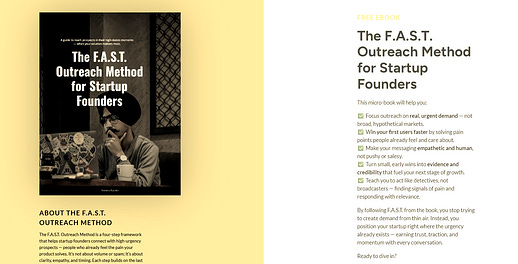
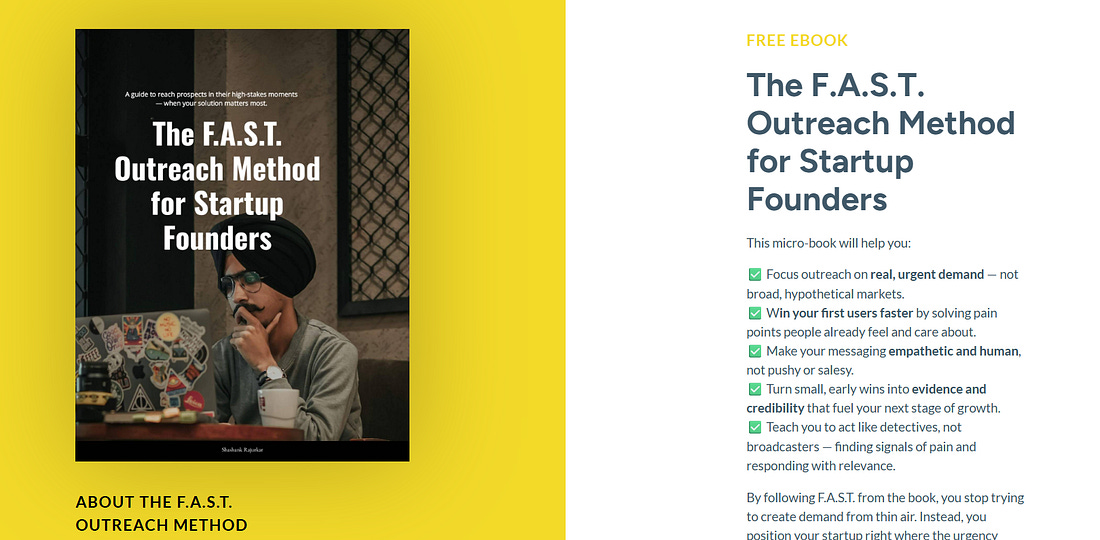
That kind of story is not anecdotal — it’s the core of influencing motion. Introducing F.A.S.T. (A Sneak Peek)I won’t reveal the full eBook here — but here’s a taste of how the framework works in context, and what you’d get if you download it.
To help you see it in action, imagine this applied: You build a micro-pilot to reduce demo follow-up delay. You find two startups publicly complaining about lost deals. You message them:
One replies. You run the pilot, show a 20% uplift, get a testimonial. Then you use that as proof to reach the next one. That’s F → A → S → T in motion — but the full version has scripts, worksheets, escalation paths, and email/DM templates. Caveats & Pitfalls
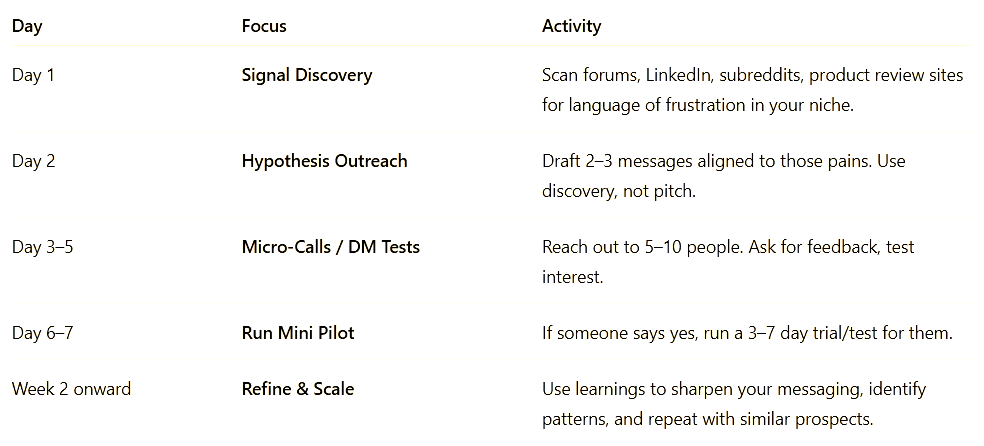
How You Can Try This This Week (Mini-Playbook)Below is a short roadmap you can apply right now — even if you don’t have paying users yet.
Download the Full F.A.S.T. eBookIf you want the full, structured version — with templates, workflows, best practices, and scaling paths — you can download the micro eBook here: 👉 [Download the F.A.S.T. Outreach Method PDF]
Use it as:
No fluff. Just actionable steps you can follow. Final ThoughtsYou don’t need traction. You need traction from the right people. Volume is meaningless if conversion is near zero. When you target those already in motion — with empathy, clarity, and proof — you turn your outreach into a scalable engine. That’s how you get from zero users → first paying users → momentum. Invite your friends and earn rewardsIf you enjoy Startup-Side , share it with your friends and earn rewards when they subscribe.
|

Startup Validation Is a Bet
Find the commercial wager with the shortest path to someone paying - whether you’re with just an idea, or an MVP, or even a functional pr...

-
Techie.Buzz posted: " [ANN] Serverless Kubernetes Solution For Cloud-Native Apps by CTO.ai CTO.ai is a provider of deve...
-
Jonathan Gibson posted: "Cryptocurrency gambling is growing at a rapid pace, and more and more people are thinking about us...
-
Crypto Breaking News posted: "Mikhail Fedorov, Ukraine's Deputy Prime Minister and the head of the country's Minist...


