🧩 The Psychology of Free: Why Curiosity Isn’t Commitment(Part 1 of The Revenue-First Founder Series)
Every founder I’ve ever coached eventually tells me the same story—though the details differ, the ending rarely does. They launch something new, keep it free, and watch users flood in. Then, they introduce pricing. It’s not failure; it’s revelation. The Comfort of “Free”Making something free feels logical. Remove friction, gather feedback, prove demand—right? Free users explore, not commit. Dropbox, Evernote, and countless early consumer startups learned this the hard way: massive top-of-funnel growth followed by conversion rates that exposed how little curiosity predicts conviction. The psychology is simple. Why Founders Still Fall for ItBecause free produces motion. Dashboards fill up. Graphs go up and to the right. But progress isn’t motion; it’s learning. That’s why the signal from free users is almost always distorted. What I See Working With FoundersWhen I help founders run early validation sprints, I often ask:
Almost every time, the first reaction is fear: “What if nobody pays?” Once they introduce even a token price, the noise drops. A Parallel Closer to HomeLook at Byju’s, the Indian ed-tech giant that built enormous reach through free lessons and demos. Now contrast that with Zoho, which charged from day one. Free fills funnels. Behavioural Economics Has a Term for ThisIt’s called the effort-cost bias: we assign honesty to effort. In short:
The AI Era Makes This Even SharperToday, anyone can prototype an idea in a weekend. AI, nocode tools, and APIs have erased the barriers to creation. When it’s easy to build anything, everything looks promising. If someone pays for your AI product, subscription, or data service, it’s not because it’s novel. The Shift That Changes EverythingFounders who stop asking “Do people like it?” and start asking “Who is willing to pay for it?” experience a fundamental change in learning velocity. Each payment, no matter how small, tightens the feedback loop: That’s revenue-first validation in action. Closing ReflectionCuriosity is cheap. Conviction costs. The real job of early validation isn’t to prove your idea works—it’s to discover who cares enough to pay for it.
Invite your friends and earn rewardsIf you enjoy Startup-Side , share it with your friends and earn rewards when they subscribe.
|
Friday, October 24, 2025
🧩 The Psychology of Free: Why Curiosity Isn’t Commitment





Tuesday, October 21, 2025
Before You Sell Your Product, Sell Your Progress
There’s a strange paradox at the heart of every early startup: You’re selling a future — and the only proof you have is your motion toward it. This article isn’t about pitching or persuasion. It’s about belief. The Problem Isn’t Attention — It’s BelievabilityStartups don’t fail to get attention. Belief is different from awareness.
And that belief doesn’t come from features, or design, or branding. Why People Struggle to Believe Early FoundersIf you strip it down, most audiences — users, investors, even early hires — are biologically wired to be skeptical. So when you say “we’re building the future of X,” people don’t hear excitement. They subconsciously ask:
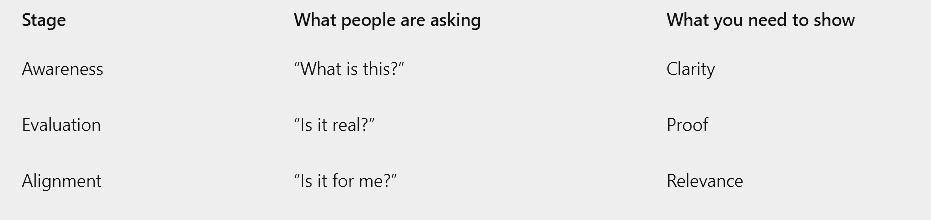
You can’t talk your way through that skepticism. Belief Has a Pattern — and Startups Can Build ItIf you study how people form belief in new ideas, you’ll notice a three-step loop:
Early founders often jump straight to the third stage — they try to make the idea relevant — before they’ve earned the right to be believed. You can’t build alignment without first proving reality. The Hidden Skill: Showing, Not Stating ProgressThere’s an art to demonstrating progress that builds belief. Founders who do it well don’t announce; they narrate. For example: ❌ “We’re launching something revolutionary.” The second line builds belief because it shows the work. Belief grows when your audience feels like they can see your brain working. Why Belief Compounds Faster Than GrowthBelief is contagious. That’s why small wins — even modest ones — matter so much early on. Every user testimonial, every pilot result, every “we learned this the hard way” post — it all compounds. Founders Who “Feel Real”If you scroll through LinkedIn or Twitter, you’ll notice something: The difference?
Authenticity is not just a tone; it’s a strategy for credibility. The Trust Equation for FoundersHere’s a simple formula I use when helping founders design communication:
As noise goes up, trust collapses — even if competence is high. Early founders win not by being louder, but by being clearer and steadier. What Founders Can Learn from JournalistsJournalists build trust fast because they use a principle called evidence stacking. Founders can borrow that. Example:
That line does more for belief than any roadmap ever could. The New Founder Archetype: The “Visible Thinker”We’re entering an era where transparency is the new authority. The founders who win attention now aren’t just builders — they’re visible thinkers. It doesn’t make them look amateur — it makes them look alive. This shift is cultural. People no longer trust glossy; they trust grounded. The Real Enemy of Belief: SilenceYou can’t be trusted if no one can see you. The problem? If you don’t share your process, the world assumes you’ve stopped. So the discipline isn’t about shipping faster; it’s about communicating motion better. Why Belief Is the Strongest Form of MarketingYou can pay for reach. You can hack algorithms. Belief is built by showing proof in plain sight. Because in the startup world, credibility is a currency minted in public. The Belief-to-Buy FlywheelWhen people believe in your movement, three things happen naturally:
That sequence never works in reverse. Your marketing, your outreach, your fundraising — they’re all easier once belief exists. From “Building” to “Broadcasting”Building in public isn’t about showing every detail — it’s about showing direction. What did you try? That’s not marketing content — it’s narrative continuity. And belief, once alive, tends to spread. The Human Side of BelievabilityBelief doesn’t just come from updates — it comes from tone. The most believable founders share with humility. They don’t posture. They invite. That subtle humility does more for trust than any growth graph. Why This Matters Beyond StartupsThis isn’t just about customer acquisition or fundraising. When everything looks like marketing, believability becomes a moat. The ShiftSo if you’re early-stage, stop trying to prove you’re big. Because belief doesn’t start with scale — it starts with signal. 👇 Author’s NoteThis article explores why people believe in new ideas. If you’d like a practical tool that helps you show that belief in your own outreach — I built a one-page resource that helps founders translate this into daily action. 👉 It’s called The Signal System Checklist — a simple guide to turn early traction into trust and trust into growth. Invite your friends and earn rewardsIf you enjoy Startup-Side , share it with your friends and earn rewards when they subscribe.
|

Startup Validation Is a Bet
Find the commercial wager with the shortest path to someone paying - whether you’re with just an idea, or an MVP, or even a functional pr...

-
Techie.Buzz posted: " [ANN] Serverless Kubernetes Solution For Cloud-Native Apps by CTO.ai CTO.ai is a provider of deve...
-
Jonathan Gibson posted: "Cryptocurrency gambling is growing at a rapid pace, and more and more people are thinking about us...
-
Crypto Breaking News posted: "Mikhail Fedorov, Ukraine's Deputy Prime Minister and the head of the country's Minist...


