🧩 Part 4: Hybrid vs Revenue-First — The Startup Learning Matrix(Part 4 of the Revenue-First Founder Series)
Most founders think of “charging early” and “offering free” as opposite strategies.
The Matrix of Startup LearningImagine a simple 2x2 grid.
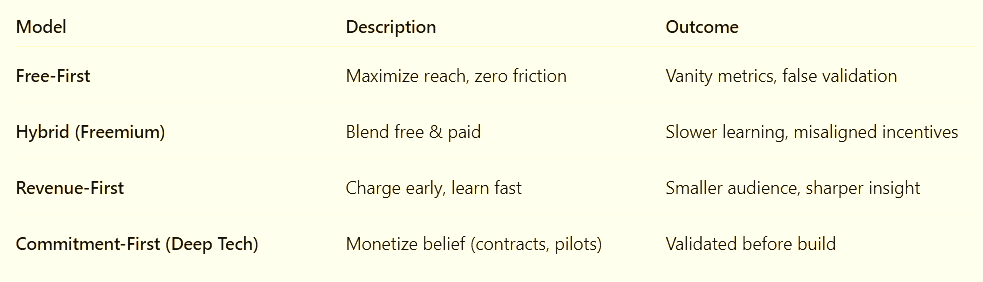
In the bottom-left: free users and shallow learning. Most founders live in the middle — the Hybrid Plateau — where free users inflate metrics and paid users are too few to reveal truth. The Hybrid PlateauHybrid models (free + paid) feel smart because they hedge risk. Zomato spent years balancing free discovery with monetized listings. The same goes for many B2B tools that stay “freemium” for too long — they learn what people like, not what people need. Revenue-First ClarityNow contrast that with Razorpay. Revenue-first startups move slower at first, but their feedback loops are sharper. The Deep-Tech RealityIn deep-tech and hardware, the revenue-first path looks different — but the logic holds. That’s still revenue-first validation: customers showing belief before the final product exists. MedTech, FinTech, Biotech — The Regulated DomainsFounders in regulated sectors often ask, “Can we even charge early?” In MedTech, early validation can come from paid research partnerships or pre-orders for clinical-grade prototypes. Regulation might delay scale, but it doesn’t prevent validation. Why Founders Default to HybridBecause hybrid feels safe. It lets you test reach before risking rejection. When you give away too much, users explore out of curiosity. That difference changes everything — roadmap, retention, and reality. Decades of Evolution
What changed? The Learning Matrix Framework
Every founder should know which quadrant they’re operating in — and why. The AI Era Accelerates the DivideAI startups highlight this divide dramatically. Freemium AI tools, on the other hand, are already facing churn and price collapse — victims of abundance. When creation is cheap, only conviction has value. Closing ReflectionFree attracts the curious. Founders who embrace that truth — in SaaS, hardware, or biotech — learn faster, spend smarter, and build products that last. The learning matrix isn’t just about pricing.
|
Wednesday, November 5, 2025
🧩 Part 4: Hybrid vs Revenue-First — The Startup Learning Matrix




Sunday, November 2, 2025
🧩 Part 3: Why the Smartest Founders Validate with Revenue Before They Write a Line of Code
🧩 Part 3: Why the Smartest Founders Validate with Revenue Before They Write a Line of Code(Part 3 of the Revenue-First Founder Series)
The most counterintuitive truth in startups is this:
The Airbnb LessonIn 2008, when Airbnb’s founders were broke and uncertain, they didn’t start by building a platform. They inflated air mattresses in their apartment, charged three guests $80 each, and proved two critical things: That was revenue-first validation — payment as proof. A few months later, they built the first version of the site, and that same logic kept guiding every iteration: build only after someone pays or commits. The Opposite StoryCompare that with Homejoy, another “sharing economy” startup that raised over $40 million to connect homeowners with cleaners. Airbnb validated pain and willingness before building. The Principle: Proof > ProjectionMost founders test what people say, not what people do. When you charge upfront — through pre-orders, pilot fees, or deposits — you’re not being aggressive; you’re compressing the learning cycle. That early friction tells you what’s real. Why It WorksBehavioral economists call it commitment escalation — when people pay, even a little, they pay attention. That’s why early payment is the purest signal a founder can get. The Playbook in ActionThis approach isn’t limited to software.
Each used payment as a proxy for proof. The Indian ParallelIn India, Razorpay validated demand by asking early businesses to pay small transaction fees before scaling. Both showed that even in complex or regulated sectors, revenue-first validation is possible if you sell the outcome, not just the product. Why Founders Avoid Charging EarlyBecause it’s uncomfortable. But that’s the point. Revenue-first validation saves you from spending months (or years) polishing a product nobody values enough to buy. How This Has EvolvedIn the 2000s, building was expensive — validating before building was rare. You can validate revenue before writing a single line of code. The AI Era Makes It Non-NegotiableWith AI, anyone can launch a product in a weekend. Charging early is no longer risky; not charging early is. Closing ReflectionRevenue-first validation isn’t about greed. When someone pays, even a little, they give you the most valuable feedback a founder can get:
That’s where real validation begins.
|

Startup Validation Is a Bet
Find the commercial wager with the shortest path to someone paying - whether you’re with just an idea, or an MVP, or even a functional pr...

-
Techie.Buzz posted: " [ANN] Serverless Kubernetes Solution For Cloud-Native Apps by CTO.ai CTO.ai is a provider of deve...
-
Jonathan Gibson posted: "Cryptocurrency gambling is growing at a rapid pace, and more and more people are thinking about us...
-
Crypto Breaking News posted: "Mikhail Fedorov, Ukraine's Deputy Prime Minister and the head of the country's Minist...


