Jugaad Is Not a Hack. It’s a Way of Seeing the World.Why clarity under constraint beats systems, strategy, and scale
In 1970, a spacecraft exploded nearly 200,000 miles from Earth. The manuals stopped helping. Engineers working on Apollo 13 were given a constraint that rendered all theory obsolete. Three astronauts would die unless progress was made immediately. They were tasked with solving an impossible problem using only the resources already available on the spacecraft.
No new tools. They built a life-saving carbon dioxide filter out of plastic bags, duct tape, a sock, and a flight manual.
This wasn’t cleverness. It was clarity under pressure. That is jugaad. Before the term startup became fashionable, many businesses were born the same way Apollo 13 survived, by responding to immediate reality rather than long-term plans. One of the most cited modern examples is Airbnb, but its early story is rarely told in the right frame. Airbnb did not begin with a grand vision of transforming hospitality. With hotels sold out during a design conference in San Francisco, the founders put air mattresses in their apartment and charged strangers to sleep on their floor. There was no marketplace logic yet. There was only one question that mattered. Will someone pay right now for this solution? Three people did. That exchange mattered more than any pitch deck. Money changed hands. Value was confirmed. A broken system, expensive hotels, revealed a gap, and progress happened without permission. This wasn’t clever marketing. Like Apollo engineers improvising with limited materials, Airbnb’s founders weren’t optimizing. They were listening to reality speak early, in the most unambiguous language available. That is jugaad operating at the zero to one stage.
Thousands of miles away, far from space capsules and control rooms, something equally precise happens every weekday. The Mumbai Dabbawala system delivers more than 200,000 lunchboxes a day with accuracy levels most modern logistics companies envy.
There is no startup funding. Most workers are semi-literate. Instead, the system runs on color codes, handwritten symbols, deep familiarity with local train rhythms, and intuitive coordination shaped by constraint. This was not innovation born from abundance. Different worlds.
When the system doesn’t support you, progress depends on how clearly you can see reality. The Misunderstanding of JugaadModern business culture often reduces jugaad to a shortcut, a hack, or a workaround until proper systems arrive. That framing misses the point entirely. Jugaad is not disorder. It appears that when resources are asymmetric, rules were written for someone else, and waiting carries a higher cost than acting.
Apollo 13 wasn’t chaotic. Both represent disciplined adaptation when formal systems fail. This is the essence of jugaad, progress within constraints. The Psychology Behind JugaadJugaad is often explained as a response to scarcity or a feature of certain environments. But that explanation only describes where it appears, not why it works. At its core, jugaad is psychological. It reflects how some minds respond when the familiar structures they rely on, tools, processes, and permissions, fall away. When the system no longer provides guidance, people diverge. Some stop. The difference is not intelligence or experience. The Make It Work MindsetWhen something breaks, most thinking is diagnostic. What went wrong? Jugaad thinking moves in a different direction. What still functions? This is not optimism. Acceptance reduces cognitive friction. Instead of fighting reality, the mind reallocates energy toward recombination, finding new uses for what already exists. In uncertain situations, this shift is powerful. Action becomes a way of learning rather than a reward for having learned enough. Jugaad thinkers do not wait to understand before acting. Why Constraints Don’t Just Limit Their FocusCreativity is often romanticized as freedom. But in practice, freedom overwhelms. When everything is possible, nothing feels necessary. Constraints narrow the field and sharpen attention. Under limitation, the mind stops searching for ideal solutions and begins assembling workable ones. Less originality. Jugaad emerges when limits are treated not as obstacles, but as design inputs. The question quietly shifts from what would be best to what would be enough to continue. Enough is an underrated threshold. Comfort With Partial SolutionsOne of the least discussed traits behind jugaad is tolerance for incompleteness. Many people feel psychological discomfort when things are unfinished or inelegant. They delay action to resolve that discomfort. Jugaad thinkers do the opposite. They move with the discomfort. They accept temporary solutions, uneven experiences, and visible imperfections. Not because they prefer them, but because they value continuity more than polish. Over time, this builds judgment, the ability to act correctly without full information. Judgment cannot be downloaded. Are Some People Naturally Better at Jugaad?It’s tempting to believe that some people are wired for this kind of thinking. In reality, it’s less about wiring and more about conditioning. People raised in stable systems internalize the assumption that structure will appear before action is required. People raised in fragile systems learn the opposite: action often precedes structure. Neither orientation is superior in all contexts. But when systems lag reality, as they increasingly do, the second adapts faster. The important insight is this. Jugaad is learnable. By delaying formalization. Jugaad is not a trait. Why This Matters NowAs environments grow more complex and change accelerates, formal systems struggle to keep pace. Rules arrive late. In these gaps, the most valuable capability is not expertise. It is adaptability. The ability to stay oriented when guidance disappears. Jugaad is not resistant to systems. And in a world where absence is becoming more common, that competence is no longer marginal. It is central. Real Startup Stories Across GTM StagesTo see how Jugaad thinking manifests in real product journeys, it helps to look at well-known startup examples, not because they were effortless successes, but because they used constraint-driven validation to unlock growth. Airbnb proved demand before scale. Slack grew because usage created pull, not because marketing pushed it. Turo built trust manually before systems ever entered the picture. Across all three, the pattern was the same. Reality came first. From Survival to SignalJugaad teaches a brutal truth. Clarity grows not from theoretical validation, but from direct economic exchange. Revenue is not success. Before channels. Someone must pay for the relief you provide. Jugaad Is a Phase But a Formative OneFounders often romanticize scrappiness. But jugaad is a phase, not a strategy. Apollo engineers did not redesign NASA around duct tape. Scrappiness extracts truth. Scaling Without Losing the Original IntelligenceThe greatest risk at scale is not inefficiency. It is epistemic drift. Forgetting why customers paid. The best organizations do not erase their early improvisations. They translate them into institutional memory. This is not abandoning jugaad. A Quiet Test of Real UnderstandingIf the system you rely on disappeared tomorrow, would you still know how to move forward? Not optimally. Just forward. That answer reveals whether your thinking is system-dependent or system literate. Closing ThoughtJugaad is often mistaken for messiness. In truth, it is clarity under constraint. It strips away what does not matter. And it reminds us that progress has never waited for perfect conditions. Not in space. Jugaad is not how you scale. - Before you build anything, make sure someone wants it enough to pay. I put together a free 7-day email course on revenue-first customer discovery — how to pull real buying intent from real conversations (without guessing, overbuilding, or hoping). If you’re a builder who wants clarity before code:
|
Tuesday, December 30, 2025
Jugaad Is Not a Hack. It’s a Way of Seeing the World.








Tuesday, December 23, 2025
Discipline Is Overrated. Spontaneity Is Underrated. Founders Need Both.
Discipline Is Overrated. Spontaneity Is Underrated. Founders Need Both.Why locking in clarity too early quietly limits what founders can build
Every founder eventually runs into this internal conflict. On one side is discipline. Planning. Structure. Consistency. The quiet pride of showing up every day and doing the work, whether it feels inspired or not. On the other side is spontaneity. Intuition. Insight. The unplanned conversation that unlocks a new direction. The idea that arrives without warning and refuses to be ignored. Most advice treats these as opposites. You are told to choose. To commit to systems. To trust process over instinct. To eliminate randomness in the name of focus. And yet, if you look closely at how meaningful companies are actually built, the story is more complicated. Discipline does not create breakthroughs. Founders need both. But not in equal measure. And not at the same time. The real skill is knowing which mode you are in, and which one the moment requires. There is a reason this tension keeps resurfacing across creative and intellectual fields. As Dorothy Parker once put it:
The line lands because it refuses the binary. The mind wanders. The eye refines - one without the other collapses. The Modern Obsession With DisciplineThe business world loves discipline because it is measurable. You can track habits. You can count hours. You can build dashboards. You can turn effort into numbers and numbers into reassurance. Discipline feels responsible. It looks like maturity. It signals seriousness to investors, teams, and even to yourself. There is a reason most founder advice eventually converges on routines. Morning rituals. Weekly reviews. Operating cadences. These things work, especially once direction is clear. But discipline has quietly become moralized. If progress stalls, the answer is assumed to be more structure. More process. Tighter goals. Better execution. Very few people stop to ask a more uncomfortable question. What if the issue is not execution at all? Discipline is powerful, but it has a blind spot. It amplifies whatever you are already doing. If the underlying assumptions are flawed, discipline helps you move faster in the wrong direction. Often, those flawed assumptions only become visible once execution is already underway. This is where founders get stuck. Some of the most successful companies avoided this trap not by abandoning discipline, but by pairing it with a willingness to question their own assumptions. Netflix is often described as an operationally rigorous company. Metrics matter. Accountability is explicit. Yet its long-term success did not come from executing the original plan more efficiently. It came from noticing when reality began to contradict that plan and responding before the data made the decision obvious. That kind of responsiveness is not accidental. It requires discipline strong enough to tolerate questioning without collapsing into chaos. What Discipline Actually Does WellDiscipline excels at execution. It creates reliability. It reduces variance. It allows work to compound over time. This is why discipline matters so much once a company has found product-market fit or a stable operating model. Psychological research supports this. Consistent routines strengthen executive control. They improve focus, reduce decision fatigue, and make progress predictable. Discipline is how effort becomes output. History is full of examples. Beethoven worked within strict compositional routines. Maya Angelou wrote on a fixed daily schedule. Edison treated invention as systematic labor rather than inspiration. None of these people waited for motivation. Discipline made their work possible. Founders need this. Without discipline, ideas remain abstract. Teams lose trust. Momentum disappears. But discipline has limits. It cannot tell you what to build. For that, founders rely on something else. What Spontaneity Actually Does WellSpontaneity is often misunderstood. It is not chaos. It is not a lack of preparation. It is not impulsiveness for its own sake. Spontaneity is responsiveness. It is the ability to notice weak signals. To connect patterns before they are obvious. To change course when reality contradicts the plan. Many of those signals appear only while the work is in motion, not before it begins. Research on creativity consistently points in this direction. Novel ideas rarely emerge from linear optimization. They arise from intersections, exposure, and attention that is not fully scripted. Sukant Ratnakar captures this dynamic succinctly:
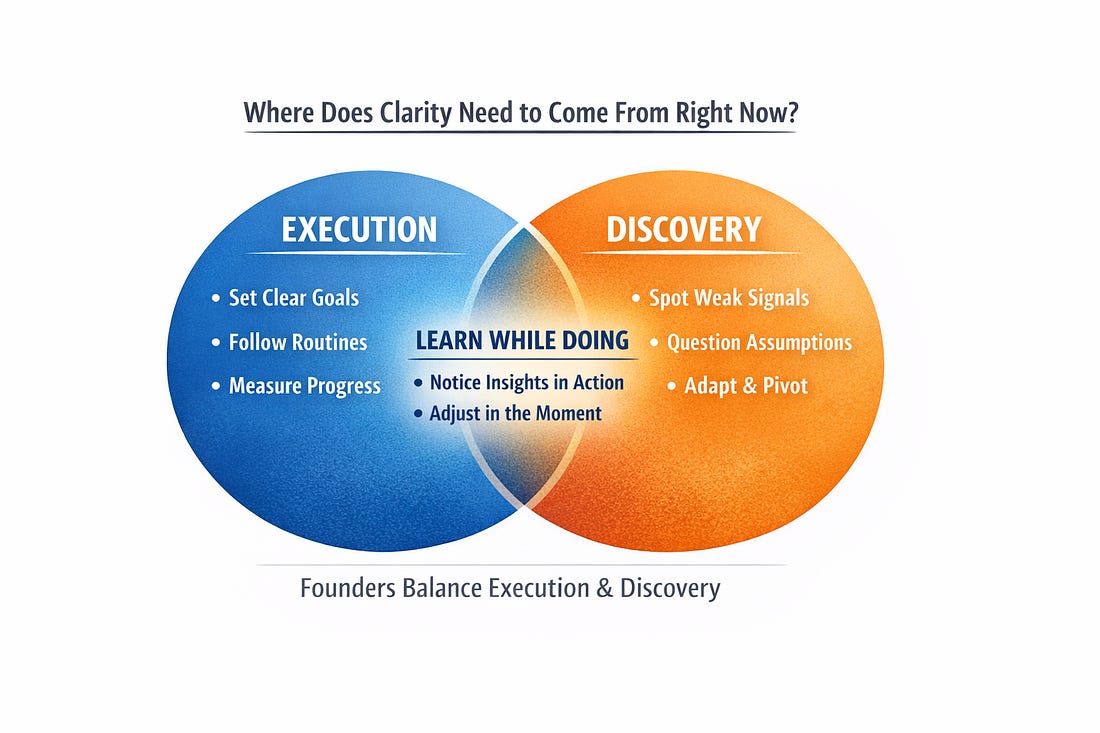
Spontaneity, in other words, is not an escape from work. It is what happens when attention stays alive inside it. This is what allows founders to notice that a customer objection is actually a feature request. That a side project has more traction than the core roadmap. That a throwaway experiment deserves serious attention. Many of the most consequential product decisions follow this pattern. Steve Jobs was famously meticulous about execution and detail, yet deeply skeptical of market research as a source of direction. He believed customers often could not articulate what they wanted until they experienced it. Intuition sets direction. Discipline made it real. Spontaneity reveals direction. Confusing these roles creates problems. The Jazz and Classical Music ParallelThe difference between discipline and spontaneity becomes clearer outside of business. Consider classical music and jazz. Classical music is built on precision. The score is written. The interpretation is constrained. Excellence comes from rehearsal and technical mastery. Jazz sounds spontaneous. Notes bend. Tempo shifts. Musicians respond to one another in real time. But jazz is not undisciplined. Jazz musicians spend years mastering scales, harmony, and rhythm. They internalize structure so deeply that they can move freely within it. What sounds improvised is supported by deep preparation. The improvisation does not interrupt the performance. It emerges from it. This is the paradox founders often miss. Spontaneity is not the absence of discipline. Founders who lack structure cannot improvise effectively. Founders who cling too tightly to structure cannot adapt. The balance is not aesthetic. It is functional. The Cost of Premature DisciplineOne of the most common founder mistakes is applying discipline too early. In the early stages of a company, many problems are not execution problems. They are understanding problems. And that understanding often arrives through partial execution, not prior analysis. You do not yet know which customer segment matters most. You do not know which value proposition will resonate. You do not know which metrics actually reflect progress. Applying rigid discipline at this stage can lock in assumptions that should remain fluid. There is a useful parallel here from science and engineering. Engineering assumes the problem is known. The task is to build the solution efficiently. Science assumes the problem is not fully understood. The task is to explore, test, and refine hypotheses. Early-stage startups are closer to scientific exploration than engineering execution. When founders apply engineering discipline before scientific understanding, they optimize prematurely. They refine solutions to problems that have not been clearly defined. This is not a lack of discipline. It is a discipline applied in the wrong domain. Over Discipline and the Loss of IntuitionThere is another cost to over-discipline that rarely gets discussed. It dulls intuition. Founders who over-optimize structure often lose touch with the subtle signals that once guided them. They rely on metrics even when metrics lag reality. They trust process more than judgment. Those signals are rarely separate from the work. They surface while things are being built, shipped, and tested. Execution becomes excellent. Outcomes become mediocre. The company ships consistently but without insight. Meetings are efficient. Strategy feels hollow. Founders in this state often describe a sense of stagnation. Not burnout, but disconnection. They are busy, but not curious. Productive, but not inspired. This is not because discipline is bad. It is because spontaneity has been crowded out. What Mature Founders Learn Over TimeEarly founders fear chaos. They crave structure because everything feels uncertain. Later, experienced founders fear stagnation. They have seen what happens when organizations become rigid. Mature founders learn to separate execution from direction. Execution is disciplined. It benefits from routine, clarity, and accountability. Direction is exploratory. It benefits from openness, reflection, and responsiveness. This distinction changes how founders allocate their time. They protect space for thinking that does not have an immediate output. They value conversations that wander. They pay attention to what feels slightly off plan but strangely important. This is not inefficiency. It is strategic awareness. Just as jazz musicians listen to the room while playing, mature founders listen to the environment while executing. The Neuroscience PerspectiveThere is also a cognitive dimension to this balance. The brain operates using multiple networks. Two of the most relevant here are the executive control network and the default mode network. The executive control network supports focus, planning, and task execution. Discipline strengthens this system. The default mode network supports imagination, reflection, and spontaneous thought. It becomes active during rest, daydreaming, and unstructured time. Creativity emerges from the interaction between these systems. Ideas arise in the default mode. They are refined and implemented through executive control. Founders who suppress spontaneity over-engage one system at the expense of the other. The result is either scattered thinking or rigid execution. Balance is not a personality trait. It is a cognitive practice. A Simple Mental ModelThis is not a framework. It is a lens. When faced with a decision, ask one question. Where does clarity need to come from right now? Sometimes the work is pure execution. The direction is sound, but progress depends on consistency. In those moments, discipline helps. Clarify goals. Create routines. Measure progress. But often, discovery happens inside execution. You only learn what matters by doing the work. Signals emerge midstream. Assumptions surface only once they are stressed. In those moments, spontaneity is not a pause from execution. It is attention within it. The willingness to notice what the work itself is revealing. Many founder frustrations come from treating every problem as if it belongs cleanly to one mode. They force execution when the work is still teaching them something. Or they keep searching for clarity long after the signal has already appeared. Clarity does not come from choosing a mode once. It helps to visualize this not as a choice between two modes, but as an overlap where learning happens while things are being built.
Execution and discovery are not separate phases. They coexist. Goals create motion, but motion creates information. The work itself becomes the source of clarity if attention is allowed to stay flexible. This idea echoes a broader truth about creative and productive work, often attributed to thinkers across disciplines:
Why This Matters More Than EverThe pace of change makes this balance increasingly important. Markets shift faster. Technology evolves quickly. Customer expectations change. Founders who rely only on discipline risk becoming efficient at outdated strategies. Founders who rely only on spontaneity risk never building anything durable. The founders who endure are those who can listen and act. Reflect and execute. Pause and commit. They build systems that support flexibility rather than eliminate it. They understand that discipline is not the goal. It is the instrument. Closing ReflectionDiscipline does not make ideas meaningful. But discipline gives structure to insight. Like jazz, what looks effortless on the surface is supported by a deep internal structure. The work of a founder is not choosing one mode forever. It is learning when to switch and having the courage to do so. It is leadership. - Before you build anything, make sure someone wants it enough to pay. I put together a free 7-day email course on revenue-first customer discovery — how to pull real buying intent from real conversations (without guessing, overbuilding, or hoping). If you’re a builder who wants clarity before code:
|

The Difference Between Repeatability and Scalability in GTM
Most GTM teams confuse repeatability with scalability. Learn the difference and why it’s quietly limiting your growth. ͏ ͏ ͏...
