Jugaad Is Not a Hack. It’s a Way of Seeing the World.Why clarity under constraint beats systems, strategy, and scale
In 1970, a spacecraft exploded nearly 200,000 miles from Earth. The manuals stopped helping. Engineers working on Apollo 13 were given a constraint that rendered all theory obsolete. Three astronauts would die unless progress was made immediately. They were tasked with solving an impossible problem using only the resources already available on the spacecraft.
No new tools. They built a life-saving carbon dioxide filter out of plastic bags, duct tape, a sock, and a flight manual.
This wasn’t cleverness. It was clarity under pressure. That is jugaad. Before the term startup became fashionable, many businesses were born the same way Apollo 13 survived, by responding to immediate reality rather than long-term plans. One of the most cited modern examples is Airbnb, but its early story is rarely told in the right frame. Airbnb did not begin with a grand vision of transforming hospitality. With hotels sold out during a design conference in San Francisco, the founders put air mattresses in their apartment and charged strangers to sleep on their floor. There was no marketplace logic yet. There was only one question that mattered. Will someone pay right now for this solution? Three people did. That exchange mattered more than any pitch deck. Money changed hands. Value was confirmed. A broken system, expensive hotels, revealed a gap, and progress happened without permission. This wasn’t clever marketing. Like Apollo engineers improvising with limited materials, Airbnb’s founders weren’t optimizing. They were listening to reality speak early, in the most unambiguous language available. That is jugaad operating at the zero to one stage.
Thousands of miles away, far from space capsules and control rooms, something equally precise happens every weekday. The Mumbai Dabbawala system delivers more than 200,000 lunchboxes a day with accuracy levels most modern logistics companies envy.
There is no startup funding. Most workers are semi-literate. Instead, the system runs on color codes, handwritten symbols, deep familiarity with local train rhythms, and intuitive coordination shaped by constraint. This was not innovation born from abundance. Different worlds.
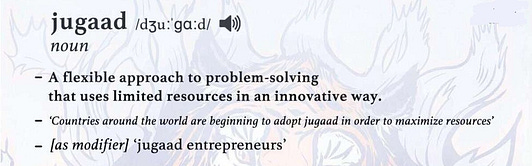
When the system doesn’t support you, progress depends on how clearly you can see reality. The Misunderstanding of JugaadModern business culture often reduces jugaad to a shortcut, a hack, or a workaround until proper systems arrive. That framing misses the point entirely. Jugaad is not disorder. It appears that when resources are asymmetric, rules were written for someone else, and waiting carries a higher cost than acting.
Apollo 13 wasn’t chaotic. Both represent disciplined adaptation when formal systems fail. This is the essence of jugaad, progress within constraints. The Psychology Behind JugaadJugaad is often explained as a response to scarcity or a feature of certain environments. But that explanation only describes where it appears, not why it works. At its core, jugaad is psychological. It reflects how some minds respond when the familiar structures they rely on, tools, processes, and permissions, fall away. When the system no longer provides guidance, people diverge. Some stop. The difference is not intelligence or experience. The Make It Work MindsetWhen something breaks, most thinking is diagnostic. What went wrong? Jugaad thinking moves in a different direction. What still functions? This is not optimism. Acceptance reduces cognitive friction. Instead of fighting reality, the mind reallocates energy toward recombination, finding new uses for what already exists. In uncertain situations, this shift is powerful. Action becomes a way of learning rather than a reward for having learned enough. Jugaad thinkers do not wait to understand before acting. Why Constraints Don’t Just Limit Their FocusCreativity is often romanticized as freedom. But in practice, freedom overwhelms. When everything is possible, nothing feels necessary. Constraints narrow the field and sharpen attention. Under limitation, the mind stops searching for ideal solutions and begins assembling workable ones. Less originality. Jugaad emerges when limits are treated not as obstacles, but as design inputs. The question quietly shifts from what would be best to what would be enough to continue. Enough is an underrated threshold. Comfort With Partial SolutionsOne of the least discussed traits behind jugaad is tolerance for incompleteness. Many people feel psychological discomfort when things are unfinished or inelegant. They delay action to resolve that discomfort. Jugaad thinkers do the opposite. They move with the discomfort. They accept temporary solutions, uneven experiences, and visible imperfections. Not because they prefer them, but because they value continuity more than polish. Over time, this builds judgment, the ability to act correctly without full information. Judgment cannot be downloaded. Are Some People Naturally Better at Jugaad?It’s tempting to believe that some people are wired for this kind of thinking. In reality, it’s less about wiring and more about conditioning. People raised in stable systems internalize the assumption that structure will appear before action is required. People raised in fragile systems learn the opposite: action often precedes structure. Neither orientation is superior in all contexts. But when systems lag reality, as they increasingly do, the second adapts faster. The important insight is this. Jugaad is learnable. By delaying formalization. Jugaad is not a trait. Why This Matters NowAs environments grow more complex and change accelerates, formal systems struggle to keep pace. Rules arrive late. In these gaps, the most valuable capability is not expertise. It is adaptability. The ability to stay oriented when guidance disappears. Jugaad is not resistant to systems. And in a world where absence is becoming more common, that competence is no longer marginal. It is central. Real Startup Stories Across GTM StagesTo see how Jugaad thinking manifests in real product journeys, it helps to look at well-known startup examples, not because they were effortless successes, but because they used constraint-driven validation to unlock growth. Airbnb proved demand before scale. Slack grew because usage created pull, not because marketing pushed it. Turo built trust manually before systems ever entered the picture. Across all three, the pattern was the same. Reality came first. From Survival to SignalJugaad teaches a brutal truth. Clarity grows not from theoretical validation, but from direct economic exchange. Revenue is not success. Before channels. Someone must pay for the relief you provide. Jugaad Is a Phase But a Formative OneFounders often romanticize scrappiness. But jugaad is a phase, not a strategy. Apollo engineers did not redesign NASA around duct tape. Scrappiness extracts truth. Scaling Without Losing the Original IntelligenceThe greatest risk at scale is not inefficiency. It is epistemic drift. Forgetting why customers paid. The best organizations do not erase their early improvisations. They translate them into institutional memory. This is not abandoning jugaad. A Quiet Test of Real UnderstandingIf the system you rely on disappeared tomorrow, would you still know how to move forward? Not optimally. Just forward. That answer reveals whether your thinking is system-dependent or system literate. Closing ThoughtJugaad is often mistaken for messiness. In truth, it is clarity under constraint. It strips away what does not matter. And it reminds us that progress has never waited for perfect conditions. Not in space. Jugaad is not how you scale. - Before you build anything, make sure someone wants it enough to pay. I put together a free 7-day email course on revenue-first customer discovery — how to pull real buying intent from real conversations (without guessing, overbuilding, or hoping). If you’re a builder who wants clarity before code:
|
Tuesday, December 30, 2025
Jugaad Is Not a Hack. It’s a Way of Seeing the World.








Subscribe to:
Post Comments (Atom)
Startup Validation Is a Bet
Find the commercial wager with the shortest path to someone paying - whether you’re with just an idea, or an MVP, or even a functional pr...

-
Jonathan Gibson posted: "Cryptocurrency gambling is growing at a rapid pace, and more and more people are thinking about us...
-
Techie.Buzz posted: " [ANN] Serverless Kubernetes Solution For Cloud-Native Apps by CTO.ai CTO.ai is a provider of deve...
-
Crypto Breaking News posted: "Mikhail Fedorov, Ukraine's Deputy Prime Minister and the head of the country's Minist...


No comments:
Post a Comment