The Most Dangerous Phase of a Startup Isn’t Idea StageOn repeatability, restraint, and the illusion of progress
The danger of early revenue is not that it lies. Revenue answers a single question: Did someone pay? Did they succeed again? In early growth, founders often mistake payment for proof. A customer paid, therefore, the value proposition is validated. A cohort converted; therefore, the funnel works. A few strong accounts expanded, therefore the model scales. But revenue in this phase behaves more like a coincidence than a system.
It arrives because of timing, motivation, luck, or exceptional customers. It shows up when the founder is involved. It disappears when conditions change. And because the numbers move in the right direction, the underlying fragility is easy to ignore. This is why this phase is so dangerous. It does not feel like failure. It feels like progress that cannot yet be trusted. What makes it worse is that most startup narratives skip directly from zero to inevitability. There is little language for the space in between, where outcomes exist but refuse to stabilize. That silence pushes founders toward the wrong instinct. Instead of slowing down to understand why success happens, they accelerate to capture more of it. They scale before they explain. The Gap Between “Working” and “Working as a Business”A product can work while the business does not.
This is the distinction that separates early traction from durable growth, and it is rarely made explicit. A product works when someone derives value from it. In the early growth phase, most startups live in the gap between those two definitions. Success depends on context. Certain customers thrive while others stall. Results vary by segment, by timing, by geography, or by how closely the founding team is involved. The same pitch produces wildly different outcomes. The same onboarding leads to opposite results. From the inside, this feels confusing rather than alarming. Founders often assume the inconsistency is noise. With more volume, they believe, the signal will emerge. Sometimes that is true. Often it is not. What is actually happening is simpler and more uncomfortable. The business does not yet know which parts of its success are structural and which are accidental. Until that distinction is clear, growth multiplies both equally. This is why scaling too early does not just amplify success. It amplifies misunderstanding. Why This Phase Is More Dangerous Than the Idea StageThe idea stage is visibly risky. Everyone expects things to break. Doubt is built into the process. Early growth is different. By the time a startup reaches this phase, confidence has already crept in. Customers exist. Money flows. External validation begins to arrive. Internally, the pressure shifts from discovery to execution. That is precisely what makes this phase more dangerous. Founders stop asking foundational questions too soon. Teams begin optimizing around metrics that have not yet proven durable. Decisions are justified by trends that have not stabilized. The organization starts behaving as if uncertainty has been resolved, when it has only been postponed. In the idea stage, failure feels acceptable. So instead of interrogating inconsistency, companies explain it away. They blame edge cases. They blame customer quality. They blame execution. Anything except the possibility that the business model itself is not yet repeatable. This is how promising startups drift into a quiet kind of failure. Not by running out of demand, but by building momentum on top of assumptions that were never stress-tested. The tragedy is that many of these companies could have survived if they had treated this phase with the same skepticism they applied at the beginning. Naming the Phase Nobody Prepares You ForEvery meaningful phase in a startup’s life has a language attached to it. Idea stage. But the phase that sits between validation and growth rarely gets named, which is why it is so often mishandled. This is the phase where the business produces outcomes, but only under specific conditions. Where success exists, but only when the right customers show up, the right people are involved, or the right effort is applied. Where results are real, but fragile. It is not pre-product market fit. It is something else entirely. This is the confidence gap. The confidence gap is where a startup has enough evidence to believe in itself, but not enough understanding to trust itself. Revenue creates momentum, but predictability has not yet arrived. Decisions feel urgent, but the foundations are still shifting. What makes this phase so difficult is that it looks deceptively stable from the outside. There are numbers to point to. Customers to reference. Progress to report. Internally, however, the company is still guessing. Until that gap is crossed, growth is not a strategy. It is a stress test.
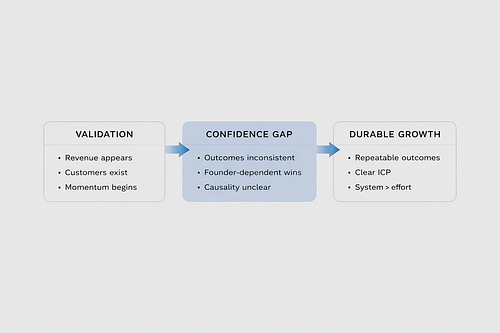
What most founders experience but rarely articulate is not a leap from validation to scale. It is a transitional phase where evidence exists, but confidence does not. Visually, it looks like this:
The first stage is visible and energizing. Revenue appears. Customers exist. Momentum builds. The last stage is durable. Outcomes repeat. Systems replace effort. Growth compounds without heroics. The middle stage is where uncertainty hides inside progress. This is where many startups mistake movement for mastery. How Founders Accidentally Make the Gap WorseThe confidence gap does not close on its own. In fact, most founder behavior during this phase quietly widens it. When outcomes are inconsistent, the instinct is to push harder. More leads. More features. More markets. More hiring. The belief is that volume will smooth out variability. Sometimes it does. Often, it simply hides it. Founders step in to save deals that should fail. They customize onboarding for customers who do not fit. They tolerate edge cases because revenue feels precious. Over time, the company learns the wrong lesson. It learns that success requires intervention. The founder becomes the glue holding together a business that has not yet learned to hold itself. This creates a dangerous illusion. From the inside, effort feels like progress. From the outside, growth appears real. But the organization is not learning what makes the business work. It is learning how to compensate when it doesn’t. The longer this continues, the harder it becomes to tell the difference. By the time the founder tries to step back, the signal is already polluted. What Actually Closes the Confidence GapThe confidence gap closes the moment a company can answer a very specific question with clarity. Why does this work? Not in slogans. But in observable patterns. Which customers succeed and why? This is not a growth exercise. It is a reduction exercise. It requires saying no to customers who distort learning. It requires resisting opportunities that generate revenue but confuse causality. It requires slowing down at the exact moment speed feels justified. The companies that survive this phase do something counterintuitive. They trade short-term momentum for long-term confidence. They choose understanding over optics. Once that understanding exists, growth becomes less dramatic. Less emotional. Less heroic. It also becomes far more dangerous to competitors. Because from that point on, success is no longer dependent on effort. It is embedded in the business itself. What Happens When Companies Skip This PhaseMost startups do not consciously decide to skip the confidence gap. They simply grow past it. They raise capital on early momentum. At first, this looks like success. Revenue increases. Headcount grows. The organization becomes busier. There is always movement, always urgency, always another lever to pull. But underneath the activity, the same inconsistencies remain. Customer outcomes still vary wildly. Sales cycles still depend on who is involved. Expansion works in some cases and fails inexplicably in others. At scale, these inconsistencies become structural. Processes are built around exceptions. Teams optimize for edge cases. Complexity accumulates faster than insight. What was once a small gap between working and repeatable becomes embedded into the company’s operating model. By the time leadership recognizes the problem, it is no longer a phase issue. It is an organizational one. This is why so many companies appear to stall suddenly after periods of rapid growth. The stall is not sudden. It is delayed recognition. Why This Phase Is Often Misread by InvestorsFrom the outside, early growth looks reassuring. There is revenue to analyze. Cohorts to inspect. Pipelines to review. The surface-level signals all suggest progress. What is harder to see is causality. Investors, like founders, are trained to look for momentum. When numbers move in the right direction, they assume understanding will catch up. Often, it does. Sometimes, it never does. The confidence gap is difficult to spot because it hides behind averages. Strong customers mask weak ones. Founder-driven wins distort sales data. Early adopters behave differently from the market that follows. The business looks healthier in aggregate than it actually is in practice. This is why some of the most painful corrections happen after funding events, not before. Capital accelerates a model that has not yet learned how to repeat itself. The result is not a collapse. It is drift. A slow divergence between what the company believes about its business and how the business actually behaves. The Quiet Difference Between Fragile and Durable GrowthFragile growth feels intense. It demands attention. Durable growth feels almost boring by comparison. The same customers succeed for the same reasons. The same actions lead to the same outcomes. New hires perform well without tribal knowledge. Revenue grows without improvisation. The difference is not ambition. Companies that cross the confidence gap stop chasing proof and start building evidence. They stop celebrating isolated wins and start studying patterns. They replace urgency with clarity. This is why the most dangerous phase of a startup is not when nothing works. It is when enough works to convince you that you no longer need to ask why. That moment feels like an arrival. One path leads to businesses that compound quietly over time. Most never realize which path they are on until it is too late. What Changed for the Companies That SurvivedWhat separates the companies that cross the confidence gap from the ones that don’t is speed or conviction. It is a restraint.
Growth did not disappear when the company slowed down to study this. It clarified.
In both cases, success followed subtraction. The business became simpler, not bigger. This is how the confidence gap closes. Not through momentum, but through understanding. Why This Phase Is So Rarely Written AboutThere is a reason this phase is missing from most startup narratives. It is uncomfortable to admit uncertainty after success. Founders are expected to project confidence once revenue arrives. Investors reward clarity, not hesitation. Teams look for direction, not doubt. Public storytelling compresses time and removes ambiguity. So this phase gets edited out. The jump from early traction to inevitable growth becomes seamless in hindsight. The questions that once kept founders awake at night are replaced by neat explanations and polished lessons. But the lived experience is different. Most founders who have built enduring businesses remember this phase vividly. The unease. The inconsistency. The sense that the company was moving forward without fully knowing why. They just rarely talk about it publicly. That silence leaves new founders unprepared. They assume confusion means failure, when in reality it often means they are standing at the most important threshold of the company’s life. The Real Risk Is Misreading ProgressThe most dangerous mistake a founder can make is not believing in their idea enough. It is believing in early progress too much. When something works once, the temptation is to protect it, scale it, and defend it. When it works twice, the temptation is to trust it. When it works a few times in a row, the temptation is to stop questioning it altogether. That is when learning slows. The confidence gap does not announce itself. It hides inside good news. It disguises itself as traction. It convinces smart people to move faster than their understanding allows. The companies that survive are not the ones that avoid this phase. Everyone passes through it. They are the ones who recognize it for what it is. A moment not to prove, but to explain. But “Do we know why it works?” Answer that honestly, and growth stops feeling fragile.
That is why the most dangerous phase of a startup is not the idea stage. It is the moment success arrives before certainty does. - Have early traction but an unclear revenue signal? One-Week Market Signal Test ($30) Validate demand. Decide with proof.
|
Monday, February 23, 2026
The Most Dangerous Phase of a Startup Isn’t Idea Stage





Subscribe to:
Post Comments (Atom)
Startup Validation Is a Bet
Find the commercial wager with the shortest path to someone paying - whether you’re with just an idea, or an MVP, or even a functional pr...

-
Techie.Buzz posted: " [ANN] Serverless Kubernetes Solution For Cloud-Native Apps by CTO.ai CTO.ai is a provider of deve...
-
Jonathan Gibson posted: "Cryptocurrency gambling is growing at a rapid pace, and more and more people are thinking about us...
-
Crypto Breaking News posted: "Mikhail Fedorov, Ukraine's Deputy Prime Minister and the head of the country's Minist...


No comments:
Post a Comment