The 0 → 1 Phase Nobody Talks About: Before Ideas Have WordsWhy Some Ideas Exist Long Before Anyone Knows What to Call Them
In Perth, Australia, around 2012, the problem was not that people could not design. The problem was that they could not describe what they were actually trying to do. Teachers were putting together worksheets. They were not aspiring designers. But the only language available to them was professional design language. So the struggle sounded like this: “I am bad at design.” When Canva began taking shape, the idea did not land cleanly because there was no category waiting for it. It was not professional design software. The early struggle was not adoption. People already needed to communicate visually every day. Canva’s breakthrough was not simply usability. Visual communication, not design. Once that language stabilized, the product suddenly felt obvious. Before it did, it felt confusing. At roughly the same time, on the other side of the world, a different confusion was unfolding. In the United States, millions of people wanted to learn a new language. Not academically. They wanted progress in small moments. But the only language available described education as programs, rigor, mastery, and completion. So when Duolingo appeared, people struggled to judge it. Was it serious? Those questions missed the point. Duolingo was not trying to replace classrooms. But habit-based learning was not yet a familiar concept. People were already learning in fragments. Again, the experience existed before the words to describe it. What These Two Struggles Have in CommonCanva and Duolingo were not misunderstood because their ideas were extreme. They were misunderstood because their language lagged behind their behavior. In both cases, people were already doing the thing in some form. They were already communicating visually. What did not exist yet were the words, categories, and mental models that made those behaviors legible. So early reactions sounded like confusion. Who is this really for? Those were not objections. They were symptoms. They signaled that these products had entered what can be called the Pre-Language Phase of Innovation. The Pre-Language Phase of Innovation DefinedThe Pre-Language Phase of Innovation is the period when an idea exists as a lived experience or internal model before shared vocabulary forms around it. In this phase: • The creator recognizes a pattern that feels real but is hard to articulate This is not a motivational phase. Language is the mechanism that turns private understanding into shared cognition. Until that mechanism exists, ideas remain difficult to explain, evaluate, or spread. As linguist Benjamin Lee Whorf observed:
This is the core constraint early innovators run into. They are not lacking belief or support. Why This Phase Is Invisible to InstitutionsOne reason the Pre-Language Phase is so poorly understood is that most institutions are structurally incapable of seeing it. Institutions rely on categories to function. Education systems require syllabi. But the Pre-Language Phase exists before categories stabilize. That creates a mismatch. Institutions are designed to evaluate within language, not before it. When something cannot be named cleanly, it is treated as incomplete, unserious, or risky by default. This is why early-stage ideas are often rejected using phrases like: “I don’t know who this is for.” Those are not criticisms of execution. They are admissions of linguistic absence. Canva could not be evaluated as a design tool because it was not one. In both cases, institutions applied the wrong vocabulary, then mistook the mismatch for a flaw. The Pre-Language Phase is invisible to systems that depend on existing language to operate. That invisibility is not accidental. It is structural. Why Language Matters More Than We AdmitLanguage does not merely describe reality. It organizes it. Without language: • Patterns cannot be recognized consistently This is why early innovators often feel clearer alone than in discussion. In isolation, the idea remains intact. Philosopher Ludwig Wittgenstein captured this limitation precisely:
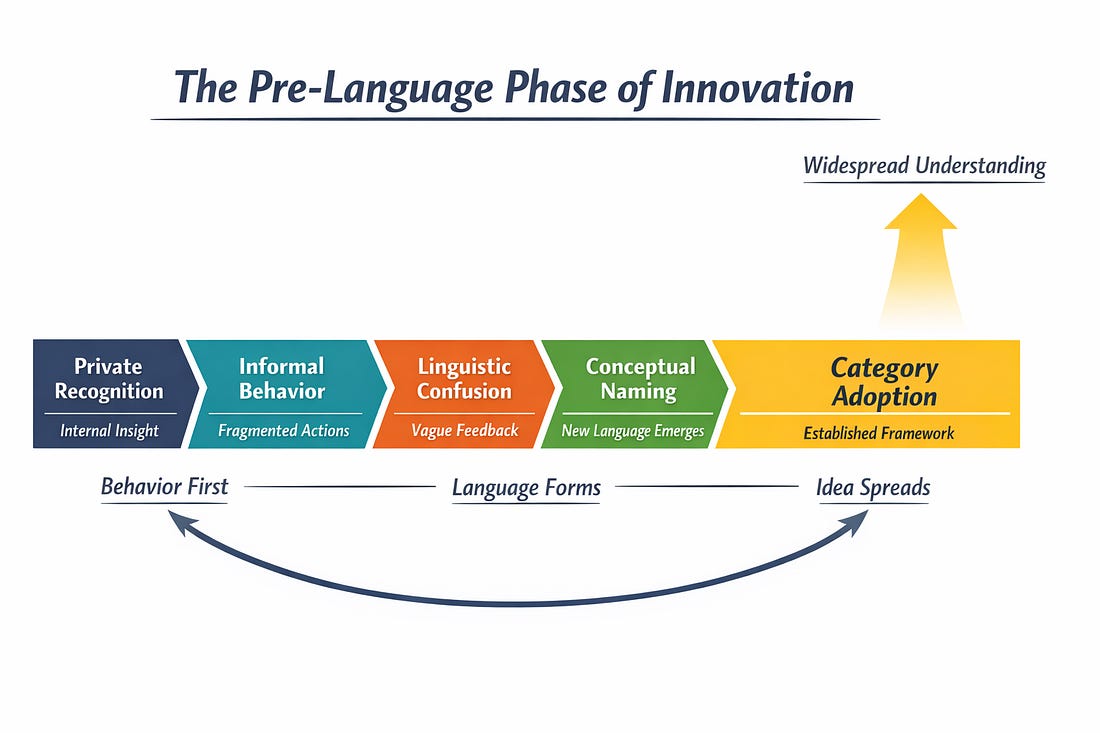
When language is missing, the world others can perceive is smaller than the one the innovator is operating in. Why Explaining Too Early Can Damage an IdeaIn the Pre-Language Phase, explanation carries risk. When you explain something that lacks language, you are forced to borrow vocabulary from nearby domains. That borrowing reshapes the idea. Visual communication becomes design. Once flattened, feedback optimizes for the wrong thing. People suggest improvements that make the idea easier to compare, not more accurate. This is why early conversations often feel draining rather than illuminating. You are not defending a finished concept. The Cost of Premature NamingThere is a temptation to solve linguistic absence by naming too early. This usually makes things worse. Premature naming locks an idea into borrowed categories that feel convenient but inaccurate. Calling Canva “simple design software” anchored it to professional design standards it was never trying to meet. Once an idea is named incorrectly, every conversation that follows is constrained by that name. Feedback becomes misaligned. This is why many original ideas stall after early traction. They get explained before they get understood. Correct language does not emerge from clever messaging. It emerges from repeated behavior that forces the world to adjust its vocabulary. Naming is not a creative act. When naming happens too early, it freezes the idea before its true shape has formed. Why Feedback Fails at This StageFeedback depends on shared categories. Without shared language: • Praise becomes generic People are not wrong. This explains why early feedback often contradicts later success. The feedback was not about the idea itself. How Canva and Duolingo Escaped the Pre-Language PhaseNeither company escaped this phase through persuasion. They escaped it through repeated behavior. Canva let people experience visual communication without becoming designers. Duolingo let people experience learning as a daily habit rather than a course. Over time, those experiences produced patterns that language could finally attach to. Words followed behavior. Once the language stabilized, adoption accelerated. Not because the products suddenly improved, but because people could finally explain to themselves and others what they were doing. The Five Stages of the Pre-Language Phase
Most ideas fail between stages three and four. Not because they are wrong, but because the absence of language feels like rejection.
This diagram captures the core mechanism. Behavior precedes language. Trying to reverse that order creates confusion. Why Most People Abandon Ideas in Stage ThreeStage three, linguistic confusion, is where most ideas die. Not because progress stops, but because feedback becomes psychologically uncomfortable. This is the stage where: • people respond vaguely What is actually happening is simple. The creator is experiencing the idea at a deeper resolution than the audience can parse. The audience responds using approximations. Over time, this gap erodes momentum. Most people resolve the discomfort by retreating into familiar categories. They reshape the idea to fit existing language so it can be understood more easily. That relief is temporary. The few ideas that survive stage three do so because the creator resists the urge to resolve confusion socially before it resolves structurally. They allow the idea to remain partially unintelligible until behavior forces clarity. Why This Phase Feels LonelyThe loneliness of early innovation is not emotional. It is informational. You are holding a model that has not yet earned language. Without language: • Others cannot reflect the idea back accurately Humans rely on shared language to confirm reality. When language is missing, understanding stays private. That isolation is structural, not psychological. Why History Makes This Obvious Only LaterOnce language forms, history compresses the struggle. Visual communication seems obvious. We forget that these concepts once felt vague and unserious. But at the time, the absence of language was the problem. Practical Implications for Builders and ThinkersUnderstanding the Pre-Language Phase changes how you operate early on. First, confusion becomes a diagnostic signal, not a verdict. Second, the goal shifts from persuasion to continuation. Third, behavior becomes more important than explanation. Fourth, feedback is filtered based on whether shared language exists. Language is not a marketing layer applied at the end. It is cognitive infrastructure. A Diagnostic Question for the Pre-Language PhaseThere is a simple way to tell whether you are truly in the Pre-Language Phase or simply avoiding clarity. Ask one question: “Is behavior happening without shared language, or is nothing happening at all?” If behavior exists, even in fragmented form, language can follow. Confusion is expected. If behavior does not exist, silence is not linguistic. It is informational. This distinction matters. The Pre-Language Phase is not an excuse for vagueness. It is a description of a specific condition where reality precedes vocabulary. Canva had users struggling to communicate visually. Behavior came first. Language followed. That is the difference between being early and being wrong. The Real Meaning of Zero to OneZero to one is not just about creating something new. It is about carrying an idea through the period when it exists without shared language. That period feels quiet. Not because the idea is weak. Language will follow if the behavior is real. It always does. - Before you build anything, make sure someone wants it enough to pay. I put together a free 7-day email course on revenue-first customer discovery — how to pull real buying intent from real conversations (without guessing, overbuilding, or hoping). If you’re a builder who wants clarity before code:
|
Wednesday, January 7, 2026
The 0 → 1 Phase Nobody Talks About: Before Ideas Have Words






Subscribe to:
Post Comments (Atom)
Startup Validation Is a Bet
Find the commercial wager with the shortest path to someone paying - whether you’re with just an idea, or an MVP, or even a functional pr...

-
Jonathan Gibson posted: "Cryptocurrency gambling is growing at a rapid pace, and more and more people are thinking about us...
-
Techie.Buzz posted: " [ANN] Serverless Kubernetes Solution For Cloud-Native Apps by CTO.ai CTO.ai is a provider of deve...
-
Crypto Breaking News posted: "Mikhail Fedorov, Ukraine's Deputy Prime Minister and the head of the country's Minist...


No comments:
Post a Comment