Pilots Are the Atomic Unit of a Real BusinessWhy founders at every early stage must sell the smallest version of their core value before they scale, fundraise, or optimize
There is a structural flaw in early-stage entrepreneurship that almost no one names directly. Founders delay the truth. They delay it at the idea stage by refining the concept instead of testing willingness to pay. The pattern looks different at every stage. The avoidance is the same. The only reliable way to remove that avoidance is through pilots. A pilot is the smallest sellable version of your core value offer. It does not require automation. It does not require product completeness. It does not require operational perfection. It only requires one condition. The customer pays because they believe the outcome is worth the price. That exchange is the atomic unit of a real business. Everything else is scaffolding. This article is for founders who are building something serious but are stuck in some version of pre-clarity. First time pre-seed founders building MVPs. Founders with traction but no clean scale. Founders who keep hearing the question, when do these convert. Idea stage entrepreneurs who have conviction but no revenue. Freelancers attempting to become businesses. Founders who rely heavily on grants. Early growth founders searching for repeatability. The pilot is not a tactic for these founders. It is a structural correction. The Illusion of Progress at the Idea StageAt the idea stage, progress feels intellectual. You refine the problem statement. You expand the vision. You map the competitive landscape. You adjust positioning. You talk to advisors. You simulate demand through conversations that never require commitment. You tell yourself you are being thoughtful. The underlying assumption is that clarity must precede selling. In reality, clarity is produced by selling. When you refuse to design a pilot early, you remain in abstraction. You can describe the future state of the world that your product enables, but you cannot describe the concrete transformation someone will pay for this month. The absence of that description is not a marketing issue. It is a structural weakness. A pilot forces compression. Instead of solving the entire market problem, you solve one slice of it for one defined customer. You price that slice. You sell that slice. You deliver that slice. That compression reveals whether your idea is commercially alive or merely conceptually elegant.
Without that compression, idea-stage founders drift for years. One of the clearest warnings about building in isolation comes from Silicon Valley entrepreneur and Stanford professor Steve Blank.
The MVP as a Comfortable ShieldPre-seed founders building MVPs often believe they are being disciplined. They are building lean. They are minimizing waste. They are preparing for scale. But many MVPs function as shields. Building feels productive. It is measurable. It produces artifacts. It creates a sense of forward motion. Selling produces exposure. When you sell before the product feels complete, you risk rejection. You risk discovering that your framing is wrong. You risk discovering that the problem is not urgent. The MVP becomes a buffer against that risk. The founder says, we are not ready to charge yet. We need to improve onboarding. We need to finish this feature. We need to refine the UX. All of those improvements might be useful. None of them answers the core question. Will someone pay for the transformation? A pilot answers that question before you invest months in refinement. It allows you to deliver manually. It allows you to compensate for product gaps with service. It allows you to learn from paid commitment instead of speculative usage.
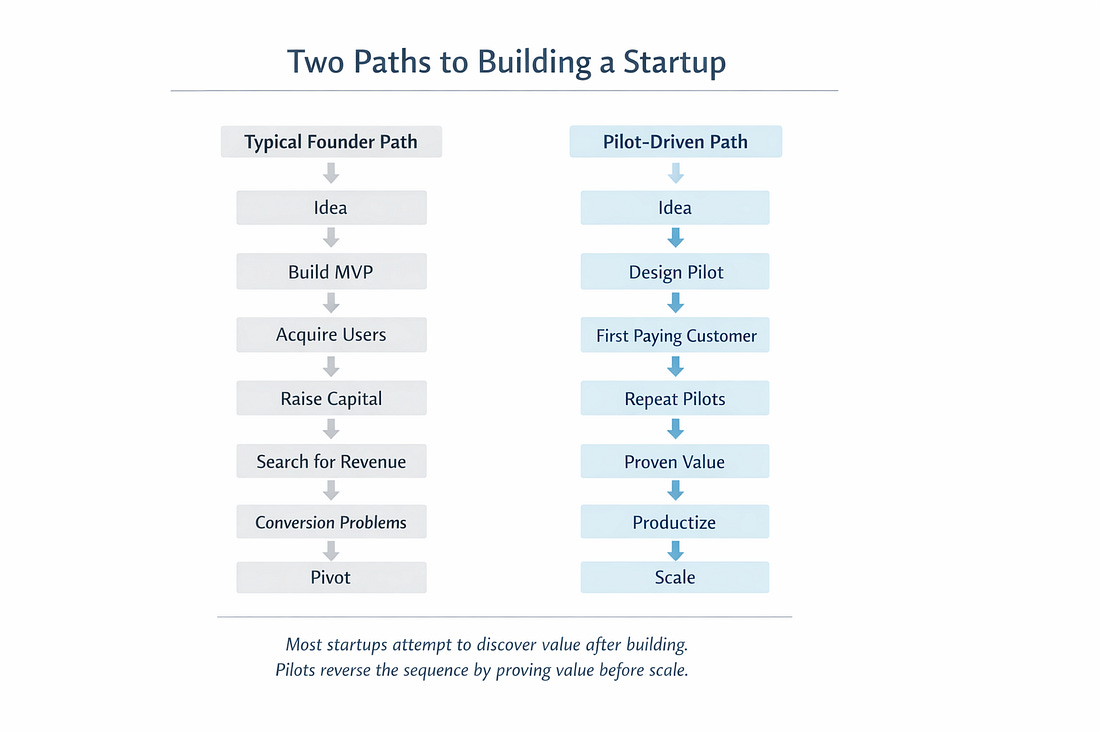
An MVP built after multiple paid pilots is categorically different from an MVP built in isolation. This is precisely why Silicon Valley entrepreneur Steve Blank has long warned founders about relying too heavily on planning before validation.
Plans, roadmaps, and MVP feature lists often collapse once real customers enter the picture. Pilots accelerate that contact early, when the cost of learning is still low. One is codifying proven value. The other is hoping to discover it.
Traction Without Conversion Is Not MomentumFounders with traction but not clean scale often operate in a grey zone. They have users. They have the growth. They have activity. They have dashboards that show upward lines. Yet revenue lags behind engagement. The recurring question appears. When do these convert? Conversion anxiety is rarely solved by tweaking funnels alone. It is often a signal that the core value proposition is too diffuse.
A pilot forces you to distill. Instead of offering broad access, you offer a defined outcome. Instead of measuring usage, you measure delivery against a promise. Instead of optimizing engagement, you optimize transformation. This reorientation clarifies who your product is truly for. You may discover that only a subset of your user base is willing to pay for a sharper version of the outcome. That discovery is not a failure of traction. It is the beginning of real positioning. Without pilots, founders with traction risk scaling ambiguity. They pour marketing spend into growth without understanding which segment actually values the result enough to fund it. Pilots convert vague traction into priced value. The Grant Dependency TrapSome founders fund their early progress primarily through grants and institutional programs. There is nothing inherently wrong with non-dilutive capital. The risk emerges when grants become a substitute for customers. Grants reward narrative. Customers reward outcomes. When your primary funding source is a grant, your incentive is to refine your story. When your primary funding source is a pilot, your incentive is to refine your delivery. Those incentives produce different businesses. A founder who repeatedly runs paid pilots learns exactly what customers struggle with, what they resist paying for, and what they are willing to fund without persuasion. That knowledge compounds. A founder who repeatedly writes grant applications learns how to frame impact, but may never pressure test willingness to pay. If your model depends on future revenue but your present survival depends on grants, pilots become essential. They reconnect your company to market reality. They test whether your value proposition survives outside institutional validation. Freelancers at the Edge of EntrepreneurshipFreelancers transitioning into entrepreneurship face a specific tension. They already know how to deliver value. They already get paid. The problem is not competence. The problem is leverage and structure. Many freelancers attempt to scale by broadening services or hiring prematurely. Others attempt to build products without distilling their core transformation. A pilot offers a different path. Instead of selling hours, you sell outcomes. Instead of offering general expertise, you define a narrow, repeatable engagement tied to a specific result. Instead of customizing endlessly, you structure a micro version of your long-term vision. This is not rebranding. It is an architectural change.
A structured pilot reveals whether your expertise can be transformed into a scalable promise. If multiple clients are willing to pay for the same defined outcome, you are no longer selling labor. You are validating a productized core. That shift is the bridge from freelancer to founder. Early Growth and the Search for RepeatabilityEarly growth founders often speak about repeatability as if it is a marketing lever. In reality, repeatability is a property of delivery. You do not achieve repeatability by scaling the distribution first. You achieve repeatability by running the same transformation multiple times and observing what remains constant.
Pilots are laboratories for repeatability. When you deliver the same promise to ten paying customers, patterns emerge. You see which customer profiles succeed fastest. You see which parts of your process are indispensable. You see which elements can be systematized and which require judgment. Only after those patterns stabilize does scaling make structural sense. Without pilots, founders attempt to scale variance. They push volume into a system that has not yet proven it can produce consistent outcomes. The result is operational strain and customer churn. Pilots discipline growth. They ensure that expansion follows evidence, not ambition. The Psychological Cost of AvoidanceAcross all these stages, the same internal dynamic persists. Founders postpone the moment of direct exchange. They tell themselves they need more proof before they ask for money. They tell themselves they need more polish before they sell. They tell themselves they need scale before they optimize pricing. In truth, they are protecting themselves from a binary answer. Will someone pay? A pilot makes that question unavoidable. The first time you price your micro offer and present it to a real customer, the conversation sharpens. Objections surface immediately. Value must be articulated precisely. Assumptions are challenged. This discomfort is not a signal to retreat. It is the mechanism by which real businesses are formed. Without that friction, founders remain in theoretical entrepreneurship. Pilots as Strategic CompressionThe deeper insight is that pilots compress complexity. Instead of designing an entire ecosystem of features, you define a single transformation. Instead of targeting a broad market, you choose a narrow segment. Instead of forecasting long term revenue, you close one paying customer. This compression creates focus. Focus produces insight. Insight produces leverage. When you expand from a compressed core, growth is coherent. When you expand from abstraction, growth is chaotic. Pilots, therefore, are not temporary experiments. They are structural filters. They remove non-essential complexity until the essence of your value is visible. Once that essence is clear, product decisions become easier. Pricing becomes rational. Marketing becomes grounded in real outcomes rather than aspirational messaging. The Compounding LogicIf you begin at the idea stage and run a paid pilot, you test willingness to pay before building infrastructure. If you are building an MVP and run a pilot, you validate value before refining features. If you have traction and run pilots, you identify which segment truly funds your business. If you are reliant on grants and run pilots, you reconnect to market discipline. If you are a freelancer and run structured pilots, you move from labor to leverage. If you are an early growth and run repeated pilots, you discover repeatability before scaling. At every stage, the pilot is not an optional tactic. It is the corrective lens. It aligns narrative with reality. It aligns ambition with evidence. It aligns the product with payment. The Only Metric That Precedes ScaleFounders often obsess over metrics that look impressive but do not sustain a company. Users can churn. Engagement can fluctuate. Social proof can mislead. Funding can run out. The most durable early metric is simple. A defined customer pays for a defined transformation and receives it successfully. Repeat that loop enough times, and you have the foundation of a company. Avoid that loop, and you have activity without stability. Pilots institutionalize that loop early. They turn philosophy into a transaction. They turn vision into exchange. They turn aspiration into evidence. For founders at any early stage, the question is not whether you are ready to scale. The question is whether you have distilled your business into its smallest sellable unit and proven that it works. If you have not, the next step is not more features, more fundraising, or more exposure. It is a pilot. Design the smallest version of your core value that someone will pay for. Sell it. Deliver it. Observe what holds constant. Then build on that. Everything durable in business begins there. ━━━━━━━━━━━━━━━━━━━━ If you’re building a product, start-up, or idea, you’ll probably enjoy The Builder’s Lens.
Read the newsletter: The Builder’s Lens
|
Monday, March 16, 2026
Pilots Are the Atomic Unit of a Real Business







Subscribe to:
Post Comments (Atom)
Startup Validation Is a Bet
Find the commercial wager with the shortest path to someone paying - whether you’re with just an idea, or an MVP, or even a functional pr...

-
Jonathan Gibson posted: "Cryptocurrency gambling is growing at a rapid pace, and more and more people are thinking about us...
-
Techie.Buzz posted: " [ANN] Serverless Kubernetes Solution For Cloud-Native Apps by CTO.ai CTO.ai is a provider of deve...
-
Crypto Breaking News posted: "Mikhail Fedorov, Ukraine's Deputy Prime Minister and the head of the country's Minist...


No comments:
Post a Comment