
Startup Validation: 1:1 or Leverage?The first distribution decision founders face when trying to prove paid demand.
Most startup advice treats distribution as a problem of scale. Find a channel. Build an acquisition engine. Make it repeatable. Lower CAC. Scale. All of that matters. But there is a problem. You may be solving the wrong distribution problem too early. When a startup is still validating an idea, MVP, prototype or early solution, the question usually isn’t:
It is:
And that creates a very different distribution decision. Should you go one customer at a time? Or should you find someone who already has access to many of the customers you need? In other words: 1:1 or leverage? This is one of the first distribution decisions a founder makes, even if they don’t think of it that way. And the answer isn’t always “go direct.” Validation is a different distribution problemIn the early stage, distribution has a different job. You are trying to move through a chain: Access → Learning → Commitment → Payment You need enough access to relevant users to understand whether the problem is real. You need enough interaction to understand whether your solution addresses it. You need enough commitment to distinguish polite interest from genuine demand. And ultimately, if you are doing paid validation, you need someone to put money behind that demand. That means the best distribution route during validation isn’t necessarily the one that can eventually scale. It is the one that can give you the fastest credible signal. This is why direct customer conversations are so powerful. But it is also why leveraged distribution can sometimes be even more powerful. The difference comes down to two things: Access. And control. The 1:1 advantageGoing directly to the end user gives you something extremely valuable: proximity. You hear the customer’s language. You see the problem. You understand objections. You can change the pitch. You can change the product. You can ask why they won’t buy. You can ask what they would pay for. And you can try again immediately. There is very little between you and the signal. That makes 1:1 particularly powerful when you are still trying to understand what is actually happening. A useful way to think about it is: 1 founder → 1 customer → 1 conversation → 1 learning loop It isn’t efficient. But efficiency isn’t necessarily the objective yet. Learning is.
The lesson isn’t that every startup should copy Recruiterbox’s exact path. It is that early direct customer contact can provide a quality of signal that is hard to get through layers of distribution. But what if you don’t have direct access?This is where the decision becomes more interesting. Imagine that your target customers are difficult to reach individually. Maybe they are concentrated inside organizations. Maybe another company already serves them. Maybe they belong to a professional community. Maybe a trusted person already has their attention. Maybe the market is fragmented, but a small number of entities sit between you and thousands of potential users. Your options now look different. You could spend weeks trying to find users one by one. Or you could ask:
That entity becomes a potential leverage point. Instead of: You → User you have: You → Entity → Users That entity might be a partner. An aggregator. A community. A platform. A distributor. A design partner. An organization. An expert. Or simply someone with a trusted audience. The point isn’t what you call it. The point is that one relationship can potentially create access to many users. The hidden trade-off: reach versus learningThis is where leveraged distribution gets complicated. Suppose you can talk directly to 20 potential customers. You also have access to a partner who can introduce you to 200. It is tempting to conclude: 200 is better than 20. But that’s not necessarily true. You may have much better learning from the 20 direct conversations. With the partner, you may only get filtered feedback. You may hear:
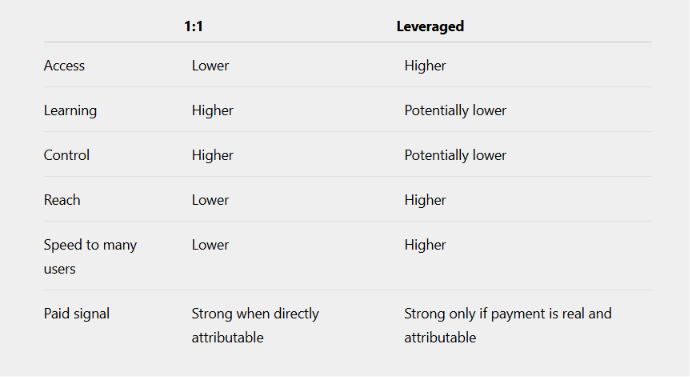
But you don’t know how interested they really are. You may see registrations but not usage. You may see usage but not payment. You may see payment but not know whether the customer would have bought without the intermediary’s endorsement. So leveraged distribution creates a trade-off:
The point isn’t that one column always wins. The point is that the right choice depends on what is limiting your validation. Partnership marketing is one version of thisThis is where partnership marketing becomes particularly interesting. A partnership can allow a startup to borrow something it doesn’t yet have: an audience. Instead of spending months building your own audience, you find someone who already has a relevant one. You create value for that audience. They give you access. The basic motion becomes: Partner → Audience → Prospects → Offer → Payment
What’s interesting isn’t simply that a partnership generated leads. It is the combination: Borrowed audience → direct conversations → product learning → payment The partnership created leverage. The direct conversations created learning. The payment created the validation signal. That’s a much more interesting model than simply saying, “Partnership marketing works.” An aggregator can create a different kind of leverageA partnership gives you access to an audience. An aggregator can give you access to a concentrated population of end users. This distinction matters. Consider a startup trying to get consumers to adopt a new food-ordering app. Instead of acquiring every customer independently through digital advertising, the startup can go to the places where those customers already are. Streatu, a food-ordering app in Bangalore, provides a concrete example. When the app was ready for its pilot, the team needed customers to trust an unknown app, download it, and place their first orders. They approached high-traffic food vendors and gave 10 receptive vendors branded stands. Customers who downloaded the app through the vendors received a discount, while individual codes allowed the startup to track which vendor generated the download. Three vendors generated more than 150 downloads, and the campaign eventually produced more than 300 downloads and 300+ orders in the first couple of weeks. The company reported a CAC below ₹100. The important insight isn’t “put signs in restaurants.” It is:
The vendors already had the customers. The startup didn’t. That made the vendor an important distribution point. But there is another important lesson here. The vendors weren’t simply generating awareness. They helped create a path from: Access → Download → Order That is much closer to commercial validation. But an aggregator can also create false validationThis is where founders need to be careful. Suppose an aggregator tells you:
That isn’t necessarily validation. It may simply be the aggregator’s interpretation of the market. The stronger signal is when the underlying users themselves demonstrate commitment. For example: Aggregator says users are interested is weak. Users engage directly is stronger. Users use the solution is stronger again. Users pay is stronger still. This is why I think the role of an aggregator during validation should be understood as:
You are borrowing its access to accelerate learning and paid validation. You are not necessarily committing to making that aggregator your long-term GTM channel. That distinction matters enormously. Sometimes the best leverage point is the customer itselfThere is another form of leveraged validation that sits somewhere between direct and indirect access: the design partner. A design partner isn’t simply a channel to reach users. The design partner becomes a concentrated source of: problem context + usage + feedback + commercial commitment Strella offers an unusually clean example. After validating its underlying behavioral hypothesis, Strella recruited 12 design partners through cold LinkedIn outreach. The partners used early versions of the product and met with the team every two weeks to provide structured feedback. The program had a clear commercial endpoint: convert to paid or don’t. All 12 converted to paid customers at launch. That is powerful because the startup wasn’t merely asking:
It created a mechanism that tested:
That is a much stronger validation loop. And it illustrates something important: Leverage doesn’t always mean reaching the maximum number of users. Sometimes the leverage comes from finding the right entity with enough depth of problem and commitment to accelerate learning. So what should a founder actually choose?I think there are four questions worth asking. 1. Can I reach the end user directly?If yes, direct 1:1 should usually be considered first. Not because it scales. Because it gives you the cleanest learning loop. You can see the problem. You can hear the objections. You can test pricing. You can ask for payment. You control the interaction. If reaching 20 users directly is easy, there may be little reason to introduce an intermediary simply because that intermediary can theoretically reach 200. 2. If I can’t reach them directly, who already can?This is where you start looking for leverage. Who already has: access? trust? attention? concentration? context? That could lead you toward partnerships, aggregators, communities, platforms, design partners or other intermediaries. The question is not:
It is:
3. Can I still learn from the end user?This is the critical test for leveraged distribution. If the intermediary completely controls the relationship, you may get reach without learning. You may get numbers without understanding. You may get feedback without knowing whether it represents the customer. So ask:
The more direct learning you retain, the more valuable the leveraged route becomes. 4. Can the route produce a payment signal?This is the final filter. Because this article is about paid validation. A large audience is not validation. A partnership announcement is not validation. Downloads are not necessarily validation. Registrations are not validation. Positive interviews are not validation. The strongest early signal is:
That doesn’t mean one payment proves product-market fit. It doesn’t. But it is a materially different signal from “people liked the idea.” The decision isn’t really 1:1 versus leveragedThis is where I think the framing becomes more useful. Don’t ask:
Ask:
The right answer depends on what constraint you currently have. If your constraint is learning, direct access may win. If your constraint is access, leverage may win. If your constraint is trust, a partner may win. If your constraint is concentrated usage, an aggregator or community may win. If your constraint is deep problem understanding plus commitment, a design partner may win. The distribution decision is therefore less about picking a channel and more about choosing the right point of leverage for the validation problem you have. What changes after validation?This is also why distribution should not be treated as a static startup function. The distribution question changes as the company progresses. During validationThe question is:
You can borrow distribution. You can use 1:1. You can use partnerships. You can use aggregators. You can use design partners. You are trying to learn and establish a commercial signal. During growthThe question becomes:
A successful partnership needs to become a repeatable partnership motion. A successful aggregator relationship needs to become a repeatable channel. A successful founder-led sales process needs to become a repeatable sales motion. This is where the distribution engine starts to matter. At maturityThe question changes again:
Now economics, conversion, retention, channel mix and operational efficiency become much more important. So the progression is: Validation → paid signal Growth → repetition Maturity → efficiency But don’t let the later stages distort the first one. The first distribution decisionThe earliest distribution decision is therefore not:
It is:
If you have easy direct access, use it. If you don’t, find the entity that already has access. If that entity can also transfer trust, even better. If it can concentrate users, better still. If you can still directly observe and learn from those users, better again. And if the route ultimately produces real payment, you have something much more valuable than reach. You have a validation signal. That is the real distinction. 1:1 gives you depth. Leverage gives you reach. The best validation strategy is often the one that finds the right balance between the two. And perhaps the most useful question for a founder isn’t:
It is:
That may be the first distribution decision worth making.
|






No comments:
Post a Comment