
Why Most Biotech GTM Strategies Fail: A Framework for 8 Biotech Business ModelsTechnology doesn't determine your go-to-market strategy. Your business model does.
Ask ten biotech founders about their go-to-market (GTM) strategy, and you’ll likely hear ten different answers. “We need to hire enterprise sales.” “We should focus on scientific marketing.” “We need partnerships with pharma.” “We need more clinical evidence before commercialization.” Each of these strategies can be effective. The problem is that they are often applied without first asking a much more important question. What type of biotech business are you actually building? One of the biggest misconceptions in biotechnology is that there is a single GTM playbook. There isn’t. A therapeutics company commercializes differently from a diagnostics company. A Contract Research Organization (CRO) follows a completely different path from a Life Sciences software company. An AI drug discovery platform succeeds through strategic partnerships, while a research tools company depends on technical sales and customer support. Yet founders, investors, and even advisors frequently compare companies that operate under entirely different commercial realities. The result is predictable. Sales cycles become longer than expected. Marketing struggles to gain traction. Commercial teams pursue the wrong customers. Investors question commercial readiness. Founders conclude that GTM “doesn’t work.” In reality, the issue is rarely execution. The issue is alignment. Before discussing marketing channels, pricing, partnerships, conferences, distributors, or sales teams, every biotech startup should answer four fundamental questions.
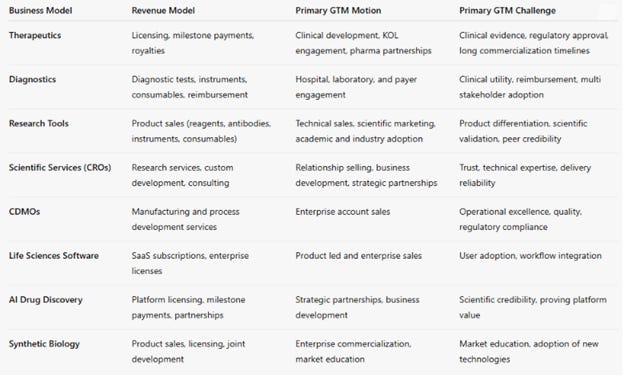
These four questions provide a practical framework for building a commercialization strategy that matches the business instead of copying another company’s approach. The Four Question FrameworkEvery biotech company is unique, but successful commercialization starts with understanding the relationship between your business model and your route to market. Technology tells you what you’ve built. Your business model explains how you create value. Your GTM motion defines how customers discover, evaluate, and adopt that value. Finally, your GTM challenges identify the barriers that must be overcome before commercial success is possible. When these four elements are aligned, commercialization becomes far more focused. Hiring decisions improve. Marketing becomes more relevant. Partnerships become more strategic. Resources are invested where they create the greatest impact. The framework below summarizes eight common biotech business models and how they differ.
Let’s explore each business model in more detail. 1. TherapeuticsRevenue ModelTherapeutics companies generate value through drug commercialization, licensing agreements, milestone payments, royalties, and strategic acquisitions. Go-to-Market MotionUnlike most businesses, therapeutics companies spend years creating evidence before commercial sales begin. Clinical trials, regulatory approvals, medical affairs, and pharmaceutical partnerships form the foundation of commercialization. Key GTM ChallengesThe biggest challenge is reducing risk. Regulators, physicians, investors, and pharmaceutical partners all require compelling clinical evidence before adoption. Commercial success depends less on marketing and more on proving safety, efficacy, and long-term value. Key TakeawayTherapeutics companies are not selling products first. They are selling confidence in the science.
2. DiagnosticsRevenue ModelDiagnostics companies earn revenue through diagnostic tests, instruments, consumables, laboratory services, and reimbursement programs. Go-to-Market MotionCommercialization requires convincing multiple stakeholders including physicians, laboratories, hospital administrators, procurement teams, and payers. Success depends on demonstrating measurable improvements in patient outcomes and healthcare efficiency. Key GTM ChallengesGenerating clinical utility data and securing reimbursement are often more difficult than developing the technology itself. Even an excellent diagnostic solution struggles without clear economic and clinical value. Key TakeawayEvidence is the product. Technology is only part of the commercial story.
3. Research ToolsRevenue ModelResearch tools companies generate revenue by selling reagents, antibodies, assay kits, sequencing technologies, laboratory instruments, automation systems, scientific software, and other consumables to academic institutions, biotechnology companies, pharmaceutical companies, and government research organizations. Go-to-Market MotionThis business model relies on technical sales supported by product specialists, scientific marketing, distributor networks, and responsive customer support. Academic institutions are often early adopters, making publications, conference presentations, collaborations, and peer recommendations powerful commercialization channels. Success is driven as much by scientific credibility and community adoption as by traditional sales and marketing. Key GTM ChallengesDifferentiation is the primary challenge. Many products address similar scientific problems, so companies must demonstrate reproducibility, product quality, technical support, and published validation. Within academia, adoption is often accelerated through word of mouth, citations in high impact journals, and recommendations from trusted research groups. Key TakeawayScientists buy performance, reliability, and trust. In academic markets, reputation spreads through publications, collaborations, and peer networks long before it reaches procurement teams.
4. Scientific Services (Including CROs)Revenue ModelScientific services companies generate revenue by providing outsourced research, custom antibody and assay development, biomarker validation, bioanalytical testing, method development, clinical research, consulting, and other specialized laboratory services. Revenue is typically project based or generated through long term research partnerships. Go-to-Market MotionCommercial success depends on relationships, expertise, and reputation rather than product marketing. Business development is driven by referrals, conference networking, repeat engagements, strategic partnerships, and demonstrated scientific excellence. Customers are buying access to specialized capabilities and trusted execution. Key GTM ChallengesClients outsource mission-critical work that directly impacts research timelines and outcomes. Companies must consistently demonstrate technical expertise, quality, regulatory compliance where applicable, and the ability to deliver reliable results. Trust takes years to build but can be lost through a single failed project. Key TakeawayFor scientific services companies, credibility is the product. Long term relationships, scientific expertise, and consistent delivery create the foundation for sustainable commercial growth.
5. Contract Development and Manufacturing Organizations (CDMOs)Revenue ModelCDMOs earn revenue through process development, manufacturing, scale up, quality assurance, and commercial production. Go-to-Market MotionEnterprise account selling dominates this model. Decisions involve technical teams, procurement, quality assurance, operations, and executive leadership. Sales cycles are typically long and highly consultative. Key GTM ChallengesCustomers evaluate manufacturing capability, regulatory compliance, capacity, quality systems, and operational reliability before signing contracts. Key TakeawayOperational excellence becomes the primary marketing message.
6. Life Sciences SoftwareRevenue ModelLife Sciences software companies typically generate recurring revenue through subscriptions, enterprise licenses, implementation services, and customer support. Go-to-Market MotionAlthough this resembles SaaS, the buyers are scientists, laboratories, and research organizations rather than traditional IT departments. Product demonstrations, customer success, and scientific workflows become central to adoption. Key GTM ChallengesBuilding sophisticated software is only half the challenge. Adoption depends on intuitive user experience, seamless integration into laboratory workflows, and measurable productivity improvements. Key TakeawaySoftware succeeds when scientists embrace it, not simply when IT approves it.
7. AI Drug Discovery PlatformsRevenue ModelThese companies commonly monetize through platform licensing, co-development agreements, milestone payments, and strategic partnerships with pharmaceutical companies. Go-to-Market MotionThe objective is not acquiring thousands of customers. Instead, success comes from securing a limited number of high-value strategic collaborations that validate the platform. Key GTM ChallengesScientific credibility remains the greatest obstacle. Pharmaceutical companies want evidence that AI produces better discovery outcomes rather than simply faster analysis. Key TakeawayPartnership quality matters far more than customer quantity.
8. Synthetic BiologyRevenue ModelSynthetic biology companies combine product sales, licensing, industrial partnerships, and joint development agreements. Go-to-Market MotionCommercialization often involves educating the market while simultaneously building enterprise relationships. Many customers are unfamiliar with the possibilities of synthetic biology, making education an essential part of GTM. Key GTM ChallengesThe greatest obstacle is changing established behaviors. Companies are frequently competing against existing processes rather than direct competitors. Key TakeawayCreating market awareness is often as important as creating innovative technology.
What Every Business Model Has in CommonAlthough these eight business models follow different commercialization paths, several principles consistently apply across the biotech industry. First, evidence matters more than marketing. Publications, validation studies, clinical trials, pilot projects, and customer references build the credibility that marketing alone cannot create. Second, every biotech company is reducing risk. Therapeutics reduce disease risk. Diagnostics reduce diagnostic uncertainty. Research tools improve experimental reliability. Software simplifies operations. Manufacturing reduces production risk. AI platforms accelerate scientific discovery with greater confidence. Understanding the risk you remove often creates a stronger value proposition than describing the underlying technology. Third, commercialization is always a multi-stakeholder process. Scientists, clinicians, procurement teams, executives, regulators, and investors all influence commercial decisions. Successful GTM strategies recognize that each audience evaluates value differently. Fourth, commercialization starts long before the first sale. Conference presentations, regulatory planning, scientific publications, pilot studies, and strategic partnerships all contribute to commercial readiness. Waiting until product launch to think about GTM is often too late. Finally, business models drive commercialization strategy. Two companies may develop similar technologies but require completely different routes to market because they create and capture value differently. Final ThoughtsThere is no universal GTM playbook for biotechnology. There are common principles, but commercialization ultimately depends on the business model behind the science. Technology explains what you’ve built. Your business model explains how you create value. Your GTM motion explains how customers adopt that value. Your commercialization challenges determine where your strategy should focus. Founders who understand these distinctions make better decisions about hiring, partnerships, pricing, messaging, customer acquisition, and commercial investment. The next time someone asks, “What’s the best GTM strategy for a biotech startup?”, resist the temptation to offer generic advice. Instead, ask a simpler question. What type of biotech business are you building? The answer to that question will shape every commercialization decision that follows.
|





No comments:
Post a Comment