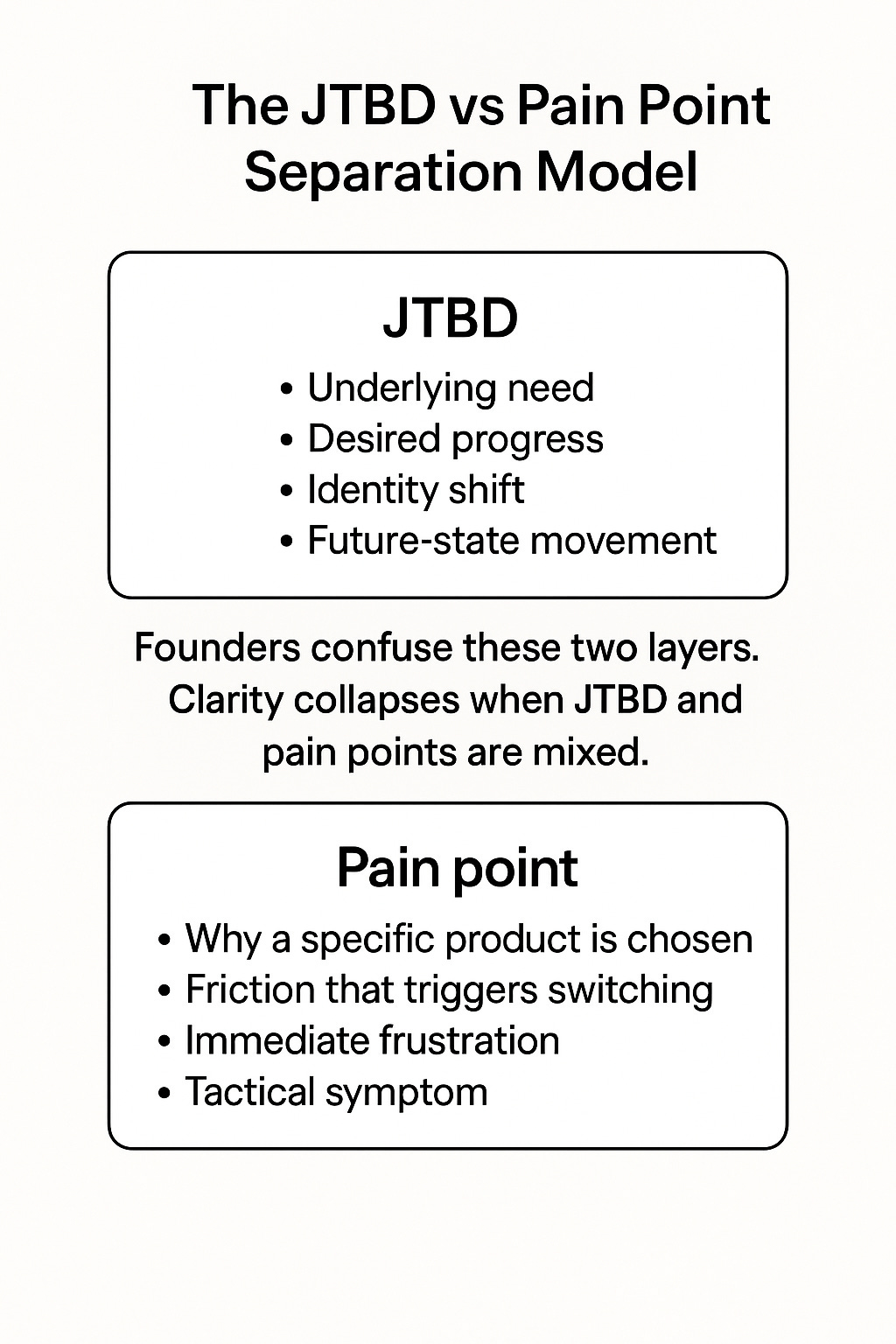
The entire startup world is obsessed with pain points. The idea sounds logical and completely misses the truth. Pain does not create markets. Identity does. And the only way to understand identity is through the Job to be done or accomplished (JTBD). A pain point is rarely the real reason someone adopts a new product. It is more often the reason someone switches from one product to another at the moment of choice. It explains selection. It does not explain motivation. It is tactical, not strategic. The deeper driver is the Job to be done or accomplished (JTBD), which represents the progress a person is trying to make toward a preferred version of themselves or their situation. JTBD is forward motion, not friction removal. It is aspiration, not irritation. It is identity, not inconvenience. When founders confuse JTBD with pain points, they optimize for the wrong layer of human behavior. They build products that remove surface-level friction but fail to deliver meaningful progress. They fix tactical issues while overlooking identity-based motivation. They interpret symptoms as needs. They address irritations while ignoring transformation. They seek clarity but build from noise. This confusion sits at the root of many failed startups. It is one of the most persistent cognitive traps in early-stage building. This essay explores why JTBD is identity-centric, why pain is selection-centric, and why founders who separate the two build clearer business models, better products, and stronger brands. It also explains why this separation is so difficult and why most founders collapse these two layers without realizing it. People Rarely Buy the Product. They Buy the Progress.In Competing Against Luck, Clayton Christensen and colleagues describe the well-known milkshake study. McDonald’s wanted to improve milkshake sales, so they tested flavor, thickness, packaging, and nutritional tweaks. None of those adjustments moved the needle. Christensen reframed the question. He asked: What is the customer hiring the milkshake to do. They discovered commuters purchased milkshakes because they needed something to occupy the long drive, something to consume with one hand, and something that would stave off mid-morning hunger. As Christensen summarized:
The Job to be done or accomplished (JTBD) was not breakfast pain relief. The JTBD was to be a person who arrives at work satisfied, engaged, and not bored during the commute. The milkshake was simply the vehicle for that progress. This distinction is central. The pain point for the commuter might be that eating a banana is messy or that a sandwich disappears too quickly. That pain point explains why the customer chooses a milkshake instead of a banana. It does not explain the deeper progress they are seeking. This pattern repeats across industries. People do not join Peloton because the gym is painful. People do not choose Notion because other tools are frustrating. People do not choose Airbnb because hotels are uncomfortable. Pain can initiate consideration. Identity drives adoption.
The Identity JTBD Is the Real Driver of BehaviorJTBD theory is often treated as a functional exercise. In reality, the deepest JTBD patterns are emotional and identity-based. They reflect who the person is trying to become. Psychologist Dan McAdams, a leading researcher on narrative identity, argues:
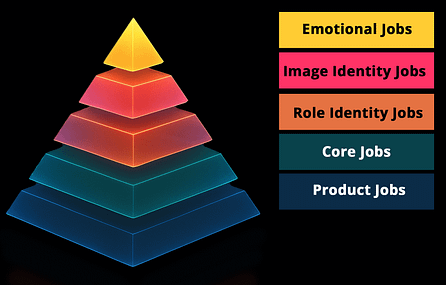
This is not self-help language. It is empirical psychology. Identity is the frame through which people interpret choices. A Job to be done or accomplished (JTBD) exists inside this identity narrative. It is the forward motion that carries someone from a current state to a desired future state. JTBD is not a task. It is a trajectory. Common identity JTBD patterns include: • chaotic to organized Pain points can exist at any part of this journey. They may influence timing, but they do not define the transformation. When founders design from pain points, they reduce the user to a set of irritations. When founders design from identity JTBD, they elevate the user to a person pursuing progress. This shift changes everything from product to brand to business model. Identity-driven JTBD explains why users stay with certain products even when cheaper or more convenient alternatives appear. Progress is sticky. Identity reinforcement is sticky. Pain relief is not.
Functional needs are the base. Emotional needs elevate relevance. Identity needs drive long-term adoption. Pain Points Create Switching. JTBD Creates Markets.Pain points explain why someone might move from Tool A to Tool B. This distinction shapes entire markets. Uber did not succeed because taxis were painful. Many cities still have painful taxis, yet not all alternatives thrive. The pain point explains switching, but the JTBD explains demand. The JTBD for Uber was predictable, transparent, and controllable mobility. This JTBD enabled dynamic pricing, ETAs, marketplace ratings, and new forms of transportation. Spotify did not succeed because iTunes was frustrating. The JTBD was effortless discovery and emotional connection to music. Airbnb did not scale because hotels were generic. The JTBD was a desire to feel like a temporary local. Figma did not grow because Sketch was painful. The JTBD was a collaborative creation and shared visibility. Notion did not spread because Google Docs was insufficient. The JTBD was to design one’s own work environment, not just use a document. When founders confuse pain points and JTBD, they optimize for friction removal rather than progress creation. This limits product vision. It also creates weak business models because pain relief businesses are easy to copy and hard to differentiate. Why Founders Confuse JTBD and Pain PointsThree psychological dynamics cause this mix-up. Salience BiasPain is vivid. Identity is subtle. Founders fixate on what is loud, not what is important. Confirmation BiasFounders often anchor to the first problem they hear. Users articulate frustrations more easily than desires for progress. As Steve Jobs put it:
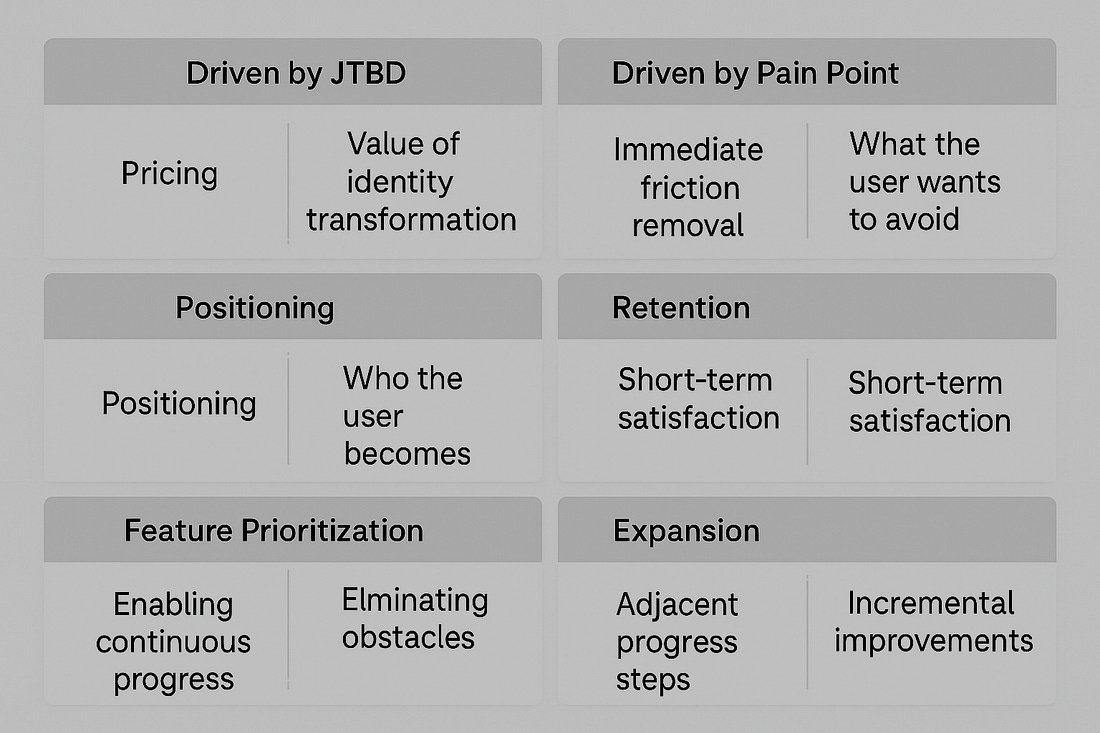
Users rarely articulate their JTBD. Availability BiasPeople can easily verbalize pain. They struggle to verbalize identity-level transformation. Founders interpret what they hear as the truth instead of interpreting what users say through the lens of what users want to become. This creates a systematic distortion. Founders end up building better tools for the person the customer is today, not the person the customer is trying to become. Identity JTBD Clarifies the Business ModelOnce a founder understands JTBD, several business model components snap into place. JTBD explains: • what customers will pay for Brand strategist David Aaker captures the identity link clearly:
Pain points justify switching.
JTBD drives strategic layers of the business. Pain points shape tactical layers. JTBD Requires Identity Awareness, Not Just Problem AnalysisChristensen’s work focused heavily on functional JTBD. But modern consumer and SaaS behavior is heavily driven by identity, status, capability narratives, and emotional progression. A 2020 study from the University of Vienna showed that consumers consistently choose products aligned with identity expression even when those products do not solve the most intense pain points. In other words, people will tolerate friction if the product aligns with who they want to become. This explains: • why professionals tolerate the learning curve of Notion Pain is tolerated. Why Founders Benefit When They Separate JTBD from Pain PointsWhen founders clearly separate JTBD from pain points, clarity increases dramatically. Founders who focus on pain• build feature-centric products Founders who focus on JTBD• build products that create real progress JTBD defines the strategic layer. The Real Principle: People Buy a Better Version of ThemselvesCustomers do not adopt products because the old product was painful. Pain points influence timing. The JTBD is the progress someone wants to accomplish. When founders internalize this distinction, product design becomes clearer, positioning becomes sharper, pricing becomes easier, and business model decisions gain coherence. Clarity emerges not from focusing on pain but from understanding progress. - Before you build anything, make sure someone wants it enough to pay. I put together a free 7-day email course on revenue-first customer discovery — how to pull real buying intent from real conversations (without guessing, overbuilding, or hoping). If you’re a builder who wants clarity before code:
|
Tuesday, December 9, 2025
People Don’t Buy Pain Relief. They Buy Progress.





Subscribe to:
Post Comments (Atom)
Startup Validation Is a Bet
Find the commercial wager with the shortest path to someone paying - whether you’re with just an idea, or an MVP, or even a functional pr...

-
Jonathan Gibson posted: "Cryptocurrency gambling is growing at a rapid pace, and more and more people are thinking about us...
-
Techie.Buzz posted: " [ANN] Serverless Kubernetes Solution For Cloud-Native Apps by CTO.ai CTO.ai is a provider of deve...
-
Crypto Breaking News posted: "Mikhail Fedorov, Ukraine's Deputy Prime Minister and the head of the country's Minist...


No comments:
Post a Comment