Solo Founding as a Structural Choice, Not a Personality TraitA framework for first-time and experienced founders to evaluate structure, coordination costs, and long-term optionality before deciding.
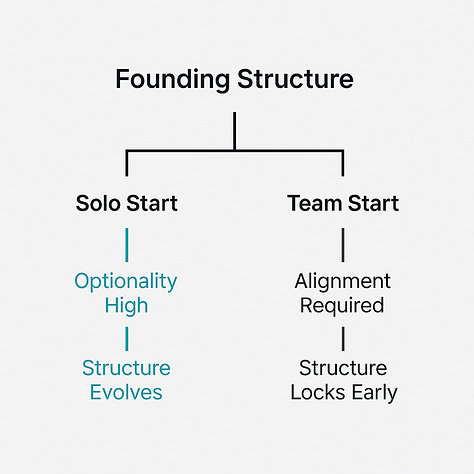
Most founders make one decision earlier than they should. They decide how many people they need before they understand what kind of problem they are solving. The choice between founding alone or with others is often framed as a question of confidence, risk tolerance, or ambition. In reality, it is a structural decision. One that shapes speed, clarity, failure modes, and how responsibility compounds over time. For first-time founders, this decision is rarely approached deliberately. It is shaped by social defaults, investor folklore, and second-hand stories that flatten nuance into rules. This article is not an argument for founding alone. Because the cost of choosing poorly is not visible on day one. It appears later, when decisions slow, incentives misalign, and early compromises harden into constraints. Before examining trade-offs, it helps to see the choice itself as a structural fork rather than a statement about ability or ambition.
Why This Decision Feels Harder Than It ShouldFirst-time founders often feel pressure to decide early. Accelerators prefer teams. Advisors ask about balance. Blogs repeat the idea that solo founders are fragile by default. The result is a false urgency. Very few founders are taught how to evaluate this choice structurally. Instead, they are asked to justify it socially. Questions like:
These are reasonable questions. They are also incomplete. They assume that collaboration is always additive and that coordination is free. Neither assumption holds consistently in modern startups. Before asking who should be in the room, the more important question is how many decision-makers the system can tolerate without slowing down. The Founding Team AssumptionStartup culture treats teams as safer. Two founders signal balance. Three signal resilience. Solo founders are often framed as provisional. This belief persists despite mixed evidence.
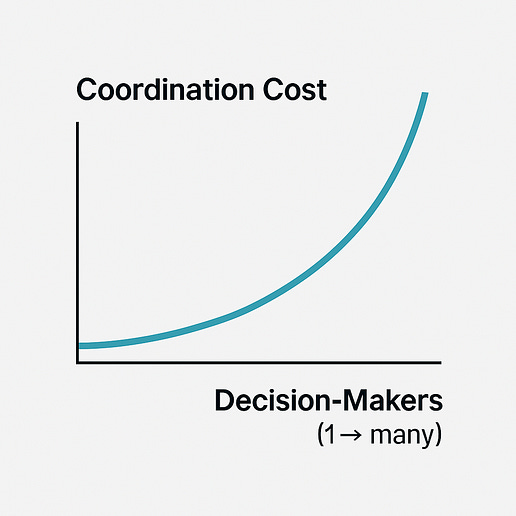
The issue is not talent. It is coordination. Every additional founder introduces a new axis of alignment. Vision, incentives, risk tolerance, pace, and long-term intent must remain synchronized. The cost of maintaining that alignment grows over time. At least one large-scale empirical study directly challenges the assumption that founding teams are structurally safer:
Jason Greenberg and Ethan Mollick are academics and researchers known for their collaborative work on entrepreneurship, crowdfunding, and team dynamics in startups. Contrary to popular belief in the venture capital world that teams are always better, their research suggests that companies started by solo founders actually tend to survive longer and generate more revenue than those started by founding pairs. This does not argue against teams. It highlights that the risks of collaboration are often underestimated, while the risks of solo founding are overstated. For founders still deciding, this is the first important reframing. The question is not whether teams are better. That balance is no longer stable by default. Coordination Is Not NeutralOrganizations exist to reduce transaction costs. That logic applies internally as well. Each decision involving multiple founders requires explanation, negotiation, and resolution. Even when agreement is strong, the process consumes time and cognitive energy. Research from Stanford on group decision-making shows that teams produce higher confidence decisions but slower iteration. Solo decision-makers move faster, even when imperfect. In environments with fast feedback loops, speed often matters more than initial accuracy. This matters for founders evaluating early structure. Modern startups do not fail because founders lack ideas. They fail because execution drags while markets move. Coordination does not scale linearly. It compounds. The cumulative effect of coordination becomes easier to reason about when treated as a curve rather than an abstract cost.
This emphasis on speed is echoed by experienced operators who have seen how delays accumulate inside organizations:
The relevance here is not leadership style. It is structural. Fewer decision-makers reduce the distance between intent and action. Cognitive Load Does Not Divide EvenlyOne argument for co-founders is shared burden. Emotional support. Distributed stress. Empirical research complicates this narrative.
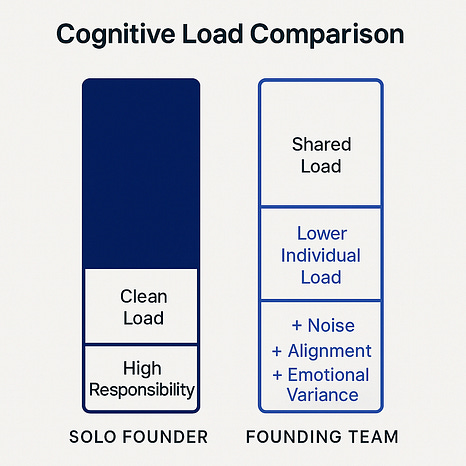
Solo founders carry more responsibility. They also operate with fewer cognitive interruptions. This trade-off is critical for first-time founders to understand. “More people” does not automatically mean less load. Sometimes it means a different load. Often noisier load.
The distinction here is not about ease, but about the shape and clarity of the load being carried. Technology Changed the Economics of HeadcountThe strongest argument for solo founding today is structural, not psychological. Modern software has collapsed roles that once required teams. Distribution, analytics, design, customer support, finance, and even elements of engineering now scale through tools. McKinsey research estimates productivity gains of 20 to 40 percent for knowledge workers using modern automation. In some workflows, the gains are significantly higher. This changes the breakeven point for hiring and partnering. A single founder with strong judgment and leverage can now outperform small teams encumbered by coordination overhead. For founders deciding today, this matters more than cultural narratives inherited from earlier startup eras. The environment changed. The advice did not. Solo Founding Is Not Isolation by DefaultA common fear among first-time founders is isolation. Building alone is equated with building without challenge. This is a category error. MIT’s Human Dynamics Lab shows that innovation correlates with exposure to diverse inputs, not with internal consensus. Teams provide this exposure incidentally. Solo founders must design for it intentionally. Advisors, peers, customers, and external thinkers can challenge assumptions without slowing execution. The difference is selectivity. Teams provide constant input. Solo founders choose when and where input enters the system. This distinction matters for sustainability. As Gary Keller writes:
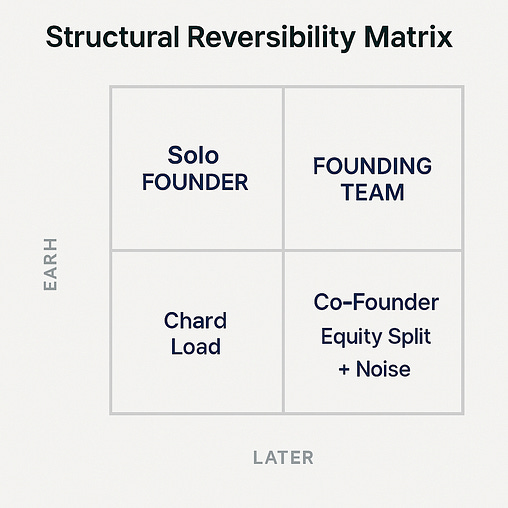
For solo founders, this is not motivation. It is an operational constraint. Focus replaces coordination as the primary scaling mechanism. Responsibility and Decision ClarityFounding alone concentrates responsibility. There is no ambiguity about ownership of outcomes. No diffusion of accountability. Research from Columbia Business School links a high internal locus of control with resilience and adaptability. Solo founders tend to score higher on this dimension. Philosophically, responsibility sharpens meaning. When consequences are clearly tied to decisions, learning accelerates. For founders still deciding, this is not about bravery. It is about feedback. Clear responsibility creates clear signals. Clear signals support better long-term decisions. Where Solo Founding Fails PredictablySolo founding is not safer. It simply fails differently. The failure modes are consistent. First, unchallenged assumptions. Without structured opposition, beliefs harden. Second, emotional looping. Stress without reflection amplifies bias. Third, avoidance. Teams distribute courage. Individuals must generate it internally. These are not arguments against solo founding. They are requirements. Decision logs, advisory structures, scheduled reviews, and long-form thinking replace co-founder debate. The risk is not being alone. It is being unexamined. Structural Reversibility MattersOne overlooked factor in early decisions is reversibility. Adding team members later is often easier than unwinding founding partnerships. Equity, authority, and identity are harder to renegotiate than to extend. For first-time founders, this asymmetry matters. Starting solo preserves optionality. It does not prohibit collaboration. It delays irreversible commitments until clarity improves. This is not about control. It is about sequence.
When decisions are mapped by reversibility over time, sequence becomes more important than certainty. Organizational Coherence Over TimePeter Drucker observed that organizations reflect their founders. In solo-founded companies, this reflection is direct. Culture emerges from consistent decisions. Strategy follows a single logic. Values are not averaged. This does not eliminate error. It reduces contradiction. Many companies fail not from lack of ambition, but from internal inconsistency. Early compromises that never fully resolve. Solo founding reduces the surface area for these fractures. A Different Founder ArchetypeThe popular founder archetype is extroverted, persuasive, and visible. The emerging archetype is analytical, systems-oriented, and execution-focused. This is not a personality shift. It is an incentive shift. Markets now reward speed, coherence, and leverage more than consensus. Founders who prefer clarity over collaboration find themselves better aligned with current conditions. This Is Not a PrescriptionSolo founding is not superior by default. Some problems require teams. Some founders thrive in partnership. Some industries demand shared authority. The relevant question is structural fit. What does an additional decision-maker add? For many modern founders, the answer is not obvious. That is precisely why this decision deserves careful thought. The Deeper PatternSolo founding exposes a simple reality. There is no shared responsibility. Only choices and consequences. This forces clarity. It removes performative alignment. It collapses excuses. When one mind shapes a company, the quality of that company tracks the quality of that thinking. Clear thinking produces coherent systems. Conflicted thinking produces fragile ones. What the Next Decade SuggestsThe next decade will produce more one-person companies at scale. More founders are using automation as labor. More businesses where software executes, and humans decide. This is not a rejection of teams. It is an expansion of viable structures. Solo founding is no longer a fallback. It is one rational starting point among several.
I’m starting a new LinkedIn newsletter called The Builder’s Lens — focused on the real mechanics behind early traction and evidence-driven decision-making for founders, makers, and side-project builders. I would love to have you as an early subscriber. - Before you build anything, make sure someone wants it enough to pay. I put together a free 7-day email course on revenue-first customer discovery — how to pull real buying intent from real conversations (without guessing, overbuilding, or hoping). If you’re a builder who wants clarity before code:
|
Tuesday, December 16, 2025
Solo Founding as a Structural Choice, Not a Personality Trait






Subscribe to:
Post Comments (Atom)
Startup Validation Is a Bet
Find the commercial wager with the shortest path to someone paying - whether you’re with just an idea, or an MVP, or even a functional pr...

-
Jonathan Gibson posted: "Cryptocurrency gambling is growing at a rapid pace, and more and more people are thinking about us...
-
Techie.Buzz posted: " [ANN] Serverless Kubernetes Solution For Cloud-Native Apps by CTO.ai CTO.ai is a provider of deve...
-
Crypto Breaking News posted: "Mikhail Fedorov, Ukraine's Deputy Prime Minister and the head of the country's Minist...


No comments:
Post a Comment