Cultural Gravity: How Constraints Become Distribution AdvantagesFour Markets. Four Decisions. Four Different Definitions of “Doing It Right.”
In the mid-2000s, Facebook shipped products faster than most companies could hold internal reviews. Features launched half-finished. In many markets, this behavior would have destroyed trust. In Silicon Valley, it accelerated dominance. Speed wasn’t just tolerated - it was admired. Shipping imperfectly signaled ambition. Waiting signaled fear. Early users didn’t ask whether the product was complete; they asked whether it was moving. Speed itself became a trust signal. The product didn’t succeed despite its rough edges. In another continent, when Walmart entered Germany, it brought scale, operational excellence, and aggressive pricing - the same playbook that had dominated the U.S. On paper, it should have worked. Instead, it failed. Not because prices were wrong. Walmart violated deep expectations around professionalism, labor relations, authenticity, and rule-based competition. Excessive friendliness felt insincere. Speed felt careless. Practices that worked elsewhere clashed with a system where precision precedes trust. After nearly a decade of losses, Walmart exited the market. The lesson wasn’t that Germany is difficult. Far from the western world, inside Toyota factories, any worker can pull the andon cord - stopping the entire production line if they detect a defect. From a speed-first mindset, this looks inefficient. From a Japanese mindset, it’s essential. Reliability is not optimized at the end. This philosophy shaped Toyota’s global reputation: exceptional quality, deep trust, and extreme customer loyalty. In Japan, innovation that risks reliability is not progress - it is irresponsibility. Toyota didn’t scale despite this constraint. Back in India, when Tata Motors launched the Nano, it was positioned as the world’s cheapest car - a triumph of engineering frugality. Yet adoption disappointed. Not because Indians rejected affordability, but because frugality in India is not about cheapness. It is about maximizing resilience under uncertainty. Buyers evaluated durability, resale value, long-term risk, and social signaling. A product optimized purely for low cost felt fragile. What was intended as value was perceived as vulnerability. The Nano didn’t fail because it was too cheap. What These Stories Have in CommonAt first glance, these stories seem disconnected - different industries, different geographies, different outcomes. But beneath them is the same force at work. Each company collided with something invisible but immovable: a local decision logic that shaped what “good,” “safe,” and “valuable” meant before any product was evaluated. Culture didn’t influence perception at the margins. The easiest way to understand this is not as preference or identity, but as gravity.
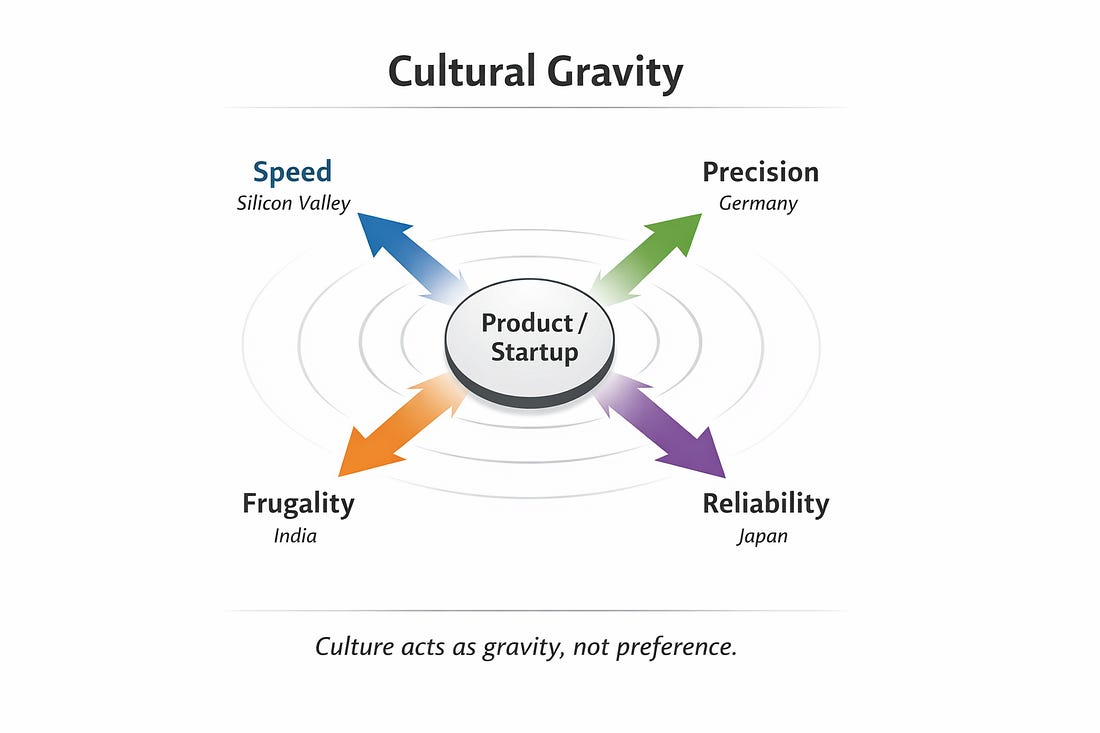
Think of every market as exerting a gravitational pull. Silicon Valley pulls products toward speed. These forces are not optional. You don’t negotiate with them, persuade them, or out-market them. You either design in alignment - or you burn energy fighting physics. When a product aligns with a market’s cultural gravity, distribution feels effortless. Each company encountered a cultural operating system - an invisible logic governing how people evaluate risk, trust, time, and value. And each outcome was determined by alignment or misalignment with that logic. These were not failures or successes of marketing. They were distribution outcomes shaped by cultural gravity. Before we dive into the operating systems of culture, it helps to anchor our understanding in the insight of one of management’s foundational thinkers.
This isn’t a clever aphorism. It’s a structural truth: if your assumptions about risk, trust, and value don’t align with the cultural logic of a market, no amount of strategy will get you adoption. Culture Is Not Identity. It Is Decision Logic Culture is often reduced to symbols: language, customs, aesthetics. For strategy, that definition is useless. What matters is culture as decision-making under uncertainty. Every market answers the same questions - but answers them differently:
These answers shape how products spread. Distribution is not neutral. A product does not scale because it is objectively superior. Four Cultural Operating Systems of ScaleThe opening stories map cleanly to four dominant cultural logics. Silicon Valley: Speed as a Moral GoodSpeed in Silicon Valley is not a tactic. Action is rewarded more than correctness. This produces an environment where:
The cultural constraint here is impatience. But that same constraint becomes a distribution advantage. Products optimized for speed benefit from rapid feedback loops, fast social proof, and capital markets that reward momentum over certainty. This is why many Silicon Valley–born products feel “unfinished” elsewhere. They are not poorly designed - they are overfit to a culture where speed substitutes for trust. Germany: Precision as Trust InfrastructureGermany runs on a different operating system. Here, precision is not pedantry. Correctness signals seriousness. German decision logic prioritizes:
The constraint is clear: speed without rigor destroys trust. This makes Germany a difficult market for products built on “launch fast, fix later” assumptions. But for companies that align with this logic, the reward is profound. Precision becomes a distribution advantage because once trust is established, switching costs are high, reputations compound slowly but powerfully, and products embed themselves deeply into workflows and institutions. In this context, slowness is not inefficiency. Japan: Reliability as a Social ContractIn Japan, reliability is not a feature. The social cost of failure is high. Japanese decision logic emphasizes:
Failure is reputational, not educational. This makes Japan hostile terrain for hype-driven launches. But for companies that adapt, reliability becomes an extraordinary distribution moat. Once trust is earned:
Innovation still exists - but it is subordinated to reliability. What outsiders see as resistance to change is actually a filtering mechanism. India: Frugality as Adaptive IntelligenceFrugality in India is often misunderstood as price sensitivity. That is a shallow reading. Frugality is not about cheapness. Indian decision logic reflects:
This produces buyers who ask:
The constraint is intolerance for waste. But frugality becomes a distribution advantage when respected. Products that succeed in India are modular, flexible, ROI-clear, and resilient. They scale through volume, not margin, and often travel well to other emerging markets. Frugality forces discipline. Strategic alignment with cultural logic doesn’t just help adoption externally - it shapes internal coherence around purpose and execution.
This insight reinforces what we’ve been seeing: when a product resonates with local cultural logic, the social and economic processes that carry it forward become more efficient - almost automatic. Why Startups Fail When They Fight Cultural GravityMost failed global expansions share the same root cause: The company’s internal optimization logic conflicts with the market’s cultural optimization logic. Speed-optimized teams enter precision-first markets. The result is rarely a dramatic rejection. Instead, it is slow non-adoption. Meetings happen. Momentum never arrives. From the inside, it feels like an execution failure. Culture as Distribution, Not Decoration Here is the strategic reframing that matters: Culture does not shape how your product is perceived. Distribution depends on:
These are cultural variables - not marketing ones. When culture aligns with your assumptions, growth feels effortless. From Constraint to AdvantageThe highest-performing global companies do not ask: “How do we adapt our product to this culture?” They ask: “How do we let this culture design our advantage?” Instead of fighting slowness, they turn thoroughness into trust. Culture becomes a force multiplier. A Founder’s Strategic PlaybookThis is not a checklist.
Culture Is StrategyThe final mistake is treating culture as something to overcome. Culture is the invisible architecture that determines:
When startups stop fighting this architecture and start designing with it, culture ceases to be a constraint. It becomes gravity. And gravity, once understood, is not an obstacle. It is what makes flight possible. - Before you build anything, make sure someone wants it enough to pay. I put together a free 7-day email course on revenue-first customer discovery — how to pull real buying intent from real conversations (without guessing, overbuilding, or hoping). If you’re a builder who wants clarity before code:
|
Monday, January 19, 2026
Cultural Gravity: How Constraints Become Distribution Advantages





Subscribe to:
Post Comments (Atom)
Startup Validation Is a Bet
Find the commercial wager with the shortest path to someone paying - whether you’re with just an idea, or an MVP, or even a functional pr...

-
Jonathan Gibson posted: "Cryptocurrency gambling is growing at a rapid pace, and more and more people are thinking about us...
-
Techie.Buzz posted: " [ANN] Serverless Kubernetes Solution For Cloud-Native Apps by CTO.ai CTO.ai is a provider of deve...
-
Crypto Breaking News posted: "Mikhail Fedorov, Ukraine's Deputy Prime Minister and the head of the country's Minist...


No comments:
Post a Comment