
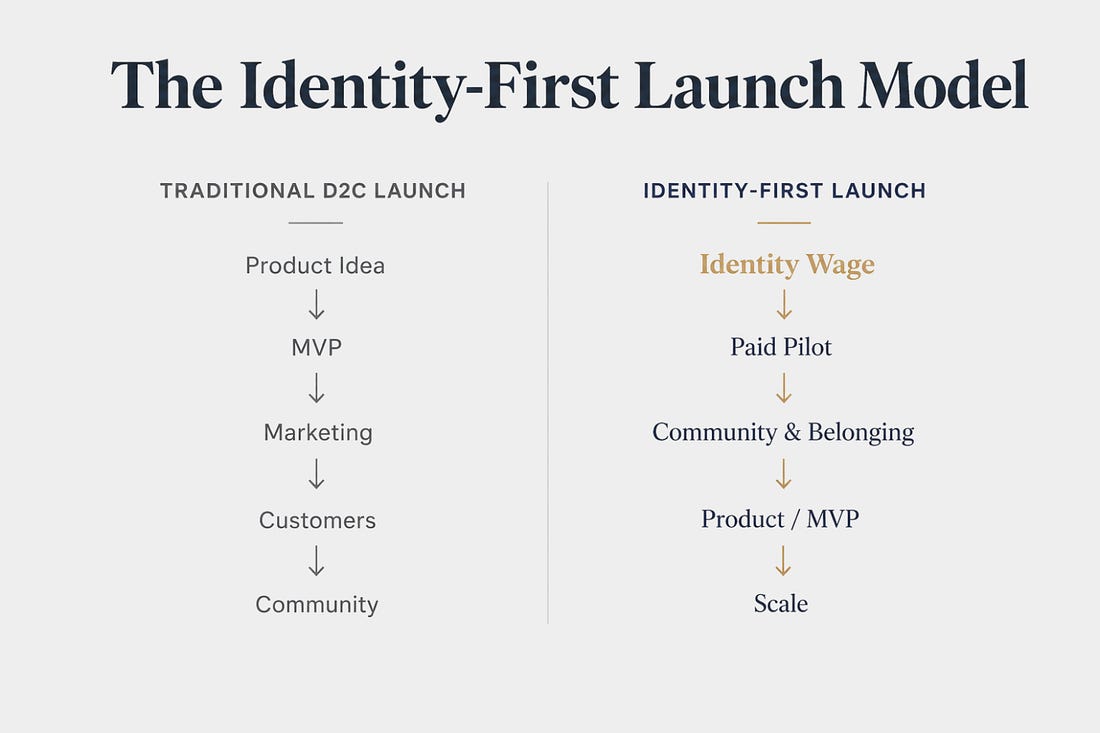
Most advice on launching a D2C startup follows a familiar script. Find a problem. Build a product. Create an MVP. Run ads. Get customers. Raise capital. Scale. While this sounds logical, it ignores a reality that many successful D2C brands intuitively understand:
The product is often just the visible artifact of a deeper transaction. When someone buys a premium coffee brand, they are not only buying coffee. When someone buys a luxury skincare product, they are not only buying skincare. When someone joins a fitness brand, they are not only buying workouts. In each case, they are buying a version of themselves. A future self. A social signal. A tribe. A belief system. A lifestyle. An aspiration. This raises an important question for founders:
I call this concept Identity Wage. And in many early-stage D2C ventures, Identity Wage is a more valuable thing to validate than product-market fit.
What Is Identity Wage?Identity Wage is the psychological and social value a customer receives from associating with a brand. The wage may come in the form of:
These rewards often matter more than the functional utility of the product. For example: A Rolex tells time. But nobody pays for a Rolex because it tells time. A luxury handbag carries belongings. But nobody pays thousands of dollars because carrying belongings is difficult. A gym membership provides equipment. But many members are actually buying the identity of becoming a healthier, more disciplined version of themselves. The product delivers utility. The identity delivers meaning. And meaning is often what drives demand. Why Founders Overestimate Products and Underestimate IdentityMost founders come from a builder mindset. They focus on:
These things are important. But customers experience brands differently. Customers ask:
These are identity questions. And identity questions frequently determine adoption long before product superiority does. This is why mediocre products attached to strong identities often outperform superior products attached to weak identities. The startup graveyard is full of technically impressive products that nobody emotionally cared about. The 10 Dimensions of Identity WageIdentity Wage is not a single thing. It can emerge from multiple dimensions. Understanding these dimensions helps founders identify what they are truly selling. 1. Functional IdentityThis is the identity created through competence and utility. Examples:
The customer identity becomes: “I am someone who is smart, organized, and effective.” 2. Emotional IdentityThis dimension focuses on feelings. Examples:
The customer identity becomes: “I am someone who feels calm, confident, empowered, or cared for.” 3. Social IdentityThis is one of the most powerful dimensions in D2C. Examples:
The customer identity becomes: “I belong to this group.” People buy belonging far more often than founders realize. 4. Cultural IdentityBrands often become symbols of cultural participation. Examples:
The customer identity becomes: “I am part of this movement, culture, or community.” 5. Founder IdentitySome brands derive value from the founder’s story and credibility. Examples:
The customer identity becomes: “I trust and follow this person.” 6. Aspirational IdentityPerhaps the most powerful identity dimension. Examples:
The customer identity becomes: “I am becoming the person I want to be.” 7. Aesthetic IdentityMany fashion, design, and lifestyle brands operate primarily here. The customer identity becomes: “I have good taste.” 8. Economic IdentitySome brands help customers signal financial intelligence. Examples:
The customer identity becomes: “I make smart economic decisions.” 9. Ethical IdentityExamples:
The customer identity becomes: “I am a responsible person.” 10. Temporal IdentityThis dimension is often overlooked. It is about being early. Examples:
The customer identity becomes: “I was here before everyone else.” This is why founder badges, early-access memberships, and limited cohorts can be so powerful.
The Mistake Most D2C Startups MakeMost founders attempt to validate products. They ask:
These questions matter. But they often come after a more important question:
If the answer is no, product improvements rarely save the business. If the answer is yes, customers often tolerate imperfect products. Think about how many successful brands launched with products that were far from perfect. Their success came from identity resonance, not product perfection. Why Identity Validation Should Come Before Product ValidationBuilding products is expensive. Inventory costs money. Manufacturing costs money. Packaging costs money. Technology costs money. Logistics costs money. Identity validation costs far less. And identity validation often predicts product success more accurately. Before investing significant capital, founders should ask:
If they do, product development becomes significantly less risky.
Why Not Just Build a Community?At this point, some founders might ask: “Why not simply build a community before launch?”
People join:
because joining is free. As a result, founders often mistake interest for conviction. A community of 5,000 people tells you very little about whether people truly value what you’re building. A paid pilot changes the equation. The moment someone pays, they move from: “This sounds interesting.” to “This matters enough for me to commit money to it.” That is a much stronger signal. More importantly, traditional communities validate engagement. Paid pilots validate identity. Someone may happily join a fashion, gaming, wellness, or coffee community for free. But are they willing to pay to become:
That is the question that matters. Free communities answer: “Do people find this interesting?” Paid identity pilots answer: “Do people value this identity enough to pay for it?” For an early-stage D2C founder, the second answer is often far more valuable than the first. The Paid Pilot: A Better Way to Launch D2C StartupsInstead of launching with a product, founders can launch with a paid pilot. A paid pilot is not about selling a finished product. It is about testing whether people are willing to pay for the identity. This distinction changes everything. The goal is not: “Can I sell this product?” The goal is: “Can I monetize the identity before the product exists?” If people pay for the identity, product development becomes a scaling exercise rather than a guessing exercise. What Is Being Validated in a Paid Identity Pilot?A well-designed paid pilot validates:
These are often stronger indicators of future success than product feedback. How Can You Sell Something Before There Is a Product?This is where many founders get stuck. They assume that without a product, there is nothing to sell. In reality, there are many things people pay for before products exist. They pay for:
These are all forms of identity wage. Five Paid Pilot Structures That Work Without a Product1. Founding Membership ProgramsExamples:
People pay to become early members. What they receive:
Identity dimensions activated:
2. Community Participation ProgramsPeople pay to help shape the future of the brand. What they receive:
Identity dimensions activated:
3. Transformation ProgramsInstead of selling a product, founders sell the outcome. Examples:
Identity dimensions activated:
4. Cultural Movement MembershipsPeople join because they believe in the mission. Examples:
Identity dimensions activated:
5. Legacy and Early-Adopter ProgramsPeople buy permanent recognition. Examples:
Identity dimensions activated:
The Future of D2C LaunchesThe traditional startup model assumes: Product → Customers → Brand But increasingly successful D2C brands follow a different sequence:
They build:
Most founders assume they need a product before they can start validating a business. The identity-first model challenges that assumption. Instead of asking: “Will people buy my product?” it asks: “Will people pay to belong to the identity my future product represents?” A paid pilot sits at the center of this approach. Its purpose is not to validate product sales. Its purpose is to validate whether the underlying identity has enough economic value to create a community, attract commitment, and generate willingness to pay before a product or MVP exists. Once identity is validated, building the product becomes significantly less risky because demand is being pulled by an existing tribe rather than pushed through marketing. The Most Important Question Every D2C Founder Should AskBefore designing products, before manufacturing inventory, before building an e-commerce store, ask: “What identity wage am I paying my customers?” Because customers rarely buy products. They buy what products allow them to become. The founders who understand this build communities before catalogs. They build movements before marketplaces. They build identity before inventory. And in many cases, that is the difference between launching a product and launching a brand. ━━━━━━━━━━━━━━━━━━━━ If you’re building a product, start-up, or idea, you’ll probably enjoy The Builder’s Lens.
Read the newsletter: The Builder’s Lens
|







No comments:
Post a Comment