
“Climate tech” is a capital allocation label.
It is not a go-to-market strategy.
Buyers do not buy climate.
When founders treat climate as a market, they build abstraction into their company from day one. The mistake goes deeper. Even within the same sector, different business models create entirely different commercial realities.
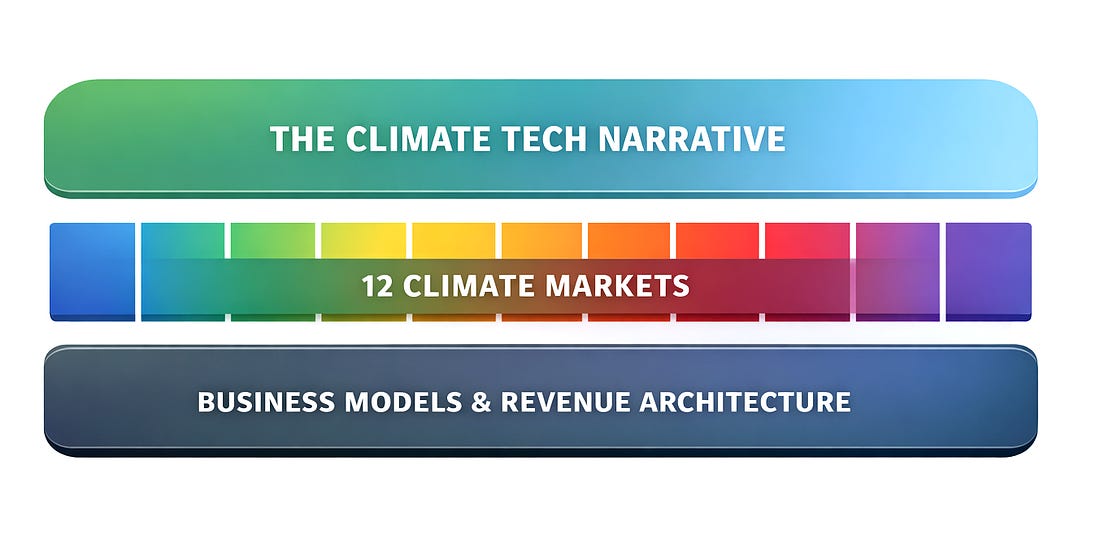
If you want to build a serious climate startup, you must understand two things clearly:
Without that clarity, you are guessing. Markets Have Physics. Climate Is a Narrative.Every real market has structural physics.
Software sold to a mid-market company behaves differently from infrastructure sold to a utility. Capex behaves differently from opex. A reversible purchase behaves differently from an irreversible one. Climate compresses radically different commercial environments into one narrative bucket. Calling everything climate tech is like calling investment banking, neobanks, and payment processors “finance startups.” Technically accurate. Commercially meaningless. The only question that matters for a founder is this: How does revenue actually move in the environment you are entering?
The 12 Climate Markets That Actually ExistThese are not academic categories. They are commercial ones. Each behaves differently depending on geography and business model choice. 1. Carbon Accounting and Reporting Platforms In the United States and the United Kingdom, platforms such as Watershed and Persefoni operate like compliance-driven SaaS businesses. Annual contracts are common. Sales cycles accelerate around disclosure deadlines. The buyer often sits in sustainability, but budget scrutiny comes from finance. Messaging that leads with regulatory readiness performs better than messaging that leads with climate impact. In Germany and Japan, carbon reporting frequently becomes an enterprise systems problem. Companies like Plan A integrate into ERP environments such as SAP. Here, the sale involves IT, finance, and compliance simultaneously. The product is not simply a dashboard. It becomes part of the core reporting infrastructure. Sales cycles extend, and implementation complexity rises. In India and Southeast Asia, startups such as Zuno Carbon combine software with advisory and implementation support to navigate fragmented regulatory frameworks. Distribution often runs through partnerships with accounting firms and sustainability consultants, enabling faster trust-based adoption among mid-market enterprises. In these contexts, channel partnerships and revenue sharing may unlock faster distribution than direct outbound sales. 2. EV Charging Infrastructure EV charging illustrates how business model choice completely changes GTM dynamics. ChargePoint in the United States operates a network-oriented model. Utilization rates and location density drive unit economics. The company must secure host sites while simultaneously building driver adoption. This creates a dual-sided scaling challenge. EVBox in Europe has leaned more heavily into hardware sales to commercial property owners, pairing chargers with network software. In this configuration, the customer is the host property. The sales argument centers on asset value, foot traffic, and long-term revenue potential. BP Pulse operates across public charging and fleet electrification. When selling to fleet operators, the conversation shifts toward uptime guarantees and total cost of ownership reduction. Consumer brand visibility becomes secondary. The charger is the same physical asset. Asset ownership and risk allocation determine everything about GTM. 3. Industrial Decarbonization Companies such as Carbon Clean sell modular carbon capture units directly to heavy industry. These sales are capex-driven, technically intensive, and committee-approved. Engineering teams, operations leaders, and finance departments all influence the decision. Pilots are common and often slow. H2 Green Steel, now Stegra, is building vertically integrated low-carbon steel production in Sweden. This is not a typical startup sales motion. It involves project finance, long-term offtake agreements, and sovereign-level support. Other decarbonization firms license technology to equipment manufacturers instead of selling directly to end operators. Boston Metal, for example, is commercializing molten oxide electrolysis for steel production and can partner with established steel producers to deploy its process. Licensing reduces commercial friction and accelerates market access, but it also reduces control and long-term margin capture. Technology does not define the company. The business model does. 4. Grid Software and Energy Management AutoGrid, now acquired by Uplight, works with utilities to manage distributed energy resources. Procurement processes are regulated and multi-year. Approval cycles depend on regulatory bodies as much as utility executives. Octopus Energy uses a retail energy model in the United Kingdom, embedding software into consumer energy contracts. Here, the GTM lever is customer acquisition at the retail level rather than utility procurement. A third variation is the commercial and industrial optimization model. Stem Inc. deploys AI-driven storage and energy management systems for large commercial facilities. The buyer is a corporate energy manager focused on demand charge reduction and cost savings. Sales cycles are shorter than those of regulated utilities but more structured than retail consumer acquisition. A regulated utility in the United States behaves differently from a competitive retail energy market in the UK. A commercial facility energy manager behaves differently from both. Geography and customer segment reshape sales physics entirely. 5. Energy Storage Form Energy is building multi-day iron-air battery systems targeted at utilities. The sales motion resembles infrastructure procurement. Contracts are long-term, capital-heavy, and tied to grid reliability planning. Regulatory approval and utility integration shape timelines more than the speed of innovation. Energy Vault develops gravity-based storage systems for grid-scale deployment. Its model centers on large project development partnerships with utilities and sovereign-backed infrastructure programs. Revenue depends on structured power purchase agreements and grid service contracts. A third variation is energy storage as a service. Stem Inc. deploys battery systems at commercial and industrial sites while retaining software control and monetizing through performance optimization. In this structure, the provider carries more asset and utilization risk but lowers upfront friction for customers. Three companies. Three GTM architectures: Same category. Different commercial physics. 6. Climate Adaptation and Resilience One Concern provides climate risk modeling to governments and large enterprises exposed to earthquakes, floods, and extreme weather. The sale is enterprise analytics-driven. Buyers include city authorities, infrastructure operators, and corporate risk teams. The value is in measuring risk exposure and planning capital. Procurement cycles can be long and influenced by public sector budgeting timelines. FloodFlash addresses the same macro problem through parametric flood insurance. Instead of selling analytics software, it sells financial protection that pays out automatically when predefined flood thresholds are met. The buyer is a property owner or business operator. The sales motion resembles insurance underwriting more than enterprise SaaS. A third variation focuses on physical adaptive infrastructure. ECOncrete designs marine infrastructure that enhances coastal resilience while improving biodiversity outcomes. The buyer is a coastal developer, port authority, or municipal infrastructure agency. Revenue depends on construction procurement cycles and engineering approval processes. In coastal United States markets, insurance pricing pressure may drive adoption of parametric protection. In parts of Southeast Asia, multilateral funding and municipal procurement may dominate the resilience infrastructure landscape. Same climate exposure. Three different monetization models. Three different sales engines. 7. Nature-Based Solutions Pachama, now acquired by Carbon Direct, builds a verification layer for forest carbon credits and monetizes through a marketplace take rate. Its GTM is platform-driven. The buyers are corporate purchasers of voluntary carbon credits. Trust, data integrity, and supply liquidity drive adoption. South Pole combines project development and advisory services, often working directly with corporates on bespoke sustainability programs. Revenue blends consulting fees with project execution margins. The sales motion is relationship-led and enterprise-focused, not marketplace-based. A third variation focuses on vertically integrated project ownership. Mombak acquires degraded land in Brazil and develops large-scale reforestation projects, generating high-integrity carbon removal credits. The buyer is typically a corporate signing long-term offtake agreements. This model is asset-heavy and capital-intensive, resembling infrastructure development more than software. One is a digital marketplace layer. One is advisory plus execution. One is asset-backed project development. Same macro category of nature-based solutions. Three entirely different commercial architectures. 8. Agricultural Climate Technology Indigo Ag works directly with farmers on regenerative agriculture and carbon programs. Adoption depends on farmer trust, yield protection, and economic return. The sales motion is field-driven and relationship-based. Farmer economics determine scale more than ESG commitments from corporates. A second variation is input substitution through biological innovation. Pivot Bio replaces synthetic nitrogen fertilizer with microbial alternatives. The buyer is still the farmer, but the value proposition centers on input cost stability and performance parity. The GTM resembles traditional ag input sales rather than carbon program enrollment. A third variation focuses on monetizing regenerative practices through structured carbon programs. Agreena enables farmers to generate and sell soil carbon credits to corporates. Here, revenue depends on measurement, verification, and credit market demand. The buyer is dual-sided: farmers on one end and corporates on the other. Agriculture in the United States often relies on independent farm economics and private carbon markets. In Brazil or India, cooperatives and government incentive structures can heavily influence adoption. Same soil. Different commercial architecture. 9. Climate Risk and Fintech Climate X provides portfolio-level climate risk analytics to financial institutions, banks, and asset managers. Its platform models physical climate exposure across real estate, infrastructure, and investment portfolios. The product is sold as enterprise SaaS, typically to risk, strategy, or sustainability teams seeking forward-looking scenario analysis. The sales motion resembles subscription software with recurring contracts, but adoption is often accelerated by regulatory stress testing requirements and investor disclosure pressure. Jupiter Intelligence focuses on high-resolution climate modeling for insurers, asset managers, and infrastructure investors. Its solutions are often embedded more deeply into underwriting and asset valuation workflows. This increases technical integration complexity and contract size but also lengthens procurement cycles. A third variation operates at the insurance product layer rather than analytics alone. Descartes Underwriting structures parametric insurance products based on climate data triggers. Instead of selling software subscriptions, it sells risk transfer instruments. Revenue comes from underwriting and premiums rather than SaaS fees. One is a portfolio analytics SaaS. One is a deeply embedded modeling infrastructure. One is risk transfer as a financial product. Same macro problem of climate exposure. Three fundamentally different monetization architectures. 10. Compliance Driven Disclosure Tools Emerging rules from bodies such as the U.S. Securities and Exchange Commission and evolving frameworks in the European Union create deadline-driven demand. One variation focuses on pure-play SaaS reporting platforms. Workiva provides cloud-based reporting tools that integrate ESG disclosures into existing financial reporting workflows. The buyer is typically finance or compliance. The sales motion resembles enterprise reporting software with annual contracts tied to regulatory cycles. A second variation blends software with advisory-led onboarding. Novisto combines ESG data management tools with implementation support to help enterprises navigate evolving disclosure regimes. Here, the product is SaaS, but adoption is accelerated through guided integration into governance and risk systems. A third variation embeds compliance into procurement and supply chains. Assent helps manufacturers manage regulatory compliance across global supplier networks. Revenue depends on recurring enterprise contracts, and urgency is shaped by jurisdictional enforcement intensity and cross-border trade exposure. In the United States, enforcement clarity and litigation risk influence adoption speed. In the European Union, standardized sustainability directives create structured compliance demand. Same regulatory momentum. Different institutional response patterns. 11. Carbon Removal Climeworks sells long-term carbon removal agreements to corporates willing to pay a premium for verified removal. The company builds and operates its own direct air capture facilities and signs multi-year offtake contracts with buyers seeking high-durability credits. The GTM resembles infrastructure-backed project finance combined with enterprise climate procurement. Charm Industrial structures forward purchase agreements, locking in future carbon removal delivery in exchange for upfront capital. Instead of waiting for full-scale deployment, it uses advance market commitments to finance growth. Revenue depends on long-term contractual confidence rather than spot market sales. A third variation focuses on modular or partnership-based deployment. Heirloom Carbon Technologies uses mineral-based capture processes and partners with industrial sites to scale deployment. In this structure, infrastructure may be co-located or co-developed, reducing standalone facility risk while increasing dependency on industrial partnerships. One model is vertically integrated infrastructure ownership. One leverages forward contracts to de-risk scaling. One embeds within existing industrial ecosystems. All operate in carbon removal. Each carries a different balance sheet structure, capital intensity profile, and GTM motion. 12. Climate Data Platforms Planet Labs sells high-frequency satellite imagery through subscription access. The model is a recurring data infrastructure. Customers include governments, insurers, agriculture firms, and defense agencies. Revenue scales with dataset breadth and long-term data access contracts rather than project-by-project engagement. Descartes Labs, acquired by EarthDaily Analytics, focuses on applied geospatial analytics built on top of satellite and earth observation data. Instead of raw data feeds, it delivers decision-ready insights to governments and enterprises. The GTM is more solution-oriented, often tied to specific use cases such as agriculture monitoring or supply chain intelligence. A third variation embeds climate data into financial and operational decision systems. Kayrros uses satellite and sensor data to generate methane monitoring and commodity intelligence for energy companies and financial institutions. Revenue depends on integration into trading, compliance, or asset management workflows rather than standalone data subscriptions. One model sells raw data infrastructure. One sells applied analytics solutions. One embeds climate intelligence directly into financial and operational systems. Business Model Is GTM ArchitectureAcross all twelve markets, one principle holds. Technology does not define your GTM. A business model defines your GTM.
These determine sales cycles, capital needs, pricing strategy, and hiring plans. Many early-stage founders postpone business model clarity. They focus on the product first. But revenue architecture shapes survival.
The Three Questions Every Climate Founder Must AnswerBefore hiring sales. Before raising capital. Before defining your category.
Climate is a mission layered across dozens of commercial systems. The founders who succeed will not be those who speak most convincingly about impact. They will be those who understand commercial physics deeply enough to design companies that can survive inside them. Mission creates momentum. Commercial precision creates endurance.
|





No comments:
Post a Comment