
Deep-Tech Startups May Be Waiting Too Long to Run Their First Paid PilotWhy do some of the most valuable pilots happen before the prototype, before the POC, and long before commercial deployment
Most deep-tech founders believe there is a natural sequence to commercialization. First, you do the research. Then, you build a prototype. Then, you prove the concept. Then, you run a pilot. Then, eventually, customers start paying. The model looks something like this:
It feels logical. After all, how can you run a pilot if there is nothing to test? But the more I study deep-tech commercialization, the more I believe this mental model is causing many founders, researchers, and university spinouts to delay customer engagement far longer than necessary. Because it assumes a pilot is primarily a technology validation exercise. In reality, some of the most valuable paid pilots happen before there is any technology to validate. And understanding this distinction can fundamentally change how deep-tech ventures approach commercialization. The Three Things Customers Buy in Deep-Tech CommercializationOne of the reasons deep-tech commercialization feels so different from software is that customers are not always buying the same thing throughout the journey. In fact, what customers are willing to pay for it as the technology matures.
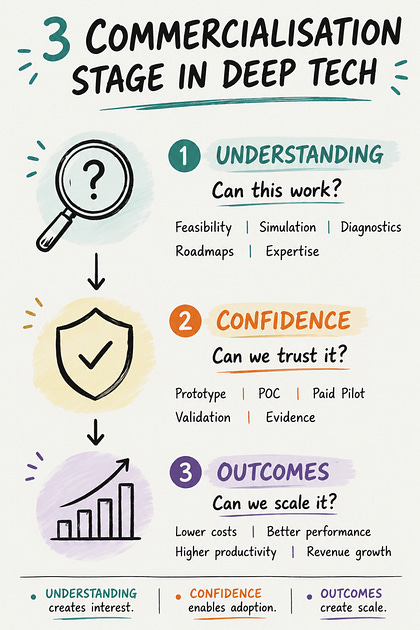
Phase 1: Commercializing UnderstandingBefore a prototype exists, customers are not looking for performance. They are looking for answers.
This is why early commercial engagements often revolve around feasibility studies, simulations, technical assessments, modelling exercises, and access to specialized expertise.
The technology-based solution may still be under development, but the learning already has value. At this stage, customers are paying to reduce uncertainty.
Phase 2: Commercializing ConfidenceOnce a prototype or POC exists, the conversation changes. Customers no longer want possibilities. They want proof.
This is where pilots, demonstrations, and validation projects become critical. The objective is no longer understanding. It is confidence.
“Should we trust this enough to move forward?” At this stage, customers are paying to reduce adoption risk. Phase 3: Commercializing OutcomesEventually, customers start buying results.
At this stage, the technology has moved beyond experimentation and validation. The discussion shifts from potential value to realized value. Customers are no longer paying for what the technology might do. They are paying for what it actually delivers.
And recognizing which phase you are in can fundamentally change how a deep-tech venture approaches commercialization. The Most Misunderstood Pilot in Deep TechWhen people hear the phrase “paid pilot,” they usually imagine a prototype being tested in a real-world environment. But I think deep-tech commercialization contains two very different types of pilots. The first is a Learning Pilot. The second is a Validation Pilot. Most founders focus exclusively on the second. The biggest opportunity often exists in the first. Learning PilotOccurs before a prototype or POC exists. The objective is to reduce uncertainty. Questions being answered include:
Validation PilotOccurs after a prototype or POC exists. The objective is to build confidence. Questions being answered include:
Most discussions about commercialization focus on Validation Pilots. Very few discuss Learning Pilots. Yet Learning Pilots are often where commercialization truly begins.
What Is a Customer Actually Buying Before a Prototype Exists?This is where many founders get stuck. They assume: No prototype = nothing to sell. But customers rarely buy technology first. They buy reduced uncertainty. Imagine a startup developing a new thermal energy storage technology. The hardware may still be years away from commercial deployment. Yet an industrial facility may already be interested in understanding:
Those questions have value. Answering them creates value. The customer may be willing to pay for that learning process long before any storage system is installed. The startup is not selling a battery. It is selling insight.
Designing a Learning PilotOne of the biggest mistakes founders make is designing an early pilot around outcomes they cannot yet deliver. For example: “We will reduce your energy costs by 30%.” That is a dangerous promise when the technology solution does not yet exist in a deployable form. A better Learning Pilot might be: “We will assess whether thermal storage could reduce energy costs at your facility and identify the conditions required for successful deployment.” Notice the difference. The first promises outcomes. The second promises learning. And learning is often exactly what the customer needs first. The goal of a Learning Pilot is not to prove performance. The goal is to help both parties make better decisions. What a Learning Pilot Looks Like Across Different Deep-Tech DomainsThe structure changes by sector, but the underlying principle remains remarkably consistent.
Across sectors, the pattern is remarkably similar. The technology changes. The uncertainty remains. Why Learning Pilots Are So ValuableThe obvious benefit is early revenue. But I suspect revenue is often the least important outcome. The real value is commercialization learning. Every Learning Pilot reveals something founders cannot discover in a laboratory.
Many deep-tech founders spend years optimizing technical performance while learning almost nothing about adoption. Learning Pilots help close that gap. They accelerate commercial learning without requiring a finished product.
The Transition From Learning to ConfidenceEventually, understanding is no longer enough. Customers want proof. This is where the Validation Pilot enters the picture. The purpose of a Validation Pilot is fundamentally different. The customer is no longer asking: “Should we explore this?” Instead, they are asking: “Should we trust this?” The startup is no longer selling understanding. It is selling confidence.
This is where prototypes, POCs, demonstrations, and real-world testing become critical. But notice something important. The Validation Pilot is not the beginning of commercialization. It is the continuation of commercialization. The relationship already exists. The learning already exists. The deployment insight already exists. The pilot simply moves the conversation to the next stage. The Commercialization Pathway Most Founders Never ConsiderMany founders still operate using a traditional model: Research → Prototype → POC → Pilot → Revenue I increasingly believe successful deep-tech ventures follow a different pathway:
The difference may seem subtle. But it changes everything. Instead of waiting years to engage customers, founders start learning immediately. Instead of building technology in isolation, they build with a deeper understanding of operational realities. Instead of assuming market demand, they observe it directly. Most importantly, they begin commercialization much earlier.
Final ThoughtPerhaps the biggest misconception in deep-tech commercialization is that customers buy products first. In many sectors, they do not. First, they buy understanding. Then, they buy confidence. Only later do they buy outcomes. That is why some of the most valuable paid pilots happen before the prototype exists. Not because customers are willing to fund unfinished technology. But because they are willing to pay to reduce uncertainty. And for deep-tech startups, that may be the earliest and most overlooked commercialization opportunity of all.
|





No comments:
Post a Comment