
Rethinking Agri GTMThe real challenge for Agri Founders, CEOs, and GTM Leaders is coordinating the ecosystem that shapes every buying decision.
We Keep Solving the Wrong Growth ProblemWhen growth slows, most agribusinesses instinctively reach for familiar solutions.
On paper, these initiatives make sense. They are measurable, actionable, and fit neatly into traditional go-to-market (GTM) playbooks. Yet many organizations continue to experience the same outcomes - slow customer acquisition, inconsistent adoption, seasonal revenue volatility, and declining channel effectiveness. The problem is not that these initiatives are wrong. The problem is that they are incomplete. Farmer operates in a far more interconnected environment than even a decade ago. Decisions are no longer influenced by a single dealer or a single field representative. Information flows through digital communities, agronomists, progressive farmers, financial institutions, government programs, and advisory platforms. Every participant shapes confidence, influences risk perception, and affects purchase decisions. In other words, agriculture has become an ecosystem of influence. Yet many GTM organizations continue to operate as though they are selling into a linear market. This disconnect is becoming one of the biggest constraints on sustainable growth. The next competitive advantage in agribusiness will not belong to companies with the largest sales force or the widest dealer footprint. It will belong to companies that learn to coordinate ecosystems better than their competitors. Agriculture Has Never Been a Linear MarketTraditional GTM models were built around a relatively straightforward buying journey.
Agriculture rarely behaves this way. Consider a farmer evaluating a new biological input, irrigation solution, or precision farming technology. The buying journey often begins long before a conversation with the supplier.
Each interaction adds confidence - or uncertainty. No single stakeholder owns the decision. This is why agricultural buying behaviour is fundamentally different from many other industries. It is distributed. And distributed decisions require distributed GTM thinking.
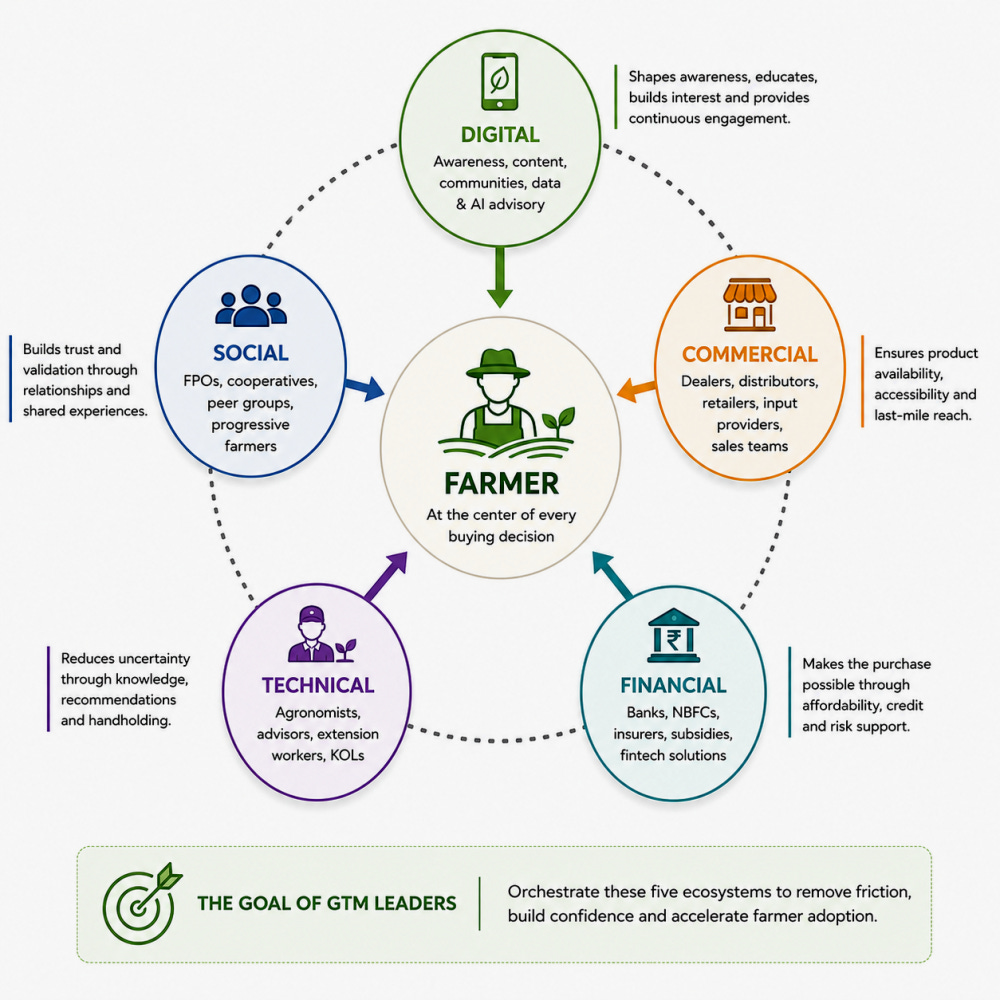
The Hidden Network Behind Every Purchase DecisionOne of the biggest misconceptions in agribusiness is that companies compete primarily through products and channels. In reality, they compete through influence networks. Every purchase decision sits inside a web of interconnected relationships. These relationships can be grouped into five distinct layers.
Layer 1: The Commercial NetworkThis is the traditional GTM layer.
Their role is straightforward: ensure products are available and accessible. Most agribusinesses invest heavily here. But this is only one part of the ecosystem. Layer 2: The Knowledge NetworkAgricultural decisions are deeply technical. Farmers seek guidance from agronomists, crop advisors, extension workers, consultants, and increasingly digital advisory platforms. These stakeholders influence not just which product to buy, but whether to adopt a new practice at all. Knowledge often determines confidence. Confidence determines adoption. Layer 3: The Financial NetworkAgriculture is capital intensive. Cash flow is seasonal. Risk is high. Financing therefore becomes an integral part of GTM rather than a separate financial function. Banks, NBFCs, insurers, embedded finance providers, and subsidy programs all shape purchasing decisions. Many excellent products fail not because farmers reject them, but because financing arrives too late or affordability remains uncertain. Layer 4: The Social NetworkPerhaps the most underestimated influence is social validation. Farmers trust experience.
Social proof often carries more weight than advertising. Layer 5: The Digital NetworkDigital influence has expanded dramatically.
Digital communities now shape awareness before a sales representative ever enters the village.
Why Traditional GTM Models Are Beginning to BreakMost organizations still manage GTM through functional excellence.
Each function optimizes its own performance metrics. Yet farmers do not experience these functions separately. They experience one buying journey. This creates a hidden problem. Every organizational handoff becomes an ecosystem handoff. Imagine a company launches a successful awareness campaign.
The farmer postpones adoption until the following season. Every individual function may have performed adequately. Yet the opportunity disappeared. Why? Because no one managed the interactions between functions and ecosystem participants. This is ecosystem friction. It is rarely visible in conventional GTM dashboards. A New Metric: Ecosystem Decision VelocityEvery buying decision moves through multiple checkpoints. Each checkpoint introduces either momentum or delay. Think of the buying journey as a relay race rather than a sprint.
Every handoff affects speed. I call this Ecosystem Decision Velocity, the speed at which a buying decision progresses across the network of stakeholders influencing adoption. High decision velocity means confidence builds consistently across the ecosystem. Low decision velocity means uncertainty accumulates at every interaction. The longer confidence takes to develop, the greater the probability that external factors -weather, competing offers, financing delays, or changing priorities - will interrupt the buying process.
For founders, this changes an important assumption. Growth is not simply about creating more demand.
That requires looking beyond the sales organization and understanding how every stakeholder contributes to - or slows down - the customer’s journey. From Sales Execution to Ecosystem OrchestrationIf agriculture is an ecosystem business, then the logical question is: What should GTM leaders optimize? For decades, GTM excellence has been associated with operational metrics:
These metrics remain important. But they only measure what happens inside the organization. They tell us very little about what happens between ecosystem participants, where many buying decisions are actually won or lost. The next generation of GTM leaders must therefore expand their role. Their responsibility is to orchestrate an ecosystem.
This is a fundamentally different leadership capability. The New Role of the GTM LeaderHistorically, GTM leaders were expected to answer questions such as:
These questions are still relevant. But they are no longer sufficient. Modern GTM leadership requires answering a different set of questions.
Answering these questions shifts the conversation from sales management to ecosystem design. It also changes organizational priorities. Instead of investing exclusively in customer acquisition, organizations begin investing in ecosystem enablement. The difference may appear subtle. Its impact is profound. Measuring What Actually MattersOne reason ecosystem thinking remains underdeveloped is that most organizations do not measure it. Dashboards focus on commercial performance.
Useful metrics, but incomplete ones. Imagine complementing these with ecosystem metrics such as:
These indicators provide a clearer picture of how efficiently confidence moves through the ecosystem. Founders often ask, “Why is adoption slower than expected?” The answer may not lie in the sales organization at all. It may lie in ecosystem friction that no one is currently measuring. Building an Ecosystem-Oriented GTM OrganizationSo what does this mean in practice? It does not mean abandoning sales. Nor does it mean replacing distributors with digital channels. It means expanding the definition of GTM. An ecosystem-oriented organization follows five guiding principles. 1. Design Around the Customer Journey, Not Internal FunctionsCustomers do not distinguish between marketing, sales, finance, or technical support. They experience one journey. Organizational structures should reflect that reality. Every interaction should build confidence rather than introduce confusion. 2. Align Incentives Across the EcosystemMisaligned incentives create hidden friction.
Each objective is reasonable. But unless these objectives reinforce one another, customers receive mixed signals. Growth depends on alignment. 3. Enable Partners, Don’t Just Manage ThemPartners should not be viewed merely as channels. They are participants in value creation. Providing technical knowledge, digital tools, market intelligence, and business support strengthens the entire ecosystem - not just the partner relationship. 4. Build Continuous Feedback LoopsThe ecosystem generates valuable intelligence every day.
Organizations that capture and act on this feedback learn faster than competitors.
5. Optimize Decision VelocityEvery unnecessary delay reduces adoption. Every unanswered question increases perceived risk. Every disconnected interaction slows growth. The goal is not simply to generate more leads. The goal is to help customers move confidently through the decision journey. That is ecosystem coordination in action.
The Leadership Challenge AheadAgriculture is entering a new phase.
Ironically, more information does not automatically create better decisions. It often creates greater complexity. This is why ecosystem coordination will become one of the defining leadership capabilities of the next decade. Founders who continue viewing GTM as a sales function may struggle to scale beyond incremental improvements. Those who understand GTM as an ecosystem capability will build organizations that adapt faster, collaborate better, and create stronger customer confidence. Products can be copied. Pricing advantages rarely last. Dealer networks evolve. Technology changes.
A Final Thought for Agri Founders and GTM LeadersAs you plan your next growth initiative, resist the temptation to ask only operational questions. Don’t just ask:
Because the future of agribusiness growth will not be determined solely by who builds the best products or employs the largest sales force. It will be shaped by those who understand that every buying decision is the outcome of a connected network of commercial, technical, financial, social, and digital influences. Perhaps the most important shift is this: For years, agribusiness has competed by optimizing individual parts of the value chain. The next era belongs to companies that optimize the connections between them. That is the real GTM challenge. And it may well become the next enduring competitive advantage in agribusiness.
|





No comments:
Post a Comment