The 0 → 1 Phase Nobody Talks About: Before Ideas Have WordsWhy Some Ideas Exist Long Before Anyone Knows What to Call Them
In Perth, Australia, around 2012, the problem was not that people could not design. The problem was that they could not describe what they were actually trying to do. Teachers were putting together worksheets. They were not aspiring designers. But the only language available to them was professional design language. So the struggle sounded like this: “I am bad at design.” When Canva began taking shape, the idea did not land cleanly because there was no category waiting for it. It was not professional design software. The early struggle was not adoption. People already needed to communicate visually every day. Canva’s breakthrough was not simply usability. Visual communication, not design. Once that language stabilized, the product suddenly felt obvious. Before it did, it felt confusing. At roughly the same time, on the other side of the world, a different confusion was unfolding. In the United States, millions of people wanted to learn a new language. Not academically. They wanted progress in small moments. But the only language available described education as programs, rigor, mastery, and completion. So when Duolingo appeared, people struggled to judge it. Was it serious? Those questions missed the point. Duolingo was not trying to replace classrooms. But habit-based learning was not yet a familiar concept. People were already learning in fragments. Again, the experience existed before the words to describe it. What These Two Struggles Have in CommonCanva and Duolingo were not misunderstood because their ideas were extreme. They were misunderstood because their language lagged behind their behavior. In both cases, people were already doing the thing in some form. They were already communicating visually. What did not exist yet were the words, categories, and mental models that made those behaviors legible. So early reactions sounded like confusion. Who is this really for? Those were not objections. They were symptoms. They signaled that these products had entered what can be called the Pre-Language Phase of Innovation. The Pre-Language Phase of Innovation DefinedThe Pre-Language Phase of Innovation is the period when an idea exists as a lived experience or internal model before shared vocabulary forms around it. In this phase: • The creator recognizes a pattern that feels real but is hard to articulate This is not a motivational phase. Language is the mechanism that turns private understanding into shared cognition. Until that mechanism exists, ideas remain difficult to explain, evaluate, or spread. As linguist Benjamin Lee Whorf observed:
This is the core constraint early innovators run into. They are not lacking belief or support. Why This Phase Is Invisible to InstitutionsOne reason the Pre-Language Phase is so poorly understood is that most institutions are structurally incapable of seeing it. Institutions rely on categories to function. Education systems require syllabi. But the Pre-Language Phase exists before categories stabilize. That creates a mismatch. Institutions are designed to evaluate within language, not before it. When something cannot be named cleanly, it is treated as incomplete, unserious, or risky by default. This is why early-stage ideas are often rejected using phrases like: “I don’t know who this is for.” Those are not criticisms of execution. They are admissions of linguistic absence. Canva could not be evaluated as a design tool because it was not one. In both cases, institutions applied the wrong vocabulary, then mistook the mismatch for a flaw. The Pre-Language Phase is invisible to systems that depend on existing language to operate. That invisibility is not accidental. It is structural. Why Language Matters More Than We AdmitLanguage does not merely describe reality. It organizes it. Without language: • Patterns cannot be recognized consistently This is why early innovators often feel clearer alone than in discussion. In isolation, the idea remains intact. Philosopher Ludwig Wittgenstein captured this limitation precisely:
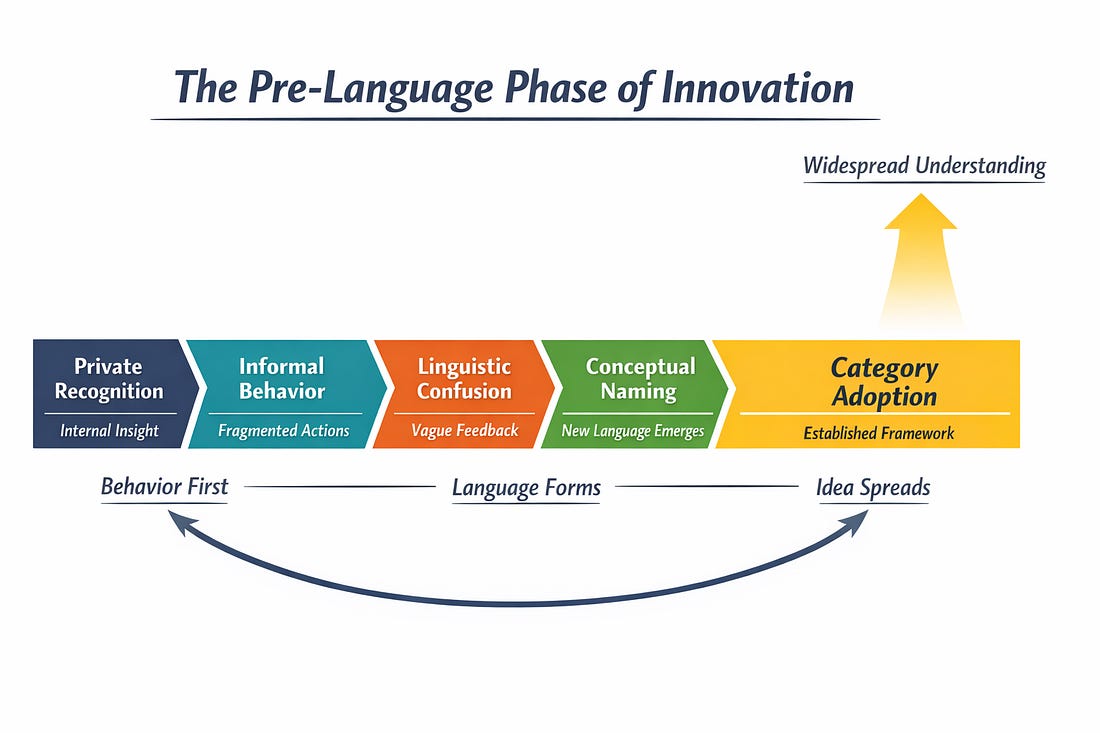
When language is missing, the world others can perceive is smaller than the one the innovator is operating in. Why Explaining Too Early Can Damage an IdeaIn the Pre-Language Phase, explanation carries risk. When you explain something that lacks language, you are forced to borrow vocabulary from nearby domains. That borrowing reshapes the idea. Visual communication becomes design. Once flattened, feedback optimizes for the wrong thing. People suggest improvements that make the idea easier to compare, not more accurate. This is why early conversations often feel draining rather than illuminating. You are not defending a finished concept. The Cost of Premature NamingThere is a temptation to solve linguistic absence by naming too early. This usually makes things worse. Premature naming locks an idea into borrowed categories that feel convenient but inaccurate. Calling Canva “simple design software” anchored it to professional design standards it was never trying to meet. Once an idea is named incorrectly, every conversation that follows is constrained by that name. Feedback becomes misaligned. This is why many original ideas stall after early traction. They get explained before they get understood. Correct language does not emerge from clever messaging. It emerges from repeated behavior that forces the world to adjust its vocabulary. Naming is not a creative act. When naming happens too early, it freezes the idea before its true shape has formed. Why Feedback Fails at This StageFeedback depends on shared categories. Without shared language: • Praise becomes generic People are not wrong. This explains why early feedback often contradicts later success. The feedback was not about the idea itself. How Canva and Duolingo Escaped the Pre-Language PhaseNeither company escaped this phase through persuasion. They escaped it through repeated behavior. Canva let people experience visual communication without becoming designers. Duolingo let people experience learning as a daily habit rather than a course. Over time, those experiences produced patterns that language could finally attach to. Words followed behavior. Once the language stabilized, adoption accelerated. Not because the products suddenly improved, but because people could finally explain to themselves and others what they were doing. The Five Stages of the Pre-Language Phase
Most ideas fail between stages three and four. Not because they are wrong, but because the absence of language feels like rejection.
This diagram captures the core mechanism. Behavior precedes language. Trying to reverse that order creates confusion. Why Most People Abandon Ideas in Stage ThreeStage three, linguistic confusion, is where most ideas die. Not because progress stops, but because feedback becomes psychologically uncomfortable. This is the stage where: • people respond vaguely What is actually happening is simple. The creator is experiencing the idea at a deeper resolution than the audience can parse. The audience responds using approximations. Over time, this gap erodes momentum. Most people resolve the discomfort by retreating into familiar categories. They reshape the idea to fit existing language so it can be understood more easily. That relief is temporary. The few ideas that survive stage three do so because the creator resists the urge to resolve confusion socially before it resolves structurally. They allow the idea to remain partially unintelligible until behavior forces clarity. Why This Phase Feels LonelyThe loneliness of early innovation is not emotional. It is informational. You are holding a model that has not yet earned language. Without language: • Others cannot reflect the idea back accurately Humans rely on shared language to confirm reality. When language is missing, understanding stays private. That isolation is structural, not psychological. Why History Makes This Obvious Only LaterOnce language forms, history compresses the struggle. Visual communication seems obvious. We forget that these concepts once felt vague and unserious. But at the time, the absence of language was the problem. Practical Implications for Builders and ThinkersUnderstanding the Pre-Language Phase changes how you operate early on. First, confusion becomes a diagnostic signal, not a verdict. Second, the goal shifts from persuasion to continuation. Third, behavior becomes more important than explanation. Fourth, feedback is filtered based on whether shared language exists. Language is not a marketing layer applied at the end. It is cognitive infrastructure. A Diagnostic Question for the Pre-Language PhaseThere is a simple way to tell whether you are truly in the Pre-Language Phase or simply avoiding clarity. Ask one question: “Is behavior happening without shared language, or is nothing happening at all?” If behavior exists, even in fragmented form, language can follow. Confusion is expected. If behavior does not exist, silence is not linguistic. It is informational. This distinction matters. The Pre-Language Phase is not an excuse for vagueness. It is a description of a specific condition where reality precedes vocabulary. Canva had users struggling to communicate visually. Behavior came first. Language followed. That is the difference between being early and being wrong. The Real Meaning of Zero to OneZero to one is not just about creating something new. It is about carrying an idea through the period when it exists without shared language. That period feels quiet. Not because the idea is weak. Language will follow if the behavior is real. It always does. - Before you build anything, make sure someone wants it enough to pay. I put together a free 7-day email course on revenue-first customer discovery — how to pull real buying intent from real conversations (without guessing, overbuilding, or hoping). If you’re a builder who wants clarity before code:
|
Wednesday, January 7, 2026
The 0 → 1 Phase Nobody Talks About: Before Ideas Have Words






Monday, January 5, 2026
10 Predictions for Startup Building in 2026
This essay is an attempt to synthesize patterns I keep seeing across founders, domains, and geographies. Some of these ideas are already visible in fragments across the startup ecosystem. Others only become clear when you compare very different environments side by side: software and deep tech, regulated and open markets, capital-rich hubs and constraint-heavy regions, cultures that reward visibility and cultures that punish it. What follows is not a forecast in the traditional sense. It’s a consolidation of signals about how startup building itself is changing — and why many of the assumptions we still operate under are quietly breaking. For years, startup advice has been presented as if it were universal. Build an MVP. Move fast. Raise capital. Find distribution. Build in public. This advice isn’t wrong. But it assumes a narrow context: software-first companies, operating in open markets, shaped by Western norms, with access to capital, talent, and digital distribution. As we move toward 2026, that assumption no longer holds. Not because startups are disappearing, but because startup building is fragmenting. What works in one domain, geography, or culture increasingly fails in another. The future of startups won’t be defined by better frameworks. It will be defined by better context awareness. 1. Startup building itself will fragmentThere will no longer be a single “right way” to build a startup. As technologies mature, markets saturate, regulations diverge, and cultures assert their own constraints, startup building will split into multiple valid paths rather than converge around one dominant model. Playbooks will stop traveling well. Universal truth: Founders who copy strategies without adapting them to context will underperform those who design their own constraint-aware approach. How this is already happening: Software startups increasingly reward speed, solo founders, and audience-led growth. Deep-tech and regulated startups still require teams, capital, and long timelines. In emerging markets, trust and relationships often matter more than feature velocity. Across cultures, public visibility versus discretion creates fundamentally different founder behaviors. Why this will intensify: The forces shaping startups are diverging faster than the advice meant to guide them. AI lowers barriers unevenly, regulation tightens selectively, capital flows concentrate in specific regions, and cultural norms around risk and visibility remain deeply local. As these forces compound, the gap between what works here and what fails elsewhere widens. Instead of converging on a single dominant model, startup building will continue to splinter into domain-specific, geography-specific, and culture-specific approaches. Fragmentation isn’t coming. It’s accelerating. 2. The idea stage will shrink everywhere, but not disappearThe cost of testing ideas will continue to fall across nearly all domains. Better tools, simulation, automation, and faster feedback loops mean founders can move from concept to signal more quickly than ever. But this doesn’t eliminate the idea stage. It compresses it. Universal truth: Ideas will no longer be judged on originality alone. Early evidence will be expected sooner, everywhere. How this is already happening: Software founders validate demand in days instead of months. Hardware teams model and simulate before physical builds. Biotech startups run computational screening before lab work. Service businesses test pricing and demand with lightweight pilots. Why this will intensify: As experimentation becomes cheaper, tolerance for untested ideas declines. Investors, customers, and partners recalibrate expectations around proof rather than vision. The faster signals become available, the shorter the patience window becomes for ideas without traction. The idea stage won’t vanish. It will become unforgiving. 3. MVP will stop meaning minimum and start meaning credibleFor years, shipping something ugly was framed as wisdom. That advice came from a time when baseline quality was low, and user expectations were forgiving. In 2026, that context no longer exists. Universal truth: The primary job of an MVP is no longer just learning. It is earning belief. How this is already happening: In consumer software, poor onboarding signals incompetence rather than an early stage. In B2B, polish is equated with operational maturity. In regulated industries, MVPs signal seriousness through compliance and reliability. In emerging markets, stability often matters more than novelty. Why this will intensify: As AI raises baseline quality across products, user tolerance for friction drops. When good enough becomes easy to achieve, anything below that feels negligent. MVPs will increasingly be judged as trust signals rather than experiments. Minimum will stay small, but credibility will be non-negotiable. 4. Execution speed will increase, but decision quality will matter moreExecution is accelerating across nearly every domain. Judgment is not. Universal truth: As speed increases, decision quality becomes the dominant constraint. How this is already happening: Software teams ship faster but compound bad strategic bets sooner. Hardware and regulated startups face costly reversals from early misjudgments. Founders mistake motion for progress and optimize the wrong metrics faster. Why this will intensify: Speed amplifies both clarity and confusion. As iteration cycles compress, feedback loops tighten, leaving less time to reflect between decisions. Founders who lack strategic filters will simply arrive at bad outcomes faster. Speed won’t save bad judgment. It will expose it. 5. Distribution will matter everywhere, but take different formsEvery startup must reach customers. That requirement does not change. What does change is how distribution is earned. Universal truth: No startup escapes distribution. Only the form of distribution varies. How this is already happening: Software startups lean on content and product-led growth. Enterprise startups rely on relationships and credibility. Emerging markets emphasize partnerships and offline trust. Regulated sectors depend on institutional access. Why this will intensify: As markets saturate and attention fragments, distribution advantages decay faster. What worked once stops working quickly. Startups will need distribution strategies deeply aligned with their context rather than borrowed playbooks. Distribution won’t get easier. It will get more specific. 6. Funding will lose narrative power, but remain a real constraintRaising capital will no longer automatically signal quality. But resources will still shape strategy. Universal truth: Capital won’t define merit, but it will define constraints. How this is already happening: Bootstrapped software startups scale without funding. Capital-heavy domains still rely on it. Some regions treat funding as legitimacy, while others prioritize cash flow. Why this will intensify: As more viable paths emerge, funding stops being the default story of success. Yet rising costs in talent, compute, and compliance ensure capital still dictates what’s possible. Funding will stop being impressive, but it won’t stop being influential. 7. Failure will decline, stagnation will riseAs building becomes easier, collapse becomes rarer. Plateaus become more common. Universal truth: The dominant risk shifts from failure to mediocrity. How this is already happening: AI-assisted teams reach good enough quickly. Risk-averse cultures avoid shutdowns. Venture portfolios see fewer zeros and fewer breakouts. Why this will intensify: Lower friction makes persistence easier but differentiation harder. Many startups will survive comfortably without ever breaking through. The pain moves from early death to long-term irrelevance. More startups will live. Fewer will matter. 8. Taste, judgment, and positioning will become core founder skillsWhen building becomes accessible, choice becomes the moat. Universal truth: What founders choose not to build matters more than what they do. How this is already happening: Software teams struggle with feature bloat. Hardware founders manage tradeoffs more than breakthroughs. Regulated startups learn restraint in messaging. Why this will intensify: As tools equalize execution, differentiation moves upstream into taste and framing. These are skills that compound slowly and resist automation. The hardest skill won’t be building. It will be about choosing well. 9. Business models will fragment faster than productsProducts will increasingly look similar. Business models will not. As tools commoditize building, differentiation shifts to how value is captured, not just what is built. Universal truth: The same product will succeed or fail based on business model choice, not features. How this is already happening: Software startups blend SaaS, usage-based pricing, services, and media. In emerging markets, cash-flow-first and service-led models outperform pure SaaS. In regulated domains, licensing and partnerships dominate over subscriptions. Creator-led businesses blur lines between product, education, and community. Why this will intensify: As markets fragment, no single pricing or monetization model travels well. Local purchasing power, trust dynamics, regulation, and buying behavior diverge faster than product capabilities. Founders will increasingly design business models for context rather than copy them from category leaders. Products may globalize. Business models will not. 10. Coaches and mentors will shift from experts to context translatorsAs information becomes abundant, advice becomes less useful in raw form. Founders don’t need more answers. They need help interpreting which answers apply to them. Universal truth: The value of guidance will shift from expertise to contextual judgment. How this is already happening: Generic accelerators underperform niche ones. Founder communities organize by domain and geography rather than stage. Operators outperform theorists as advisors. Playbook-based coaching loses credibility outside software hubs. Why this will intensify: As startup paths fragment, generic advice creates false confidence. Coaches and mentors who can translate principles across domains, cultures, and constraints will become exponentially more valuable than those who simply know the rules. The future mentor won’t say what works. They’ll help founders see what applies. ClosingBy 2026, the real question won’t be: What’s the best way to build a startup? It will be: What’s the best way to build this startup, in this context, with these constraints? Startup building isn’t becoming easier or harder. It’s becoming more situational. I’m especially interested in how these patterns show up across different domains and geographies. If you’re seeing a divergence or would add a prediction from your own vantage point, I’d be curious to learn from it. - Before you build anything, make sure someone wants it enough to pay. I put together a free 7-day email course on revenue-first customer discovery — how to pull real buying intent from real conversations (without guessing, overbuilding, or hoping). If you’re a builder who wants clarity before code:
|

How to Launch a D2C Startup?
Discover why successful D2C startups validate identity before building products and how paid pilots can prove demand before an MVP exists...

-
Techie.Buzz posted: " [ANN] Serverless Kubernetes Solution For Cloud-Native Apps by CTO.ai CTO.ai is a provider of deve...
-
Crypto Breaking News posted: "Mikhail Fedorov, Ukraine's Deputy Prime Minister and the head of the country's Minist...
-
Crypto Breaking News posted: "Circle's merger with Concord Acquisition Corp, a special purpose acquisition company, or ...


