Why Most Early GTM Advice Fails Because It Assumes Demand ExistsEarly Go-To-Market Is a Discovery Problem, Not an Execution Problem
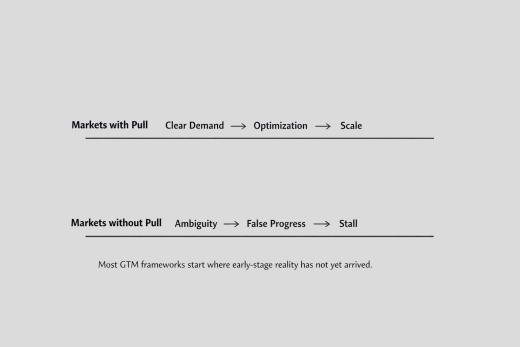
The Assumption That Breaks Most Early GTM ThinkingMost early go-to-market advice fails long before execution ever begins. Not because founders misunderstand it. Not because they lack discipline. But, because the advice is built on an assumption that rarely holds at the beginning. That assumption is a demand. Not potential demand. Not a theoretical demand. Real demand. The kind where buyers already recognize a problem, already feel the cost of inaction, and already believe a solution should exist. The kind where the primary challenge is discovery, not conviction. Nearly everything that passes for standard GTM wisdom quietly depends on this condition being true. Defining an ICP assumes that there is a stable category of buyers who already understand themselves in relation to a problem. Messaging frameworks assume that the problem language already exists and simply needs refinement. Funnels assume intent. Sales motions assume readiness. Even the language of “traction” assumes that something is already pulling. Early teams almost never operate in that environment. Instead, they are working inside a fog where buyers do not agree on the problem, do not feel urgency, or do not believe that solving it matters enough to justify change. The market is not resisting because execution is weak. It is resisting because the narrative has not yet formed. This is where the mismatch begins. Founders are told to behave like demand exists when their actual job is to determine whether demand can exist at all. They are asked to optimize interactions that have not yet earned the right to be optimized. The result is a strange form of progress theater. Activity increases. Frameworks are filled in. Conversations happen. Yet nothing accumulates. The advice itself is not wrong. It is simply written for a later chapter. When applied too early, it does not reveal the truth. It masks it.
Why “Validation” Becomes a Comforting FictionOne of the most misleading concepts in early GTM is validation. Not because the idea is flawed, but because the way it is practiced is deeply confused. In most early teams, validation quietly becomes a softer word for optimization. Founders test positioning. They refine messaging. They run interviews. They look for nods, interest, engagement, and positive reactions. They interpret responsiveness as a signal. They treat politeness as encouragement. They mistake coherence for conviction. None of this is malicious. It is human. But it sidesteps the only question that actually matters early. Will someone change their behavior? Not will they say it is interesting. Not will they agree that it is a problem. Not will they imagine a future where it might matter. Will they act differently today than they did yesterday because this problem feels unavoidable? True validation is uncomfortable because it forces contact with indifference. It surfaces avoidance, deferral, rationalization, and apathy. It reveals that many problems sound important until they compete with real constraints. Time. Risk. Reputation. Habit. Status quo. Early validation is not about improving clarity. It is about discovering friction. It is about learning where the story collapses when it meets reality. This is why so many early efforts feel like they are learning but not advancing. Teams collect insight without consequence. They hear feedback without cost. They iterate without exposure. They are validating narratives, not behavior.
Optimization gives the illusion of progress because it produces a movement. Validation produces discomfort because it produces limits. Most founders, understandably, prefer the former. But markets do not care how thoughtful your experiments are. They only respond when the pressure is real. Early GTM Is Not Execution. It Is Sense Making.The deepest misunderstanding in early GTM is the belief that the work is primarily about execution. That, if the right framework were applied with enough discipline, momentum would follow. In reality, early GTM is not a mechanical problem. It is a meaningful problem. Before there can be demand, there must be belief. Before belief, there must be a shared understanding of what is at stake. Before that, there must be a moment where a previously tolerable situation becomes intolerable. This is not something a funnel creates. It is something reality creates. Early GTM lives upstream of motion. It is the work of sense-making. Of discovering where the world already feels unstable and learning how to name that instability in a way that resonates. This is why personas often mislead early teams. Personas freeze people in abstraction when what actually drives action is context. Timing. Pressure. Constraint. The same individual can be a perfect buyer in one moment and completely unreachable in another. What matters is not who someone is, but what they are experiencing when the problem becomes undeniable. Early GTM is the search for those moments. It is slower than execution and harder to measure. It does not produce neat dashboards or clear benchmarks. It often feels like wandering. But it is the only phase where leverage is created rather than applied. Once pull exists, execution matters enormously. Frameworks help. Playbooks compound. Scale becomes possible. Before pull exists, execution is noise. The uncomfortable truth is that no amount of GTM discipline can substitute for a missing reason to care. Until that reason is found, the most dangerous thing a team can do is get better at selling something no one urgently needs. That is the work most early advice skips. Not because it is unimportant, but because it cannot be standardized. And that is exactly why it matters. Where Early Teams Misread the SignalWhen early GTM efforts stall, teams rarely interpret the stall correctly. The default explanation is execution. The message is not sharp enough. The ICP is too broad. The channel choice is wrong. The cadence is off. Something needs to be tightened. This diagnosis is comforting because it preserves the belief that demand exists somewhere just out of reach. If only the system were tuned better, it would reveal itself. But most early stalls are not execution failures. They are signal failures. What teams encounter instead of resistance is ambiguity. Prospects do not say no. They say maybe. They show curiosity without commitment. They agree without acting. They defer without rejecting. This ambiguity is often misread as partial validation. In reality, it is usually a lack of pressure. When a problem is real and costly, the response is not polite interest. It is tension. Buyers ask sharper questions. They introduce constraints. They push back on details that matter. They test credibility because the stakes feel high. Ambiguity signals the opposite. It suggests that the problem can be safely ignored. Early teams that mistake ambiguity for progress often double down in the wrong direction. They broaden the story to make it more appealing. They add features to reduce friction. They soften claims to sound reasonable. Each move reduces tension further. What looks like traction building is often pressure leaking out of the system. Over time, the product becomes easier to understand but harder to care about. The market responds with silence, not rejection. Rejection would be useful. Silence is corrosive.
The Cost of Borrowed GTM LogicAnother reason early GTM advice fails is that it is almost always borrowed. Founders look to companies they admire and reverse engineer what appears to have worked. They adopt similar narratives, similar motions, similar sequencing. The logic feels sound because it comes from visible success. What is missing is context. Most visible GTM success stories are written from the middle, not the beginning. They describe how demand was captured, not how it was created. The hardest part of the story has already been erased by time. Early demand creation rarely looks clean. It often involves narrow positioning that would not survive scale. It involves saying no to audiences that look attractive on paper. It involves leaning into problems that feel uncomfortable to articulate because they are not yet widely acknowledged. None of this fits neatly into a reusable framework. So when early teams import GTM logic from later-stage companies, they inherit conclusions without the conditions that made those conclusions valid. The result is a strategy optimized for a world that does not yet exist. This is why copying successful GTM motions so often produces activity without outcome. The logic is internally consistent but externally misaligned. Early GTM is not about doing what worked before. It is about discovering what could work now, in this specific reality, with this specific audience, under these specific constraints. Borrowed logic skips that work. It replaces inquiry with imitation. What Progress Actually Looks Like Before Pull ExistsOne of the most disorienting aspects of early GTM is that real progress often looks like a regression.
The audience gets smaller, not larger. Instead of accumulating interest, teams begin accumulating clarity. They learn which problems do not matter enough. Which narratives collapse under scrutiny? Which moments fail to trigger action? This kind of progress is hard to celebrate because it does not compound visibly. There are no obvious metrics that capture it. It does not feel like momentum. Yet this is the phase where leverage is quietly forming. When the pull finally appears, it often feels sudden. In reality, it is the result of many discarded paths and resisted temptations. It emerges when a problem, a moment, and a belief align tightly enough that action feels obvious. From the outside, it looks like execution finally clicked. From the inside, it feels like recognition. This is why early GTM work cannot be rushed or abstracted away. It is not a checklist to complete. It is a process of confronting reality until something undeniable remains. Only then do playbooks become useful. Only then does optimization matter. Only then does scale make sense. Until that point, the most valuable thing a team can do is resist the urge to look like they are progressing and focus instead on discovering whether progress is even possible. That distinction is uncomfortable. It is also decisive. The Discipline Early GTM Actually DemandsThe hardest part of early GTM is not learning what to do. Founders are constantly pressured to interpret activity as progress. Meetings, demos, conversations, inbound interest, pilot users. All of it creates the sense that something is forming. The temptation is to move forward, to formalize, to scale prematurely.
Early GTM demands the opposite instinct. It requires the discipline to pause when things seem almost working. To question signals that feel encouraging but lack consequence. To sit with uncertainty longer than is comfortable. This discipline is rare because it runs against narrative momentum. Stories want to be resolved. Founders want coherence. Teams want to believe that effort is accumulating. But belief must be earned by reality, not manufactured by repetition. Early GTM work often involves letting promising ideas die. Not because they are wrong in theory, but because they fail to produce urgency in practice. It means abandoning solutions that are liked but not needed. It means recognizing when interest is cosmetic. This is not pessimism. It is respect for how change actually happens. Markets do not reward elegance or effort. They reward relevance under pressure. Until that pressure is felt, discipline matters more than confidence. The Real Reason Most Early GTM Advice MissesMost early GTM advice fails not because it is poorly designed, but because it is solving a different problem. It is designed to help teams capture demand, not to confront the absence of it. That distinction is rarely made explicit. So founders internalize failure as personal. They assume they are executing poorly when the truth is that the underlying condition for execution does not yet exist. Early GTM is not a race to best practices. It is an inquiry into reality. A search for the moment where a problem becomes unavoidable, and belief becomes shared. Only after that moment does GTM start to resemble what most advice describes. Until then, the work is quieter. Slower. Less legible. It involves saying no more often than yes. It involves narrowing rather than expanding. It involves listening for tension rather than affirmation. This is why early GTM cannot be templated. It is not a sequence of steps. It is a confrontation with indifference until something breaks through. When it does, progress feels sudden. In hindsight, it looks obvious. But it is never accidental. The real failure is not ignoring GTM advice. - Have early traction but unclear revenue signal? One-Week Market Signal Test Validate demand. Decide with proof.
|
Monday, February 9, 2026
Why Most Early GTM Advice Fails Because It Assumes Demand Exists





Subscribe to:
Post Comments (Atom)
Startup Validation Is a Bet
Find the commercial wager with the shortest path to someone paying - whether you’re with just an idea, or an MVP, or even a functional pr...

-
Jonathan Gibson posted: "Cryptocurrency gambling is growing at a rapid pace, and more and more people are thinking about us...
-
Techie.Buzz posted: " [ANN] Serverless Kubernetes Solution For Cloud-Native Apps by CTO.ai CTO.ai is a provider of deve...
-
Crypto Breaking News posted: "Mikhail Fedorov, Ukraine's Deputy Prime Minister and the head of the country's Minist...


No comments:
Post a Comment